Skip to main content Skip to search Skip to navigation

High medieval knives for reenactment


Items  1 - 5 of 5

In the High Middle Ages, the knife was not merely a tool – it was part of everyday life for everyone, from the humble peasant to the knight, and was almost always worn at the belt. Anyone wishing to create a historically accurate re-enactment camp or market stall set in the 11th to 14th centuries will find it hard to do without a suitable High Medieval knife. This category brings together models from across the High Middle Ages – from narrow quill and sharpening knives to hand-forged Viking knives with carbon steel blades and leather sheaths.

Knives in the High Middle Ages: forms, function and historical sources

Messer im Hochmittelalter: Formen, Funktion und historische Quellen

In the High Middle Ages – roughly from the year 1000 to the early 14th century – the knife was the universal companion. It was used for eating, craftsmanship, harvesting and everyday precision work. It was scarcely regarded as a weapon in the strict sense; its place on the belt was a matter of course and constant. The common Middle High German term was ‘mezzer’ – a word which at the time encompassed any cutting blade tool, regardless of size or use.

Typical of the period were straight or slightly curved blades with a simple edge. Handle materials ranged from wood and horn to bone, and even simple wooden shafts with riveted fittings. Metal decorative elements or elaborate crossguards were reserved for the upper classes. The common people carried robust, functional items – little decoration, great utility.

The Maciejowski Bible (c. 1250) is considered the most important visual source for the 13th century, depicting knives on the belts of soldiers, craftsmen and servants. Additionally, archaeological finds from England, Scandinavia and the German-speaking world provide concrete evidence regarding blade geometry, handle construction and scabbard design. These sources form the basis for the models in this category.

Materials compared: stainless steel or carbon steel for re-enactment?

Steel Suitability Properties
Carbon steel Historical Develops a patina, can be sharpened to a finer edge, authentic appearance – requires maintenance (oiling, storing in a dry place)
Stainless steel LARP / Market Low maintenance, easy to care for, rust-resistant – ideal for intensive outdoor use and frequent market appearances

For collectors and authenticity-conscious re-enactors, carbon steel is the first choice: the blade tarnishes over time, develops a characteristic patina and can be sharpened to a finer edge than most stainless steel alloys. However, if you regularly carry your medieval knife at the market, hang it up in your tent when it rains, or simply don’t feel like carrying out extensive maintenance after a long weekend, you’re better off with stainless steel. The visual difference between the two variants is barely noticeable to the untrained eye – both types of steel are available in our range.

What did knives look like in the Middle Ages? Types and their characteristics

Quill-point and sharpening knives

11th–14th century

Narrow, tapered blades for precision work such as trimming quill pens or sharpening leather. Slim profile, simple handle made of wood or horn. Available in the range as a stainless steel version in various handle colours from around €10.

Cutting knife

c. 1250 (Maciejowski Bible)

Wider, slightly rounded blade for serving food at the table. Directly based on illustrations from the Maciejowski Bible. Handle in wood, black or natural white – a recognisable table knife for High Medieval table settings.

Utility knife with tang

Viking Age transition

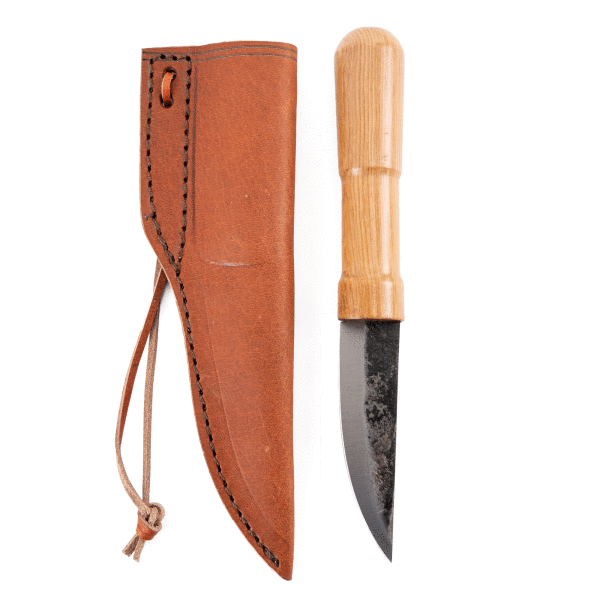
Sturdy everyday knives in which the handle – often made of wood or horn – is fitted directly onto the tang. Hand-forged versions with carbon steel blades approximate the style of the early High Middle Ages and reflect the fluid transitions to the Viking Age.

Price ranges and quality levels: Which knife suits your needs?

Entry level · approx. €10

Stainless steel quill or sharpening knives in the style of the 11th–14th centuries – ideal for your first market appearance or as an addition to your existing costume. Available with a wooden handle, black handle or natural white handle. Easy to maintain, visually suitable for simple reenactments.

Mid-range · approx. €25

Stainless steel table knife, based on depictions in the Maciejowski Bible (c. 1250). Hand-forged appearance, various handle options. For regular market visitors or re-enactors who wish to add a historically accurate piece to their cutlery set.

Upper segment · €30–36

Hand-forged utility knives with carbon steel blades, wooden handles and leather sheaths – including Viking and High Medieval knives with tangs. For experienced re-enactors and collectors who value historically documented materials and an authentic finish.

The Maciejowski Bible as a historical source for knife shapes

Die Maciejowski-Bibel als historische Quelle für Messerformen

The Maciejowski Bible – also known as the Crusader Bible – was produced around 1250 in France and is one of the richest pictorial sources for 13th-century equipment, clothing and everyday objects. Its miniatures depict knives on the belts of soldiers, servants and craftsmen: carried on a simple strap, usually without a guard, with a plain handle. These depictions provide more concrete insights into shape and carrying methods than many textual sources, as they show knives in their actual context of use.

The folding knives in the range are directly modelled on these illustrations – blade width, handle proportions and overall length correspond to what is seen in the Maciejowski Bible. Additionally, archaeological finds from England (such as those from the London Thames mud), from Scandinavian grave contexts and from southern German town centres are incorporated into the design. For re-enactment depictions from the late 12th century onwards, the Maciejowski Bible, in combination with such finds, is the most reliable guide.

Visual sources are often more valuable for reenactment research than purely textual sources: whilst texts rarely describe the knife in passing, miniatures show the handle length, blade shape and scabbard construction in direct relation to the person carrying it – and thus in true scale.

Care and storage: How to keep your High Medieval knife in good condition for a long time

Carbon steel blades are more sensitive to moisture than stainless steel. After each use, wipe the blade dry and rub it lightly with acid-free oil (e.g. camellia oil or neutral machine oil). This allows a patina to form in a controlled manner, rather than surface rust developing. Do not store permanently in a damp leather sheath – the leather can absorb moisture and promote rust spots.

Treat the leather sheath regularly with leather grease or leather balm to keep it supple and prevent it from cracking. If the sheath has become wet after outdoor use, allow it to air-dry completely first – never use heat (radiators, hairdryers), as this will make the leather hard and brittle. Only reinsert the knife once the sheath and blade are dry. Suitable accessories for medieval knives are also available in our range.

Stainless steel blades can be easily cleaned with warm water and a dry cloth. Avoid aggressive cleaning agents or scouring pads – they can leave fine scratches that make the surface look dull. Allow to dry completely before returning the knife to its sheath.

Wooden handles benefit from occasional treatment with linseed oil or beeswax. This helps the wood absorb less moisture, keeps it grippy and, over time, develops a pleasant patina. If handles are very dry, lightly sand them first, then apply several thin coats, allowing them to dry completely between applications.

If you have any questions about choosing the right model for your reenactment, you can contact the Vehi Mercatus team by phone Mon–Fri from 8 am–12 pm and 1 pm–3 pm. As a Trusted Shops member, a 30-day return policy applies. You can find related categories such as Early Medieval knives, Late Medieval knives and accessories for Medieval knives directly within the Medieval knife range.

Whether you’re looking for a High Medieval knife for the first time or want to add a historically accurate piece to your existing collection – in this category you’ll find everything from simple everyday knives to hand-forged pieces with leather sheaths. Take your time to browse and choose whatever suits your reenactment.

Frequently asked questions

In Middle High German, the common term was ‘mezzer’ – a word that at the time encompassed any cutting blade tool, regardless of size or intended use. It was not until the Late Middle Ages and the early modern period that language began to differentiate more clearly between types of knives such as pocket knives, table knives or utility knives.

Typical of the High Middle Ages (c. 1000–1300) were straight or slightly curved blades with a simple handle design. Handle materials were primarily wood, horn and bone; elaborate guard bars or metal decorations were reserved for the upper classes. An important source of imagery is the Maciejowski Bible (c. 1250), which depicts knives worn at the belt in various everyday situations.

In the reenactment sector, hand-forged carbon steel is regarded as a mark of quality – the blade develops a patina, can be finely honed and acquires a distinctive look over time. Vehi Mercatus offers its own hand-forged models with leather sheaths as well as affordable stainless steel variants for market use, all of which are based on historical prototypes.

Carbon steel is historically closer to the original, develops a patina and can be sharpened to a finer edge – but requires regular maintenance (oiling, storing in a dry place). Stainless steel requires significantly less maintenance and is rust-resistant, making it ideal for intensive outdoor use at markets and camps. Visually, the two variants are almost indistinguishable to the untrained eye.

Collector’s knives in the medieval context are reproductions of historical originals based on archaeological finds or pictorial sources. They are characterised by hand-forged blades, natural handle materials (wood, horn, bone) and often include leather sheaths. They are suitable both for display in a showcase and for authentic use during re-enactments.

Discover related categories

You might also be interested in