Medieval costume for men
A medieval costume for men is more than just a fancy dress outfit – it’s a gateway into a role, an era or a community. Whether you’re visiting a medieval market for the first time, a regular at LARP events, or simply looking for something special for Carnival: here you’ll find tunics, trousers and complete outfits that actually look the part.
 Early Medieval500–1066
 High Medieval1050–1250
 Late Medieval1250–1500
 Market-Medieval / Larptimeless
What does a medieval costume for men consist of?
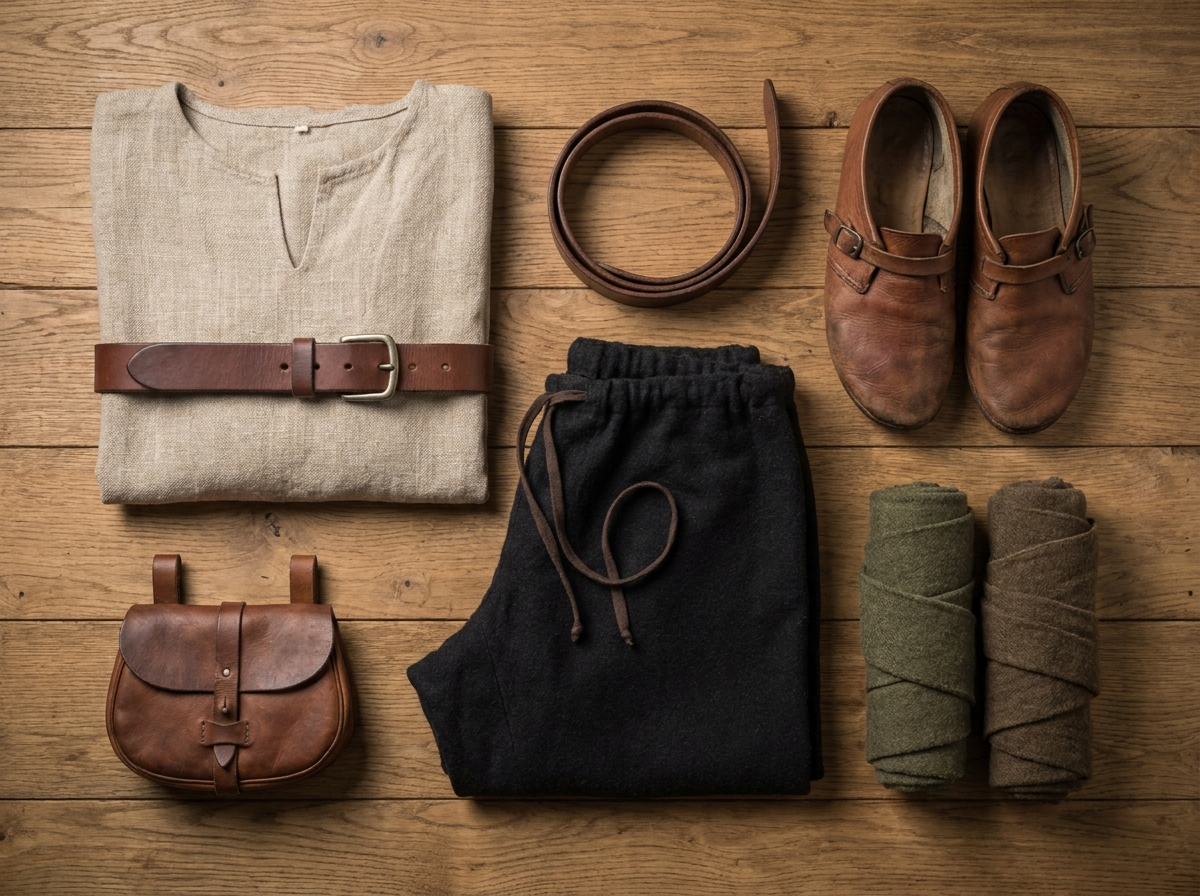
The basis of every medieval costume for men consists of four parts: a tunic or shirt, matching trousers, a belt and shoes. These four elements alone create a convincing look – the rest is refinement.
If you want to go the extra mile, work with the layering principle: a simple undershirt is followed by the actual tunic, over which a sleeveless cape, a doublet or a short coat can be worn. This layering was commonplace in the Middle Ages and lends the outfit depth and authenticity today.
The belt is not merely an optional accessory – it is functional and indispensable. It keeps the tunic in shape, gives the silhouette structure and serves as a strap for a bag, knife or pouch. A long belt, wrapped once around the hips and tied at the front, is historically documented for many periods and roles.
Leg wraps, a headdress and a belt pouch or bag refine the look and transform a simple outfit into a coherent ensemble.
An overview of the most important costume roles
Vikings
Knee-length tunic, leather belt, leg wraps, optional fur trim on the collar. Sturdy, distinctive and well-documented by archaeological finds. The Asgrim tunic from approx. €34 is a solid choice for beginners.
Peasant / Farmhand
Simple shirt or short tunic, plain trousers with drawstring, leather belt. The most affordable way to start with period costume – the Peter trousers from approx. €25 go with almost everything.
Nobleman / Merchant
Higher-quality fabrics, visible braiding on the neck and sleeves, doublet over the tunic. Elevates the character’s status and is particularly suitable for themed parties or weddings.
Knight / Crusader
The tabard is worn over the gambeson, with optional armour pieces such as chainmail or breastplate. The crusader is immediately recognisable by the distinctive red cross on the tabard.
Price tiers: What do you get for which budget?
The Peter medieval trousers, made from 100% cotton with a drawstring, are a solid basic item for just over €25. Paired with a simple shirt, they make a functional outfit for your first visit to a medieval market or your next fancy dress party.
The knee-length Asgrim Viking tunic (100% cotton, V-neck, short sleeves) offers significantly more silhouette and character for around €34. The sleeveless Arais ranger’s cape with hood and front slit costs approx. €42 and works as a second layer over a shirt or on its own as summer attire.
The Freydis Viking tunic (100% cotton, unisex) features intricate hand embroidery on the neck and sleeves and is available in several sizes. Combining one or two pieces from this range creates an outfit that stands out at the market and in the LARP camp.
What occasions is a medieval costume suitable for?
At a medieval market, you’ll often wear your costume for several hours at a time. Comfort is key here: natural fibres such as cotton and wool feel more comfortable against the skin than synthetics and regulate temperature better. Pair this with medieval shoes instead of modern trainers and a belt bag instead of a rucksack – both make the overall look more cohesive and are practical at the same time.
In LARP, freedom of movement is key. The layering principle helps to adapt your outfit to changing temperatures. Which materials and styles are permitted depends on the rules of the respective group – many groups require natural fibres or at least clothing that is visually unobtrusive. A sleeveless cape like the Arais is well suited as a layer that can be quickly put on and taken off.
You don’t need a full costume set for Carnival. A single striking piece – such as the Arais hooded tunic – is perfectly sufficient for the party. Combined with dark trousers and a simple belt, you can create a harmonious medieval costume with minimal effort. If you want to cause a bit more of a stir, go for a Viking Carnival costume as a complete set.
For these occasions, finer fabrics and visible trimmings are recommended. Tunics with hand embroidery or a doublet worn over the tunic add visual highlights that stand out in photos and in a group. A matching long belt and a cloak complete the outfit.
Vikings or High Middle Ages? Choosing the right era
Early Middle Ages / Vikings
Knee-length tunic, simple cut, braided trim at the neck and sleeves. Earthy and natural colours dominate – well documented by archaeological finds from Scandinavia. Viking attire for men is one of the most popular ranges because the cuts are simple and versatile.
High Middle Ages
The cotte – a long, fitted garment – characterises this era. The first visible layering: an under-gown plus an over-gown. Silhouettes become more structured, with sleeve widths and lengths varying according to social status and function. Tighter-fitting styles emerge for trousers and leggings.
Late Middle Ages
Wams, slimmer silhouettes and elaborate trim details characterise the Late Middle Ages. Garments become more figure-hugging, and accessories such as wams gain in importance. For a coherent portrayal, it is worth matching the cut, colour and accessories to this era.
Materials: Why fabric matters
| Material | Suitability | Use in the range |
|---|---|---|
| 100% cotton | Historically close | Main material – 26 out of 35 items; breathable, easy-care, looks good in photos |
| Wool | Historical | Keeps you warm, fits the body better; ideal for autumn and winter events |
| Polyester / Nylon / Viscose | LARP / Costume | Cheaper to buy, but less comfortable against the skin and looks worse in photos – often appears artificial under light |
| Faux fur (100% polyester) | LARP / Costume | Used as trim on collars and sleeves; less suitable for re-enactment, but practical for LARP and carnival |
Natural fibres look more authentic, are gentler on the skin and more durable with proper care. Our own brand, Vehi Mercatus, consistently uses cotton, linen and wool – no synthetics. This is a conscious choice, not a given in our range.
Caring for medieval costumes made from natural fibres

Natural fibres are more robust than their reputation suggests – provided you follow a few basic rules.
Undyed linen fabrics can be washed at up to 60°C, making them easy to care for in everyday use. Dyed linen and cotton should be washed at a maximum of 40°C, otherwise the colours will fade. Before the first wash, it is advisable to soak the garment briefly in cold water to set the colours.
Wool requires a little more care: hand wash or use a gentle wool cycle, then dry flat on a surface – never in the tumble dryer, as the fibres may shrink and become matted.
It is not necessary to wash the garments between events every time. Airing them out is often sufficient. Stubborn dry stains on wool can be removed with a clothes brush. When storing, keep the garments dry and without plastic wrap so that the fibres can breathe and mould does not form.
From a simple starter outfit to a detailed Viking ensemble with hand embroidery – choose the option that suits your occasion and budget, and gradually add matching accessories and extra layers to your medieval costume for men.
Frequently asked questions
The basic outfit consists of a tunic or shirt, matching trousers, a belt and shoes. These four items create a convincing look for medieval markets, LARP or carnival. Accessories such as a belt pouch, leg wraps or headgear refine the look, but are not essential to start with.
Historically accurate materials include wool, linen and hemp. In today’s range, 100% cotton is the most commonly used material – it is breathable, easy to care for and looks much more authentic in photos than polyester or viscose. Wool is recommended for autumn and winter events, as it keeps you warm and fits the body better.
Undyed cotton and linen can be washed at up to 60°C. Dyed fabrics should be washed at a maximum of 40°C to prevent the colours from fading. Wool items are best washed by hand or on a wool cycle and left to dry flat – never in the tumble dryer.
Yes, medieval attire works brilliantly for Carnival. For a party, a single striking piece such as a hooded tunic or a tabard is often enough – no need for a full outfit. If you’d like to invest a bit more, you can put together a coordinated complete outfit with a belt and matching trousers.
The range includes sizes from S to XXXL. Some styles are available in combined unisex sizes (S/M, L/XL, XXL/XXXL), which offers more flexibility in terms of fit. If you’re unsure about choosing a size or combining individual pieces, the Vehi Mercatus team is happy to help over the phone.
Discover related categories
 Viking tunic & medieval tunic
 Men’s capes & cloaks
 Tunics & tabards
Leg wraps & leg wraps
Tunics & tabards
Leg wraps & leg wraps
 Helmets
Chainmail shirts
Helmets
Chainmail shirts
 Medieval shirts
 Medieval accessories