
Bow and arrow
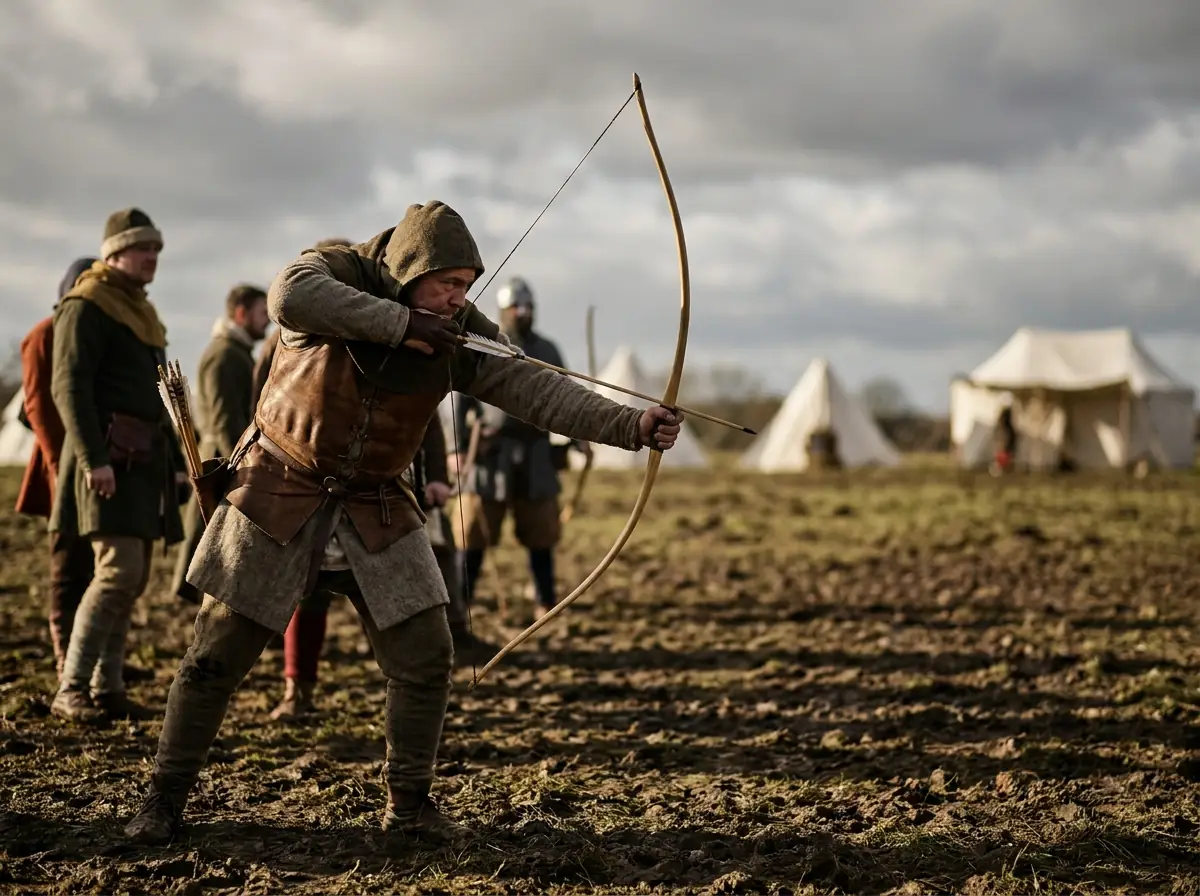
The bow and arrow are among the oldest ranged weapons in human history – and remain an integral part of medieval re-enactment, LARP and historical archery to this day. In this category, you’ll find wooden bows and matching accessories to help you get started with traditional archery – solidly crafted, designed for adults, and at a fair price.



Bows and arrows in the Middle Ages: history and significance

Bows are among the oldest weapons known to mankind – the earliest evidence of bows and arrows dates back to the Neolithic period, around 10,000 years before our era. In the European Middle Ages, archers were an integral part of any serious army, particularly in the light infantry. The weapon was cheap to manufacture, quick to learn and had a devastating effect on the battlefield against close-knit troop formations.
The English longbow, in particular, is regarded as one of the most effective weapons of the High Middle Ages. Made from yew wood, often nearly two metres long and drawn to weights of 60 to over 100 lbs, it could shoot arrows at ranges of 200 to 300 metres. The effective combat range was around 100 to 150 metres – sufficient to fire upon enemy formations from a safe distance before close combat ensued.
In addition to the longbow, there were various types of bow depending on the region and era: the composite bow from the Orient and the Mongolian steppes, which was constructed from several layers of material and could store enormous energy within a small space, as well as the recurve bow, whose curved limbs allowed for greater power over the same length. In Central Europe, the simple single-piece bow – the so-called simple bow – was the most widespread type.
Using a bow and arrow correctly: accessories and care

Anyone starting out in archery needs more than just the bow itself – the right accessories make the difference between an enjoyable training session and avoidable injuries. The most important piece of protective kit for beginners is the arm guard (bracer): it protects the forearm from the recoil of the string when shooting – a pain that every archer has experienced at least once and subsequently avoids at all costs.
A quiver is ideal for carrying and quickly drawing arrows – whether as a hip quiver for the classic archer’s look at a medieval market or as a back quiver for a more distinguished appearance. The choice of quiver type is also a matter of historical context: European archers predominantly carried arrows on their belts, whilst steppe peoples more frequently used back quivers. In our subcategory of bows and quivers, you’ll find suitable accessories, including options for younger archers.
Wooden arrows with natural feathers are historically accurate and complement the character of a medieval bow well. Ensure they are compatible with your bow’s draw weight – arrows that are too light on a powerful bow can cause dangerous flexing. Wooden bows should be stored dry and unstrung; bows hung while strung lose their elasticity over time. The bowstring should be checked regularly for wear and fraying – a broken bowstring during a shot is not only annoying but can also damage the bow. You will also find suitable arrowheads for training and decoration in the shop.
The role of archers in medieval warfare

In medieval warfare, archers were not mere foot soldiers – in England, longbowmen were regarded as a separate branch of the military with a lengthy training period. The physical strain was enormous: archaeological examinations of the skeletons of English archers reveal significant deformities in the spine and shoulder joints, caused by years of intensive training. Some boys began practising as early as the age of seven.
Their military effectiveness is well documented historically: at the Battle of Crécy (1346) and the Battle of Agincourt (1415), English longbowmen decimated entire formations of heavily armoured French knights. Tightly formed cavalry and infantry could be rendered incapable of action in a short time through targeted mass fire. A skilled archer could fire up to twelve arrows per minute – with hundreds of archers lined up in a row, this created a virtually impenetrable hail of arrows.
Aside from military use, the bow was also the preferred hunting weapon of the Middle Ages in Europe. Hunting bows were shorter, lighter and had a lower draw weight – they were used for stalking small game and red deer, not for combat on the battlefield. This functional distinction between war bows and hunting bows is also reflected in the variety of historical finds.
Buying a longbow: What to look out for when starting out
A beginner’s wooden bow made of ash, 140 cm in length, is a solid starting point for adults. Draw weights of 20–30 lbs are ideal for beginners – providing enough power for a satisfying shooting experience without overloading the muscles. Sets including a bow and five arrows make getting started easier without having to worry about compatibility issues.
For regular practice at the archery range or use at medieval events, a draw weight in the mid-range is recommended. Ash is a tried-and-tested, robust wood for bow-making offering good value for money – historically common, easy to work with and readily available. A quiver and arm guard should be considered from the outset.
Anyone aiming for historically accurate draw weights of 60 lbs and above should already have experience in archery. Such bows require regular training and are intended for events where authenticity is paramount. Yew wood replicas based on historical models are the benchmark here – often made to order.
What types of bows were there in the Middle Ages?
Longbow
Mostly made of yew wood, up to 1.80 m long, draw weight 60–160 lbs. The weapon of the English Yeomen – feared on the battlefield, complex to manufacture and to train with.
Recurve bow
Curved limbs allow for greater energy storage in a more compact length. Typical of steppe warriors, Mongols and Byzantine archers – often used as a horsebow.
Selfbow
Made from a single piece of wood, widely used across regions. A robust everyday weapon for hunting and basic military service – inexpensive to produce and easy to replace.
Composite bow
Composed of several layers of material – wood, horn and animal sinew. High performance in a compact design, dominant in the Near and Far East. Rare in Europe, but known as spoils of war.
Comparison: Historical longbow vs. entry-level wooden bow for re-enactment
- Yew wood, handcrafted according to historical models
- Draw weight 60–160 lbs – military specifications
- Today: Custom-made or collector’s items
- Requires a long learning curve and specialised training
- High price, limited availability
- Ash wood, solid mass-produced construction
- Draw weight 20–35 lbs – suitable for training and the market
- 140 cm long, suitable for adults
- Affordable, robust and ready to use
- Sets with arrows available for immediate use
The intended use is key to your choice: if you’re looking for a bow to add to the atmosphere at a medieval market, for occasional shooting at events, or simply as a decoration, a well-made entry-level model made of ash wood is the perfect choice. For serious archery training, we recommend joining an archery club, which also offers courses, shooting ranges and expert guidance. If you’re also interested in crossbows or wish to explore the category further, you’ll find a comprehensive selection in our subcategories. In addition, it’s worth taking a look at other weapon replicas from the armoury.
Bows and the legal situation: What you need to know
Whether you’re looking for your first bow for a medieval market or want to try your hand at historical archery as a re-enactor – in this category you’ll find wooden bows and sets for adults that provide a solid introduction. Take a look at our subcategories for bows and crossbows, as well as arrowheads and accessories.
Frequently asked questions
Yes, archers were firmly established in medieval warfare. The English longbow, in particular, was considered one of the most feared weapons of the High Middle Ages. In battles such as Crécy (1346) and Agincourt (1415), English archers decimated entire formations of heavily armoured knights through targeted mass fire.
An English longbow could shoot arrows up to 200 to 300 metres. The effective combat range was around 100 to 150 metres; at this distance, an arrow could still develop sufficient penetrating power to threaten armour. A skilled archer could shoot up to twelve arrows per minute.
In Europe, the simple selfbow – a bow made from a single piece of wood – was the most widespread. The English longbow, made from yew wood, is considered the most militarily effective type of the European Middle Ages. In the Orient and among the steppe peoples, the composite bow – made from wood, horn and sinew – dominated; it could generate enormous power within a small space.
For adults, a bow length of around 140 cm is considered a good starting point. The optimal length depends on body height and draw length – taller archers generally require a longer bow so that the string is not stretched too tightly and the bow retains its elasticity. Historical longbows often had lengths of up to 1.80 m.
Yes, owning a bow is generally legal for adults in Germany – bows are not classified as prohibited weapons under the Weapons Act. However, carrying a bow in public and shooting in public spaces are prohibited. For training, we recommend joining an archery club or using a suitable shooting range.
Discover related categories
 Medieval helmets
 Shields & bucklers
 LARP weapons
 Knightly weapons
 Medieval axes
 Lances & spears
 Gambesons & armour vests
Arm guards
Gambesons & armour vests
Arm guards


