


Spoon


Spoons in the Middle Ages: Everyday Life, Materials and Social Significance
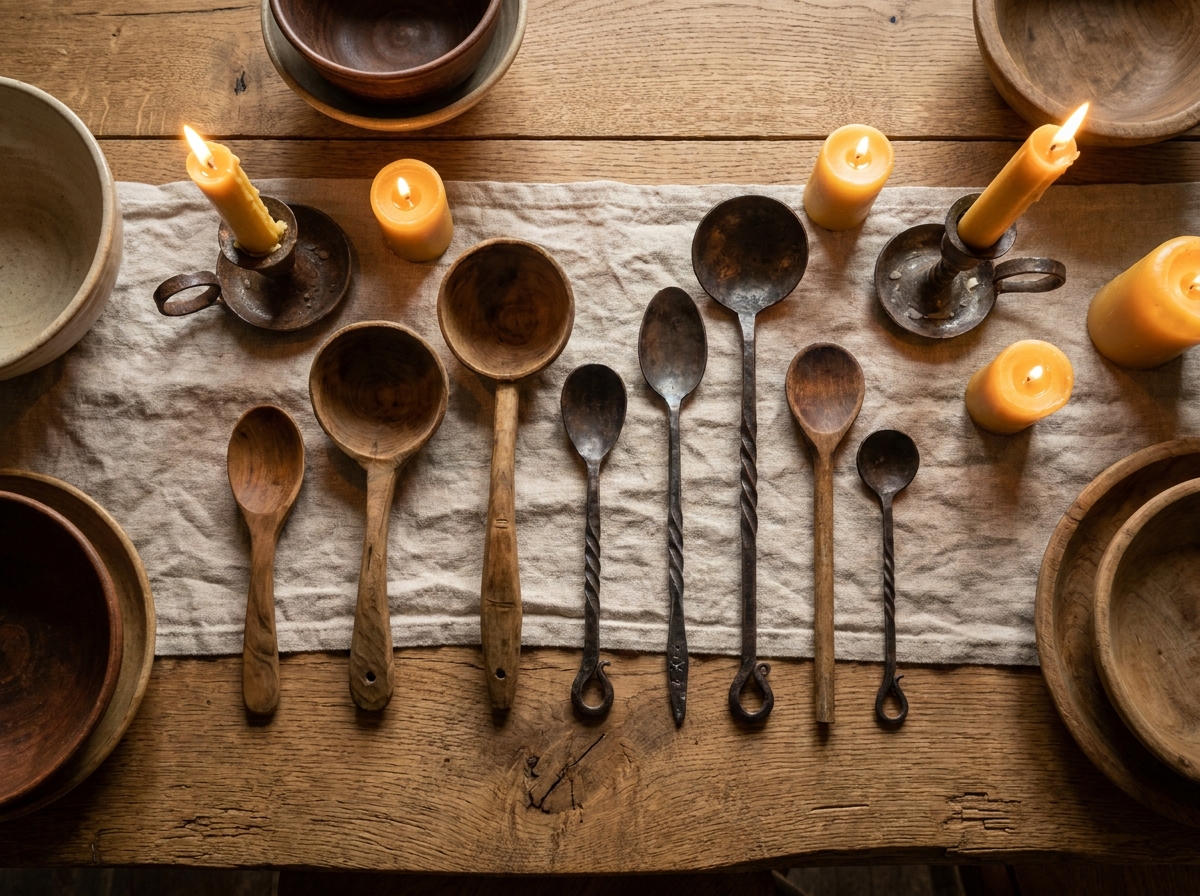
The spoon is one of humanity’s oldest tools – and in the Middle Ages, it was far more than just a kitchen utensil. Back then, anyone sitting down to a meal brought their own cutlery: a personal spoon, usually carried on a belt alongside a knife. Forks were a rarity, only appearing sporadically at courtly tables in the late Middle Ages – and even then, they were viewed with scepticism. The spoon, on the other hand, was ubiquitous, as porridges, stews and soups formed the basis of the medieval diet across all social classes.
The material used revealed the owner’s social status at a glance. Simple peasants and craftsmen ate with wooden spoons made from turned or carved wood – inexpensive to produce and functional in every respect. Spoons made from animal horn were also widespread: light, sturdy and tasteless. Those who could afford it owned spoons made of pewter or even silver. These pewter spoons, with their characteristic handle ends such as pyramid heads or acorn heads, were regarded as status symbols and were sometimes passed down through the generations. Medieval cutlery thus essentially consisted of spoons and knives – both personal items that one always carried with one, supplemented by one’s own drinking cup and eating bowl.
Periods and stylistic variations: From the Early Middle Ages to the Late Middle Ages
Early Middle Ages & Viking Age
Simple turned or hand-carved wooden spoons made of lime, aspen or birch dominate. The shapes are organic and simple – archaeological finds show broad, flat bowls with short handles. For Viking depictions, natural wooden spoons are the historically correct choice.
High Middle Ages
With growing trade and increasing specialisation in crafts, the first pewter spoons for the middle classes in towns began to appear. Wooden spoons remained the everyday utensil for the general population. Twisted metal handles emerged as a design feature and can still be found in modern stainless steel replicas.
Late Middle Ages
Characteristic handle ends such as the pyramid head and the acorn head are well documented archaeologically and form the basis of the pewter spoons in the range. Spoons are worn on a belt in a leather sheath – an authentic detail that should not be missing from late medieval depictions. Twisted handles are found on both pewter and early metal versions.
Product overview: Spoon variants in the range
Stainless steel spoons
Forged stainless steel spoons with a twisted handle and a twisted end – robust, dishwasher-safe and durable for daily use at markets and in the warehouse. Available with a wooden handle, black handle or natural white handle.
Late medieval spoon with leather sheath
Stainless steel spoon with matching leather sheath for wearing on a belt – a detail that completes any late medieval costume. Several handle variants available for visual variety whilst retaining the same function.
15th-century pewter spoon
Faithful replicas based on historical finds: the pewter spoon with pyramid head (c. 1400) and the pewter spoon with acorn head – both from the 15th century, ideal for sophisticated late medieval re-enactments and medieval camps.
Materials compared: wood, pewter, horn and stainless steel
Which material for which purpose? The following overview will help you decide – whether for historically accurate re-enactment or practical use at events.
| Material | Suitability | Notes |
|---|---|---|
| Wood (cherry, maple, aspen, lime) | Historical | Inexpensive, lightweight, suitable for all periods – Early to Late Middle Ages. Not dishwasher-safe. |
| Horn (cow or buffalo horn) | Historical | Lightweight, tasteless, nickel-free – ideal for medieval reenactment cooking and hornware enthusiasts. Suitable for cold and lukewarm dishes only. |
| Pewter | Historical | Historically documented from the late Middle Ages. Characteristic handle ends (pyramid head, acorn head). Status symbol of the middle classes. |
| Stainless steel | LARP | Modern alloy in a historical design. Easy to care for, dishwasher-safe, robust for use at events. |
Wooden spoons and horn spoons are the most historically authentic options for early and high medieval re-enactments. The horn spoon has been used in camp kitchens for centuries: it is tasteless, does not react with food and is nickel-free – ideal for people with intolerances too. However, horn is not suitable for hot food, as heat can warp the material.
Spoons for re-enactment and LARP: what is important when choosing?
- Wooden spoons for early medieval and Viking reenactments are historically accurate
- Pewter spoons with pyramid-shaped or acorn-shaped heads for late medieval camps
- Spoons with leather sheaths can be worn authentically on a belt
- Horn spoons as natural everyday utensils for all periods
- Combine with a cutlery set for a cohesive camp setting
- Stainless steel spoon with twisted handle: robust, easy to clean
- Handle options (wood, black, natural white) for a personalised look
- Leather sheath also makes LARP outfits more authentic
- Complemented by a fork and awl for a complete cutlery set
- Affordable enough to pack several sets
Anyone looking to round off their camp or re-enactment will find the perfect range in the overarching category of Medieval Cutlery – from individual items to sets.
Care and practical tips for wooden spoons and horn spoons
Wooden spoons do not belong in the dishwasher – the combination of heat and constant moisture causes the wood to crack and swell. Instead, rinse briefly with warm water after use and leave to dry. Regular rubbing with linseed oil or beeswax protects the wood from drying out and significantly extends its lifespan. Allow freshly oiled spoons to dry thoroughly before first use.
Horn spoons are suitable exclusively for cold and lukewarm foods. Heat – such as from hot soup or the dishwasher – permanently warps the material. They are ideal for egg dishes, caviar, spices or yoghurt. To care for them, simply rub them occasionally with a natural cooking oil (e.g. coconut oil or olive oil), which restores the horn’s suppleness. Horn is not dishwasher-safe – hand washing with lukewarm water is the right choice.
Stainless steel spoons are the easiest to care for in the range: dishwasher-safe, robust against knocks and resistant to rust. They are the most practical choice for daily use at medieval markets and multi-day events. After use, simply rinse with water and dry – that’s it. For models with a leather sheath, treat the sheath occasionally with a leather care product to keep it supple.
Whether you’re looking for a simple wooden spoon for your first market appearance or a detailed pewter spoon with an acorn head for your late medieval camp – in this category you’ll find the right option for your project. Complement your spoon with a complete cutlery set for a cohesive overall look at the camp.
Frequently asked questions
In the Middle Ages, the spoon was the most important eating utensil and was carried by almost everyone on a daily basis. In addition, people carried a personal knife, which was worn on the belt. Forks were occasionally found at courtly banquets, but were long considered unusual and were by no means widespread. Every guest brought their own cutlery, drinking cup and often their own eating bowl.
The vast majority of medieval spoons were made of wood – lime, aspen, cherry and maple were common types of wood. Animal horn (cow or buffalo horn) was also widely used and was considered robust and tasteless. Wealthier classes owned spoons made of pewter or silver, recognisable by characteristic handle ends such as the pyramid head or acorn head, which were particularly popular in the 14th and 15th centuries.
Horn spoons are particularly suitable for cold and lukewarm dishes: egg dishes, yoghurt, caviar, spices or honey. Horn is tasteless, nickel-free and does not react with food – which is why horn spoons are still valued today as cutlery for people with allergies. Horn spoons are not suitable for hot food or the dishwasher, as heat can permanently deform the material.
The idiom “to kick the bucket” as a euphemism for dying has its roots in medieval dining culture. As the spoon was a personal, everyday object that its owner always carried with them, putting down one’s own spoon symbolised the end of earthly life. Anyone who no longer needed their spoon had stopped eating – and thus stopped living.
Yes, the stainless steel spoons in our range are robust, dishwasher-safe and designed for daily use at events. They combine historical design with modern materials – twisted handles and characteristic shapes are based on medieval models, without compromising on ease of care. For re-enactments with high standards of authenticity, wooden or pewter spoons are recommended as historically more accurate alternatives.