By selecting "Accept all", you give us permission to use the following services on our website: Strictly necessary cookies, YouTube, Vimeo, ReCaptcha, releva.nz Retargeting, Google Analytics, Google Ads, Google Tag Manager, Meta Pixel, Brevo, PayPal Express Checkout und Ratenzahlung. You can change the settings at any time (link “Data privacy settings” at the bottom of every page). For further details, please see Individual configuration and our Privacy notice.
The settings you specify here are stored in the "local storage" of your device. The settings will be remembered for the next time you visit our online shop. You can change these settings at any time (link “Data privacy settings” at the bottom of every page).
For more information on cookie lifetime and required essential cookies, please see the Privacy notice.
To view YouTube contents on this website,
you need to consent to the transfer of data and storage of third-party cookies by
YouTube (Google).
This allows us to improve your user experience and to make our
website better and more interesting.
Without your consent, no data will be transferred to YouTube.
However, you will also not be able to use the YouTube services on this website.
To view Vimeo contents on this website, you need to consent to the
transfer of data and storage of third-party cookies by Vimeo..
This allows us to improve your user
experience and to make our website better and more interesting.
Without your consent, no data will
be transferred to Vimeo. However, you will also not be able to use the Vimdeo services on this website.
To submit forms on this page, you need to consent to the transfer of data and storage of third-party cookies by Google.
With your consent, reCAPTCHA, a Google service to avoid spam messages via contact forms, will be embedded.
This service allows us to provide our customers with a safe way to contact us via online forms. At the same time, the service prevents spam bots from compromising our services.
After you gave your permission, you might be asked to answer a security prompt to send the form.
If you do not consent, unfortunately you cannot use the form. Please contact us in a different way.
This script helps us, to offer you relevant services and products on other digital platforms.
Description:
Names of set cookies: dmc-12, dmc-12-r
Cookie validity: dmc-12 (2 Jahre), dmc-12-r (2 Jahre)
List of cookie domains: hyj.mobi
Place of processing: European Union
dmc-12
dyn.: No
Expires: 2 years
Storage type: Cookie
dmc-12-r
dyn.: Yes
Expires: 2 years
Legal basis:
The legal basis for the processing of personal data required by Art. 6 I 1 GDPR is specified below.
- Art. 6 Abs. 1 s. 1 lit. f DS-GVO
Place of processing: European Union
This is a web analysis service. It allows the user to measure advertising return on investment (ROI) and track user behavior. Data collected: anonymized IP address, date and time of visit, usage data, click path, app updates, browser information, device information, JavaScript support, pages visited, referrer URL, location information, purchase activity, widget interactions.
This is an advertising service. This service can be used to display personalized or non-personalized advertising to users. With Google Ads Conversion Tracking, we can measure our advertising success in the Google advertising network. We place advertisements in the Google advertising network so that our offers can be found more easily. We try to optimize our advertising as much as possible. Also to keep advertising costs as low as possible. This is reflected in our prices.
This is a tag management system. The Google Tag Manager allows tags to be integrated centrally via a user interface. Tags are small sections of code that can track activities. Script codes from other tools are integrated via the Google Tag Manager. The Tag Manager makes it possible to control when a specific tag is triggered.
To send data to Meta, you need to consent to the transfer of data and storage of third-party cookies by Meta.. This allows us to improve your user experience and to make our website better and more interesting.
To send data to Brevo, you need to consent to the transfer of data and storage of third-party cookies by Brevo. This allows us to improve your user experience and to make our website better and more interesting.
In order to unlock offers for extended payment options, in particular express checkout and payment in instalments, we require your consent to the data transfer and storage of third-party cookies of the payment provider PayPal. This allows us to also offer you express checkout and payment by instalments. Without your consent, only the technically necessary data transfer to PayPal will take place, but you will then not be able to use the express checkout or extended offers for payment by instalments on this site.
Description:
Using express checkout and Displaying offers for payment in instalments for individual items or your entire purchase.
Would you like to see these contents? Activate the desired contents for one session only or allow the website to remember these settings. Once you have given your consent, the third-party data can be loaded. For this, third-party cookies might be stored on your device. You can change these settings at any time (link “Data privacy settings” at the bottom of every page). For further details, please see the Privacy notice.
Whether it’s medieval attire for your first visit to a market, a well-thought-out LARP outfit for a multi-day event, or the right costume for a… themed party – anyone exploring a historical theme will sooner or later ask themselves: what does it actually involve, and how do I make the whole look cohesive? This page gives you an overview of the most important topics, their historical background and the appropriate equipment.
The Middle Ages roughly span from around 500 to 1500 AD – a period of a thousand years during which society, technology and culture underwent fundamental changes. Characteristic of this era are the feudal system with vassals and lords, the dominant role of the Church in everyday life, craftsmanship within guilds, and chivalric culture with tournaments and crusades. Castles, market squares and cathedrals still shape our image of the Middle Ages today.
Daily life depended heavily on social class and region: a peasant in the early medieval north lived under completely different conditions to an urban merchant in the late Middle Ages. Clothing made of wool, linen and leather was the norm for all social classes – synthetic fibres did not exist. In the High Middle Ages (c. 1000–1300), the image was shaped by the Crusades, the Romanesque and Gothic styles; the Late Middle Ages (1300–1500), by contrast, were marked by the Black Death, growing cities and the emergence of early firearms – a transformation that is also reflected in clothing and equipment.
Medieval language, quotations and coat-of-arms mottos
Anyone wishing to create an authentic atmosphere at a medieval market or during a re-enactment often turns to Middle High German greetings. ‘Seid gegrüßet’ or ‘Gott zum Gruße’ not only sound appropriate – they also have a genuine historical basis. In the High Middle Ages, such formal greetings were common among the nobility and the bourgeoisie; common folk often contented themselves with a simple bow or a tip of the hat.
Well-known medieval quotations come primarily from courtly love poetry and the great chivalric epics. Walther von der Vogelweide, one of the most significant minstrels of the 12th/13th century, wrote, for example: “Under der linden an der heide” – a verse that is still regarded today as the epitome of courtly poetry. Such texts reflect the values of chivalric society: honour, loyalty and courtly love.
A coat-of-arms motto – also known as a motto or, in Latin, a ‘motto’ – was the personal maxim of a noble house, displayed on banners, shields and seals. The best-known example is the motto of the Knights Templar: ‘Non nobis Domine, non nobis, sed nomini tuo da gloriam’ (Not unto us, O Lord, not unto us, but unto Thy name give glory). “God with us” was also a widespread motto across various eras. For LARP characters and re-enactment groups, such mottos offer a wonderful opportunity to give their own group a distinctive identity.
An overview of the major themes
Vikings
Early Middle Ages · Northern Europe
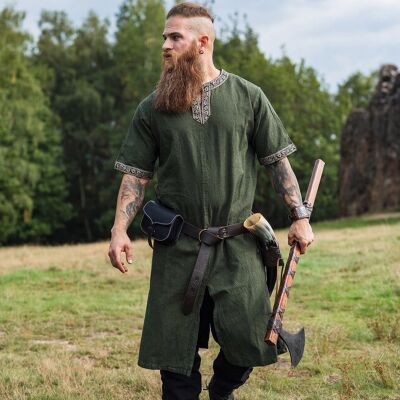
Seafarers, traders and warriors from Scandinavia – the Vikings fascinate with their culture, mythology and their presence from Iceland to Byzantium. Typical: Viking tunic, brooches, drinking horn and Viking jewellery.
Knights & Crusaders
High Middle Ages · Heraldry & Tournaments
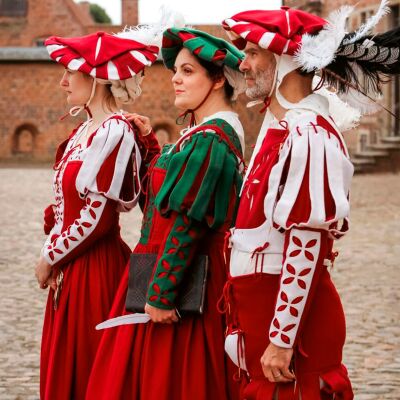
The High Middle Ages saw chivalry in its heyday. Tabards, chainmail, shields and swords are just as much a part of this as heraldry and Crusaderoutfits. A vast subject for both re-enactment and LARP.
Germans & Celts
Migration Period · Iron Age Roots
Germans and Celts offer fascinating themes beyond the classical Middle Ages. Celtic clothing and Germanic attire combine Iron Age aesthetics with an archaic charm.
Romans
Antiquity to the Early Middle Ages · Legionaries & Administration
From the Republic to Late Antiquity: Roman legionaries, merchants and civilians offer a wide spectrum. Roman clothing, sandals and armour pieces make this theme particularly attractive for living history events.
Fantasy themes
Elves, Witches & Pirates
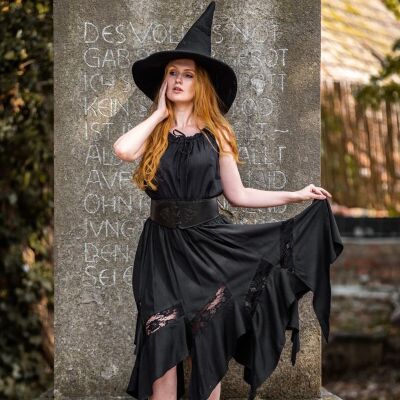
Not every event follows historical rules. Elven clothing, witch outfits and pirate garb expand the historical spectrum with fantastical elements – ideal for LARP, themed parties and costume festivals.
Medieval events: markets, festivals and spectacles
Medieval markets are the largest and most visible segment of the scene – ranging from small castle festivals with a few hundred visitors to the Mittelalterlich Phantasie Spectaculum (MPS) with thousands of guests across multiple locations throughout Germany. What they all have in common is that the atmosphere, costumes and equipment must be just right to make the experience complete.
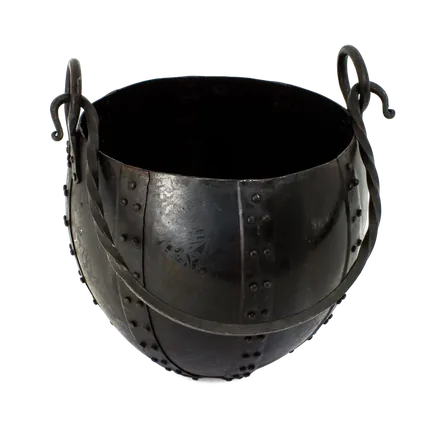
Reenactment camps take it a step further: here, history is brought to life through reenactments, with historical camps, authentic equipment and often a programme lasting several days. Medieval camp equipment such as tents, cooking utensils and lanterns is just as important as the costumes themselves. LARP events such as Conquest of Mythodea combine historical aesthetics with fantasy elements and are often the largest privately organised role-playing events in Europe.
When planning, it’s worth taking a look at the medieval market calendar from Vehi Mercatus at vehi-mercatus.de/marktkalender/ – there you’ll find over 500 listings for events in Germany, Austria, Switzerland and other countries. You should plan your costume, tent and themed accessories well in advance of the event – popular sizes often sell out early.
Putting together the right outfit for the theme
Getting started · Basic outfit
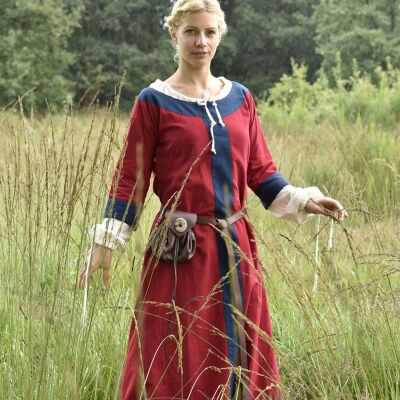
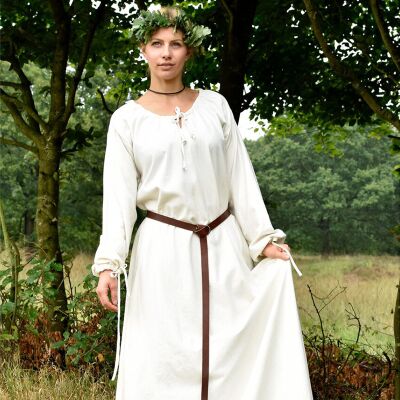
The foundation of any historical outfit: a tunic or shirt, paired with matching trousers or a skirt, a simple leather belt and shoes. With these four elements, you’ll be well-equipped for most events and can expand your outfit step by step.
Building up · Full costume
In the second step, you can add to the basic outfit with a coat or cloak, a headdress, a bag and matching jewellery. Theme-specific details make all the difference: Viking brooches and a drinking horn, a knight’s tabard with a sword, or witch’s accessories for fantasy themes.
Camp Setup · Multi-day Events
For multi-day re-enactment camps or LARP events, camp equipment is required: a tent, historical crockery, cutlery, lanterns and cooking utensils. Natural materials such as linen, wool and leather not only make a visual difference – they are also superior in terms of comfort when worn over long periods.
Medieval theme party: costume vs. authentic attire
Themed Party & Carnival
A basic costume with a tunic, cloak and belt is sufficient
Affordable entry-level options available
Synthetic materials are also acceptable
Enhance with genuine accessories such as jewellery or knives
Investing in quality pays off over several seasons
📞 Not sure which outfit suits your theme and event? Our team is available to advise you by phone Mon–Fri 8am–12pm and 1pm–3pm – with over 20 years’ experience in specialist retail for the medieval, reenactment and LARP sectors. Plus: a 30-day return policy and Trusted Shops membership.
Whether you’re putting together your first medieval market outfit, planning a themed party or, as an experienced re-enactor, looking to complete your costume – at Vehi Mercatus you’ll find the right range for every theme. Browse through our themed worlds and let yourself be guided by over 11,000 items and years of experience in the scene.
Frequently asked questions
The Middle Ages (c. 500–1500 AD) were characterised by the feudal system, the power of the Church, craft guilds and chivalry. Typical elements include castles, market squares, garments made of wool and linen, and a strong dependence of daily life on social class and region. The High Middle Ages are associated with the Crusades and Gothic architecture, whilst the Late Middle Ages are associated with the Black Death, urban growth and early firearms.
In the Middle Ages, forms of greeting depended heavily on social class. Among the nobility and the educated, phrases such as ‘Seid gegrüßet’ or ‘Gott zum Gruße’ were common, accompanied by bows or the lifting of a hat. Ordinary people often made do with a gesture or a simple nod. At medieval markets and during re-enactments, such phrases help create an authentic atmosphere.
A motto – also known as a devisa or, in Latin, a motto – is a short guiding phrase that noble families, orders of knights or towns used as a maxim on banners, shields and seals. Well-known examples include the Templars’ motto ‘Non nobis Domine’ or the widely used motto ‘God with us’. In LARP and reenactment, many groups use their own mottos to give their community a distinctive identity.
Well-known medieval quotations come primarily from courtly love poetry and the great chivalric epics. Walther von der Vogelweide, one of the most significant poets of the 12th/13th centuries, is still regarded today as the voice of the courtly Middle Ages. Numerous sayings emphasising values such as honour, loyalty and trust in God have also been handed down from chronicles of knights, legends of saints and municipal laws.
For a medieval-themed party, a basic outfit consisting of a tunic or dress, a simple cloak and a leather belt is sufficient. If you want to make a bigger impression, enhance your costume with authentic accessories such as jewellery, a knife or matching shoes. Medieval children’s clothing is also available. Clothing made from natural fibres looks far more authentic than synthetic alternatives.