

Ritter Shop
Knights have fascinated people for centuries – as mounted warriors, as iconic figures of the Middle Ages, and as role models for codes of honour and martial arts. In the Vehi Mercatus Knight Shop, you’ll find knightly clothing, knightly outfits, armour pieces, weapons and accessories for re-enactment, LARP and medieval markets – curated by a team with genuine expertise in the field.
 Ancient…–476
 Early Medieval500–1066
 High Medieval1050–1250
 Late Medieval1250–1500
 Renaissance1400–1600
Modern era
Renaissance1400–1600
Modern era
 Market-Medieval / Larptimeless
What defines a knight? Historical background
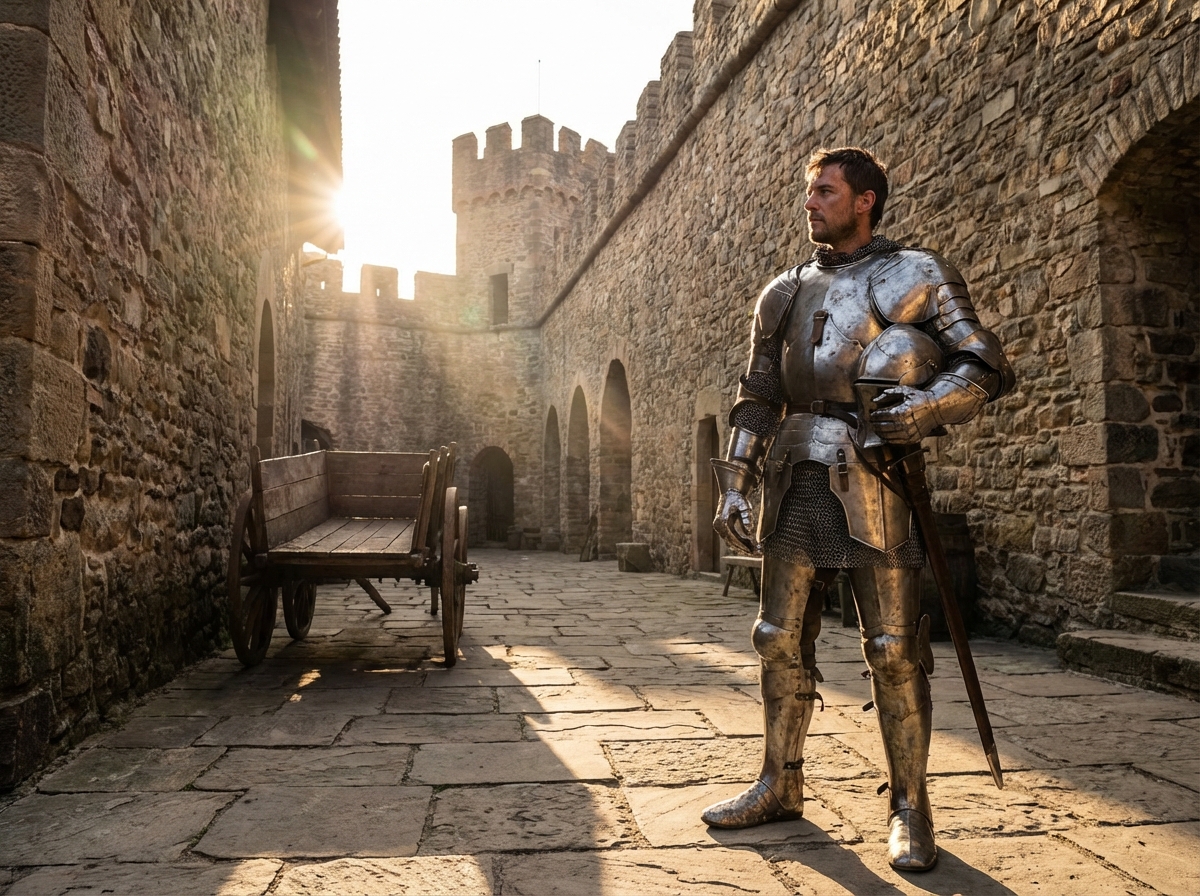
The term ‘knight’ refers to the mounted warrior of the Middle Ages, who not only fulfilled a military role but also occupied a clearly defined position within feudal society. Knights were part of the nobility, owned land or fiefs, and were bound by a duty of loyalty to their liege lord. This status was associated with a code of honour – chivalry – which encompassed bravery, loyalty, the protection of the weak and religious duty.
The heyday of chivalry spanned from the 11th to the late 15th century. Figures such as Richard the Lionheart or Godfrey of Bouillon remain defining role models in the collective memory to this day – not only as warlords, but as the embodiment of chivalric ideals. With the emergence of mercenary armies and the use of firearms, the individual armoured horseman lost his military superiority. Chivalry did not disappear overnight, but transformed: tournaments, courtly ceremonies and titles of nobility kept the spirit alive for centuries to come.
A knight’s attire: layers, materials and function
A knight’s attire was not a single garment, but a well-thought-out layered system comprising everyday clothing and combat equipment. As the innermost layer, the knight wore a linen shirt directly against the skin, along with leggings – close-fitting legwear fastened to a waist belt. This base layer was indispensable both in everyday life and beneath the armour, as it prevented chafing and friction caused by metal parts.
Over this came the gambeson – a padded, quilted tunic made of linen or wool – serving as a cushioning layer that absorbed blows and provided a protective barrier between the body and the armour beneath. Over the gambeson, the knight wore the chainmail (hauberk), a mesh of iron rings that offered flexible protection against cutting and piercing weapons. In the late Middle Ages, plate armour – comprising breast, arm and leg plates made of forged steel – supplemented or replaced the chainmail. A tabard was often worn over the armour – a linen or woollen overgarment bearing the knight’s coat of arms, which made his allegiance and lineage visible on the battlefield.
Knight’s armour by period: Early, High and Late Middle Ages
Early Middle Ages
Chainmail dominates as the most important protective equipment. Helmets are kept simple – the nasal helmet with its characteristic nose guard offers protection without fully covering the face. Wooden shields covered in leather complete the outfit.
High Middle Ages
The pot helmet replaces the nasal helmet and protects the entire head. The chain mail becomes heavier and denser due to additional reinforcements. The surcoat – a loose-fitting overgarment – protects the armour from the weather and bears the knight’s coat of arms. Shields become smaller and more triangular.
Late Middle Ages
Full plate armour with a visor helmet becomes the norm. Arm and leg guards made of forged steel are crafted to a precise fit. Craftsmanship and materials reach their peak – a full suit of armour can cost several years’ wages for a craftsman.
Putting together a knight’s outfit: an overview of clothing, armour and weapons
A simple medieval tunic, medieval trousers, a belt and matching knight’s shoes form the basis for any market visit or costume. This basic outfit is suitable for beginners, children and visitors to medieval markets without a specific role to play.
A gambeson as a padding layer, plus a knight’s tabard, a helmet from the High Medieval range and a knight’s knife on the belt – this set impresses at markets and in LARP both visually and functionally. For show fights, foam LARP weapons are also recommended.
A complete reenactment set includes chainmail, breastplate, leg guards, arm guards and a medieval sword with a historically accurate blade shape. For exhibition fights and performances at reenactment events, every piece should be appropriate for the chosen era.
Comparison of knight’s equipment for LARP and reenactment
- Historically documented materials (wool, linen, steel)
- Accurate representation of the era and region
- Chainmail and metal plate armour
- Attention to detail in cut and decoration
- Swords with correct blade geometry
- Safety and mobility are paramount
- Foam weapons instead of metal blades
- Lighter materials for prolonged use
- Visual authenticity more important than material accuracy
- Durability for intensive play
Vehi Mercatus offers both ranges – whether you’re looking for a functional LARP helmet or chainmail armour that’s as true to the original as possible, you’ll find both in our range.
What should you wear to a medieval festival? Tips for your first visit to a market

For your first visit to a medieval market without a specific character role, a simple basic outfit is perfectly sufficient: a long tunic made of natural fibres, trousers in a historical cut and a plain leather belt. Anyone wishing to appear as a knight will stand out clearly from the crowd with a tabard in their coat of arms’ colours and a simple helmet – both are quick to put on and instantly recognisable.
Shoes are often underestimated when putting together a medieval outfit: modern trainers or sneakers worn under historical clothing catch everyone’s eye. Historical shoe styles with flat soles and undyed or hand-dyed leather make all the difference visually. To complete the look, accessories such as a pewter cup on the belt, a belt pouch or a cloak harmoniously round off the overall appearance – without much effort.
Whether you’re putting together your first knight’s outfit for a medieval market or building a historically accurate re-enactment kit – at the Vehi Mercatus Knight’s Shop, you’ll find the right items for every level. Browse through the range and gear up for your next adventure.
Frequently asked questions
A knight wore a layered system consisting of a linen shirt and leggings as a base, over which a quilted gambeson served as a padding layer, and a chainmail coat made of ring mail. In the late Middle Ages, full plate armour was added. A tabard bearing the knight’s own coat of arms was often worn over the armour to ensure recognition on the battlefield.
For a visit to a medieval market without a specific role, a simple tunic made of natural fibres, trousers in a historical cut and a leather belt are sufficient. Anyone wishing to appear as a knight should complete the outfit with a tabard and a helmet. Historical leather shoes instead of modern trainers make the biggest visual difference. Accessories such as a belt pouch or a cloak round off the look.
Knights wore so-called leggings – tight-fitting, stocking-like legwear made of linen or wool, which were fastened to a waist belt. In the High Middle Ages, wider breeches were also added as undergarments. Trousers were not a standardised garment, but varied depending on the era and the wearer’s social status.
With re-enactment armour, historical authenticity is paramount: natural fibres, metal parts and period-appropriate details are crucial. LARP armour, on the other hand, prioritises safety and mobility – foam weapons and lighter materials are standard here. Both types have their place, depending on whether you are taking part in historical re-enactments or active mock battles.
The end of classical chivalry as a military force came with the emergence of mercenary armies and firearms in the 15th and 16th centuries. A single armoured horseman lost his tactical advantage against well-organised infantry and early firearms. The nobility and chivalric ceremonies such as tournaments persisted for a long time, but the military role of the knight had become obsolete.
Discover related categories
 Helmets
Chainmail & Hauberks
Helmets
Chainmail & Hauberks
 Knightly weapons
Shoulder plates
Chainmail gloves
Knightly weapons
Shoulder plates
Chainmail gloves
 Armoury
 Crusader outfit


