


The Witcher props


Geralt of Rivia carries two swords – one made of steel, one of silver – and this duality lies at the heart of The Witcher universe. Anyone wishing to experience the world of the White Wolf beyond the screen will find authentic Witcher merchandise here: a replica of the iconic silver sword, as well as pieces of armour that bring Geralt’s monster-hunting gear to life.
Steel and silver: the witcher’s two swords

A witcher without his two swords is not a complete witcher. This rule runs through the entire Witcher universe – from the novels by Polish author Andrzej Sapkowski, through the game series by CD Projekt Red, to the Netflix series. The steel sword is intended for combat against humans, bandits and ordinary animals. The silver sword, on the other hand, is effective against monsters, ghosts and magical creatures – silver as the weakness of supernatural beings is a deeply rooted element of Witcher lore.
In the game series, the blades bear specific names: the most famous steel sword is the Sword of Destiny, which is closely linked to the principle of surprise and Geralt’s fate. Ciri’s blade is named Zireael – High Elven for ‘swallow’ – and is one of the most iconic blades in the entire canon.
Anyone watching the Netflix series closely will notice that Geralt often carries only one sword. This is not a lore-based decision, but simply a matter of production logic – having two swords on an actor’s back during long days of filming is logistically complex and not always practical from a safety perspective. In the game and the novels, however, the dual-sword setup is consistently maintained.
An overview of the most famous Witcher swords
Geralt’s silver sword
The distinctive blade with curved crossguards is the witcher’s most recognisable symbol. The design from The Witcher 3: Wild Hunt serves as the template for most available replicas – including the silver sword from Battle Merchant in the shop.
Aerondight
Aerondight is the most powerful silver sword in The Witcher 3 and is earned through the ‘Favour of Fate’ questline – it requires impeccable conduct and grows stronger with every defeated enemy. As a replica, it is currently rarely available; the design is less iconic than Geralt’s standard blade.
Zireael / Swallow
Zireael is Ciri’s personal blade – slimmer and lighter than Geralt’s swords, suited to her fighting style. The name comes from the High Elven language and means “swallow”. The blade is particularly sought-after as a collector’s item and cosplay prop for Ciri cosplayers.
The Witcher silver sword as a replica: What you need to know
| Feature | Detail | Significance for buyers |
|---|---|---|
| Blade material | 420 stainless steel | Decorative standard Realistic appearance, not sharp, not suitable for combat |
| Guard | Characteristically curved | Key distinguishing feature – this is where the attention to detail shines through |
| Sheath | Wooden core with leather covering and metal fittings | A more premium look than pure imitation leather scabbards |
| Total length | approx. 119–127 cm | Correct proportions of the one-and-a-half-handed sword for cosplay and wall mounting |
| Suitable for LARP | Not applicable | LARP Only foam versions from other manufacturers permitted |
The Battle Merchant replica is based on the design from The Witcher 3: Wild Hunt. The 420 stainless steel blade gives the sword a realistic sheen and sufficient rigidity for wall mounting and photography – without meeting the requirements of a combat-ready weapon. The characteristically curved crossguards in particular are the defining quality feature: a replica that merely roughly follows the silhouette here immediately loses its recognisability.
Witcher swords in a historical context: where does the design come from?
- Blade length 90–110 cm, total length up to 140 cm
- Straight or slightly curved crossguards
- Suitable for one or two hands
- Widespread in European sword-making during the Late Middle Ages
- Modelled on High Medieval and Late Medieval swords
- Total length approx. 119–127 cm – close to the historical model
- Characteristically strongly curved crossguards – fantasy element
- Slim, light blade for the Witcher’s fighting style
- No historical authenticity, but recognisable medieval DNA
- Complements film and fantasy swords well in a collection
Anyone interested in Witcher replicas is exploring the broader realm of medieval sword history. The Geralt sword has its roots in the European one-and-a-half-hand sword of the 13th to 15th centuries – a weapon form that combined versatility in combat with reach and control. CD Projekt Red specifically chose this type as a basis and developed it further with fantasy elements – particularly the curved crossguards – to create a distinctive silhouette. This also explains why Witcher swords attract interest in the re-enactment scene: the historical DNA is recognisable, even if the end result clearly lies in the realm of fantasy.
Who are Witcher props suitable for?
Anyone attending a convention as Geralt needs the sword – a Witcher costume without the characteristic blade feels incomplete. The steel replica looks convincing and, thanks to its realistic length, is screen-ready. Important: always check the event’s house rules regarding weapon replicas in advance – many conventions have clear guidelines on blade length and materials.
Witcher fans who collect replicas as display pieces will find the silver sword an iconic item. With a matching wall mount – available as an accessory for swords – it becomes the centrepiece of any gaming room or office décor. In the price range of €67–130, the range is also well suited as a gift idea for Christmas or birthdays.
Steel replicas are not LARP-approved and must not be used in LARP play. Only specially tested foam versions that meet safety standards are permitted for use in LARP. You can find foam swords in the LARP Weapons section.
Monster Hunter Equipment: The Witcher’s Vambraces and Protective Gear

In addition to the silver sword, the Witcher range also includes the Witcher’s monster hunter arm guards – crafted by Lord of Battles from 100% leather. Arm guards are part of Geralt’s characteristic protective gear and complete a Witcher outfit far more than the sword alone. The greaves are functionally rooted in the Witcher’s fighting style: as a melee fighter who deliberately combines sign magic and sword techniques, Geralt needs freedom of movement in his arms whilst simultaneously protecting his forearms.
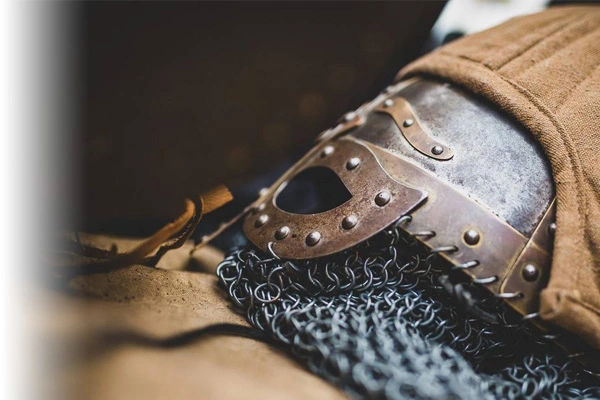
The chain mail made from 100% carbon steel is another armour element that fits the Geralt look. The combination of leather bracers and chain mail sections follows the layering principle of medieval protective gear – leather as flexible base protection, metal as a reinforcing element in exposed areas. For a complete Geralt costume or a wall display, the combination of sword and armour accessories creates a harmonious overall look. The price range from approx. €67 for the arm guards to €130 for the silver sword allows you to gradually assemble a full Witcher outfit – or specifically choose a single piece as a statement item.
Anyone interested in further medieval arm guards or wishing to complement the Geralt look with matching armour will find a wide selection of armour pieces in the shop. Related categories such as Game of Thrones props, Lord of the Rings props, Harry Potter props and Vikings props appeal to similar collecting interests and can be easily combined.
Whether as wall decoration, a cosplay prop or the start of a fantasy sword collection – the Witcher silver sword and monster hunter arm guards bring the spirit of the Witcher tangibly into your home. Check out the current range and equip yourself with the White Wolf’s gear.
Frequently asked questions
Geralt generally carries two swords. In the lore, the steel sword is known as the Sword of Destiny – a name closely linked to the principle of surprise and Geralt’s fate. The silver sword is referred to by various names throughout the game. Ciri’s blade is called Zireael, which means ‘swallow’ in the Old Elven language.
The most legendary silver sword in The Witcher 3 is Aerondight – it is earned through the ‘Favour of Fate’ questline, requires flawless conduct, and grows stronger with every defeated enemy. For collectors and cosplayers, however, Geralt’s iconic standard silver sword with its characteristic curved crossguards is the centre of attention, as it is available as a replica.
Aerondight is obtained through the 'Favour of Fate' quest line in the 'Blood and Wine' DLC. Geralt must complete a series of tasks without committing a single misdeed – the sword tests the witcher’s character. As a decorative replica, Aerondight is currently rarely available in shops; the best-known replica available is Geralt’s standard silver sword from The Witcher 3.
Geralt always carries a steel sword and a silver sword – both strapped to his back, which is one of his most distinctive visual features. The steel sword is used against human enemies and animals, the silver sword against monsters and magical creatures. This iconic way of carrying them is replicated in replicas using back straps, which are often available as accessories.
This is a production decision, not a lore error. Carrying two heavy blades on an actor’s back during long days of filming is logistically complex and poses safety challenges. In Andrzej Sapkowski’s novels and CD Projekt Red’s game series, however, the distinction between steel and silver is consistently maintained and remains a central element of the Witcher mythos.