


Medieval buttons


Historical buttons are far more than just a functional fastening – they lend character to a medieval garment, showcase craftsmanship and anchor an outfit in its era. Whether it’s a 15th-century-style pewter button, a brass button with a floral pattern or a simple horn button: choosing the right button plays a key role in determining how authentic a historical garment appears. Anyone wishing to authentically accessorise a medieval garment should also pay the necessary attention to the buttons.
Buttons in the Middle Ages – a brief look back at history
Brooches, clasps and hooks
Before the button became established as a fastening in Europe, brooches, clasps, hooks and simple ribbons dominated medieval clothing. Garment fastenings and brooch pins held coats and cloaks together – the button was not yet an everyday item.
The spread of the button
In the 13th century, the button spread rapidly throughout Europe as a fastening element. Tighter-fitting clothing necessitated precise fastenings. The earliest button finds originate from urban contexts – a sign of their initial significance as a status symbol.
Late Middle Ages: Tin, Brass and Bronze
In the Late Middle Ages, pewter became one of the most common metals for simple buttons worn by the general population. Brass and bronze were associated with high-quality clothing. Archaeological finds reveal button shapes such as cones, spheres and discs – these can be attributed to specific periods and social classes.
Renaissance and Modern Era
With the Renaissance, decorative demands on buttons increased significantly. Hollow brass buttons and elaborately decorated disc buttons were increasingly found on middle-class clothing. Motif buttons featuring flowers, animal figures and geometric patterns became a means of artistic expression.
Hand-cast replicas based on historical finds

The majority of the range comes from our own brand, Vehi Mercatus, and is based on archaeological finds from the 15th and 16th centuries. The buttons are hand-cast based on historical models – this means that every piece bears the characteristic features of traditional craftsmanship: slight surface variations, natural proportions and a feel that machine-made buttons lack.
Prices range from approx. €0.83 to €2.10 per piece, making it easy to order larger quantities for a complete outfit – as a typical medieval garment requires between 8 and 20 buttons, depending on the cut. Depending on the product variant, polished surfaces or an antique look are available, allowing you to use shine and patina to specific effect. You’ll also find garment fastenings for coats and cloaks, as well as pocket and belt fittings, in the range as further haberdashery accessories.
Button shapes and their historical models
Disc button
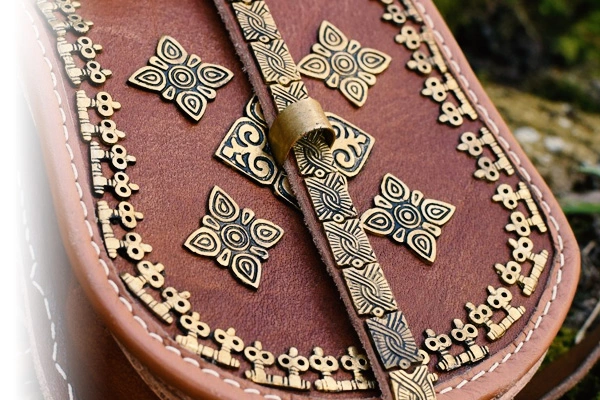
Flat, with a floral or geometric motif – the disc button is one of the longest-used shapes. Available in the range as a brass button with a floral pattern, rose motif or Celtic knot pattern. Ideal for High Medieval and early modern garments.
Cone button & ball button
Three-dimensional button shapes, typical of the Late Middle Ages. Reproduced based on archaeological finds – in both pewter and brass. Characteristic of the sleeve rows on Late Gothic garments.
Hollow buttons & motif buttons
Hollow brass buttons are lighter than solid buttons and well suited to traditional costumes and modern-day re-enactment. Motif buttons featuring roses, acorns or Viking knot patterns serve as a stylistic expression depending on the cultural context.
Which button suits which garment?
In the Early Middle Ages and the Viking Age, buttons were still used sparingly. Horn buttons or plain brass buttons without elaborate motifs are historically more accurate. Many garments from this period were fastened with brooches and toggles instead. For a Viking garment, buttons with knot patterns or simple geometric shapes are recommended.
In the High Middle Ages, brass disc buttons became increasingly fashionable on sleeves and collars. Floral motifs and geometric patterns are historically documented. A medieval shirt with disc buttons on the cuffs immediately looks more authentic than a version with modern plastic buttons.
The Late Middle Ages mark the heyday of historical buttons: pewter buttons in conical or spherical shapes, brass buttons with floral patterns or rose motifs, and conical buttons with acorn-head motifs are all archaeologically attested. Anyone creating men’s or women’s clothing for the 15th century will always make a safe choice with pewter buttons or brass disc buttons.
For modern-era re-enactment and Renaissance garments, hollow brass buttons and Baroque disc buttons are ideal. These shapes are also found in traditional costume fashion. As a complementary fastening element, tassels and tassel cords are suitable, functioning as a historically accurate alternative to the modern buttonhole.
Workmanship and fastening: What to bear in mind when sewing

Historical buttons differ significantly from modern variants in terms of fastening. Both types are available in our range: buttons with an eyelet on the back and buttons with two through-holes.
Eyelet buttons are sewn directly onto the fabric without the need for a traditional buttonhole. This makes them particularly well-suited for heavy woollen garments, where a cut buttonhole would weaken the fabric. The eyelet lies flat against the fabric and is held in place simply by wrapping the thread around it.
Buttons with a through-hole can be used like modern buttons and require a matching buttonhole or a loop. Plain cord or cord with brass tips are a historically accurate alternative here – they form a loop through which the button is threaded, thereby avoiding the need to cut a buttonhole altogether.
Materials compared: brass, pewter, horn and more
| Material | Suitability | Period / Use |
|---|---|---|
| Brass | Historical | Late Middle Ages to modern times; robust, gold-coloured; versatile with motifs such as roses, floral patterns or Celtic knots; also suitable for re-enactment and LARP |
| Pewter | Historical | 14th–16th century; silver-coloured, hand-cast; typical shapes include cones, pyramids and spheres; ideal for late medieval re-enactment costumes |
| Horn | LARP | Early Middle Ages and simple costumes; organic material, understated appearance; good for nature-inspired or early medieval outfits |
| Hollow button (brass) | LARP | Modern era and traditional costumes; lighter than solid buttons; simple to use; also suitable for stage costumes and carnival outfits |
With the right historical button, every garment is brought together to create a harmonious overall look – whether for re-enactment, LARP or the next medieval market. Browse through our range, combine brass, pewter and horn according to era and style, and feel free to seek advice via our helpline if you have any questions.
Frequently asked questions
In the Middle Ages, buttons were often made from pewter, brass and bronze. Pewter was the typical material for the lower classes, whilst brass and bronze were associated with finer garments. Archaeological finds also include buttons made from horn, bone and – in the case of very wealthy wearers – silver. The range at Vehi Mercatus includes replicas in brass, pewter and horn, based on these historical findings.
That depends heavily on the cut and the period. A typical late medieval jacket or surcoat may require 12 to 20 buttons on the sleeves and front. Simpler tunics often require only 4 to 8 buttons on the collar and cuffs. As individual prices in the range vary between approx. €0.83 and €2.10, it is easily possible to order larger quantities of matching buttons for a cohesive outfit.
Eyelet buttons have a metal eyelet on the back and are sewn directly onto the fabric – without a buttonhole. This is particularly practical for heavy woollen fabrics, as no cut is needed in the fabric. Buttons with a through-hole function like modern buttons and require a buttonhole or a loop made from cord. Both variants are available in the range.
Pewter buttons in conical or spherical shapes are typical of the Late Middle Ages from the 14th to the 16th century. Brass disc buttons with floral motifs are suitable for the High Middle Ages and the Early Modern period. For Viking and early medieval costumes, horn buttons or plain brass buttons without elaborate decoration are more suitable. Hollow brass buttons are the right choice for modern-day re-enactment and traditional costumes.
Yes, historical buttons are just as suitable for LARP costumes and outfits as they are for re-enactment. Horn buttons and hollow brass buttons in particular are easy to work with and ideal for homemade clothing. The affordable unit prices make it easy to use high-quality hand-cast buttons for costume projects instead of inferior plastic alternatives.