
Medieval necklace and medieval pendant
Medieval necklaces and pendants combine historical craftsmanship with personal significance – whether as a Thor’s hammer amulet, a lunula moon pendant or a solid bronze torques. This category gives you an overview of styles, materials and cultural backgrounds, so you can find the perfect piece for your re-enactment, LARP costume or everyday wear. Prices range from simple entry-level pieces starting at around €10 to impressive replicas such as the large Snettisham torques.




What did medieval necklaces look like? A historical overview
Medieval necklaces ranged from simple wire and link chains made of bronze or iron to elaborately crafted torques – open neck rings made of twisted metal, which were already worn in the Iron Age and remained in use until the early Middle Ages. The range was enormous: simple leather necklaces with animal heads as clasps were a popular alternative to metal chains, which not everyone could afford. Metal chains, on the other hand, signalled status and wealth – the longer, heavier and more elaborately crafted they were, the higher the social status of the wearer.
In the early Middle Ages, hook and wrap fastenings dominated, as snap hooks did not appear until much later. Typical chain lengths ranged between 45 and 70 cm, with shorter chains lying closer to the neck and longer pieces worn over the tunic as amulet pendants. There were considerable regional and temporal differences: Viking-era pieces display different stylistic features to courtly chains of the High Middle Ages.
From the Viking Age to the High Middle Ages: periods and their typical pieces
Early Middle Ages / Viking Age
Simple bronze chains, torques and amulets characterised this era. Archaeological finds from Haithabu and Gotland reveal Thor’s hammer pendants, moon amulets (lunulae) and animal-head end caps on leather and metal chains. What is typical of this phase of the Middle Ages? The symbiosis of practical function and spiritual significance – amulets protected their wearers, while chains served as portable stores of value.
High Middle Ages
More elaborate link necklaces, cross pendants and knightly insignia emerged. Ecclesiastical symbols gained in significance, and gemstones were set in metal mountings. Necklace styles featuring multiple rows or wide metal plates adorned courtly society.
Late Middle Ages
Goldsmith-crafted necklaces, reliquaries and pilgrim badges as wearable pendants dominated the scene. Medieval pewter badges and pilgrim badges were widespread, affordable devotional objects. Figure-accentuating necklaces with medallions and elaborate clasps bore witness to the wealth of their owners.
Types of pendants and their cultural origins
Nordic-Germanic
Thor’s hammer (Mjölnir) is the most famous Viking pendant of all – original finds come from Ödeshög and Scania, among other places. The ‘Vendel’ pendant depicts Odin’s two ravens, Hugin and Munin. Bronze lunula moon amulets appear in both Slavic and Nordic contexts and were regarded as protective symbols. The ‘Gotland’ bead pendant is a handcrafted replica of Viking-era finds from Gotland, Sweden.
Christian-ecclesiastical
A reliquary pendant (also known as a reliquary) is a small container – usually made of metal – in which relics of saints were kept. Those who wore such a pendant believed themselves to be under the protection of the respective saint. Ecclesiastical pendants are generally referred to as pectorals (chest crosses), medallions or cross pendants. In common parlance, terms such as saint’s pendant or amulet necklace are also used.
Practical & functional
Not all pendants served a representational purpose. Needle cases on chains kept sewing needles safe – indispensable for medieval women. Keys worn as pendants symbolised authority over the household and were practical at the same time. Bridle fittings with animal motifs adorned horse tack and were also found as imitation pendants on chains. Even a small ‘toiletries set’ consisting of tweezers, an ear spoon and an awl could be worn on a pendant.
Which chain goes with what? A guide for re-enactment and LARP
For a starter Viking outfit, a simple Viking chain with a hook clasp in 60 cm (silver-plated or bronze) is the most versatile choice – it can be combined with almost any pendant. A simple Urnes amulet or a bronze Thor’s hammer pendant completes the look without breaking the bank.
For early medieval women’s attire, a needle case on a pendant or a Gotland-style bead pendant is recommended, both of which are archaeologically attested styles. Viking re-enactors opt for leather chains with animal-head ends such as ‘weasel head’ or ‘Mandermark’ – authentic and robust at the same time. Replicas of Thor’s hammer based on original finds from Ödeshög or Scania complement historically inspired attire.
In LARP, you have greater freedom with materials and design: silver-plated pieces look more decorative on stage, whilst larger pendants catch the eye better from a distance. Complete your ensemble with matching medieval bracelets, brooches or a medieval ring from the medieval jewellery range.
Materials and their significance: bronze, silver, leather and more
| Material | Suitability | Properties & Use |
|---|---|---|
| Bronze | Historical | The most affordable and widely used metal for amulets and necklaces; warm golden hue, develops a patina easily; typical of the Viking Age and the early Middle Ages |
| Silver-plated / Silver | Historical | A balance between authenticity and price; silver-plated brass chains for a higher-quality appearance without the cost of solid silver; documented original finds in silver |
| Brass | LARP | Typical tool material, also used for chain clasps; slightly lighter in colour than bronze; durable and easy to work with |
| Leather | Historical | Authentic, folk-style variant; Viking leather chains ‘Wieselkopf’ and ‘Mandermark’ with animal-head end caps; robust, lightweight and comfortable to wear |
What jewellery was actually worn in the Middle Ages? The answer depends heavily on social class and the era: common folk wore leather and bronze jewellery, whilst the nobility and clergy preferred gold, silver and gemstones. Common to all social classes was a fondness for amulets and symbols believed to offer protection.
Terms relating to necklaces: What do torques, collier and Singapore chains mean?
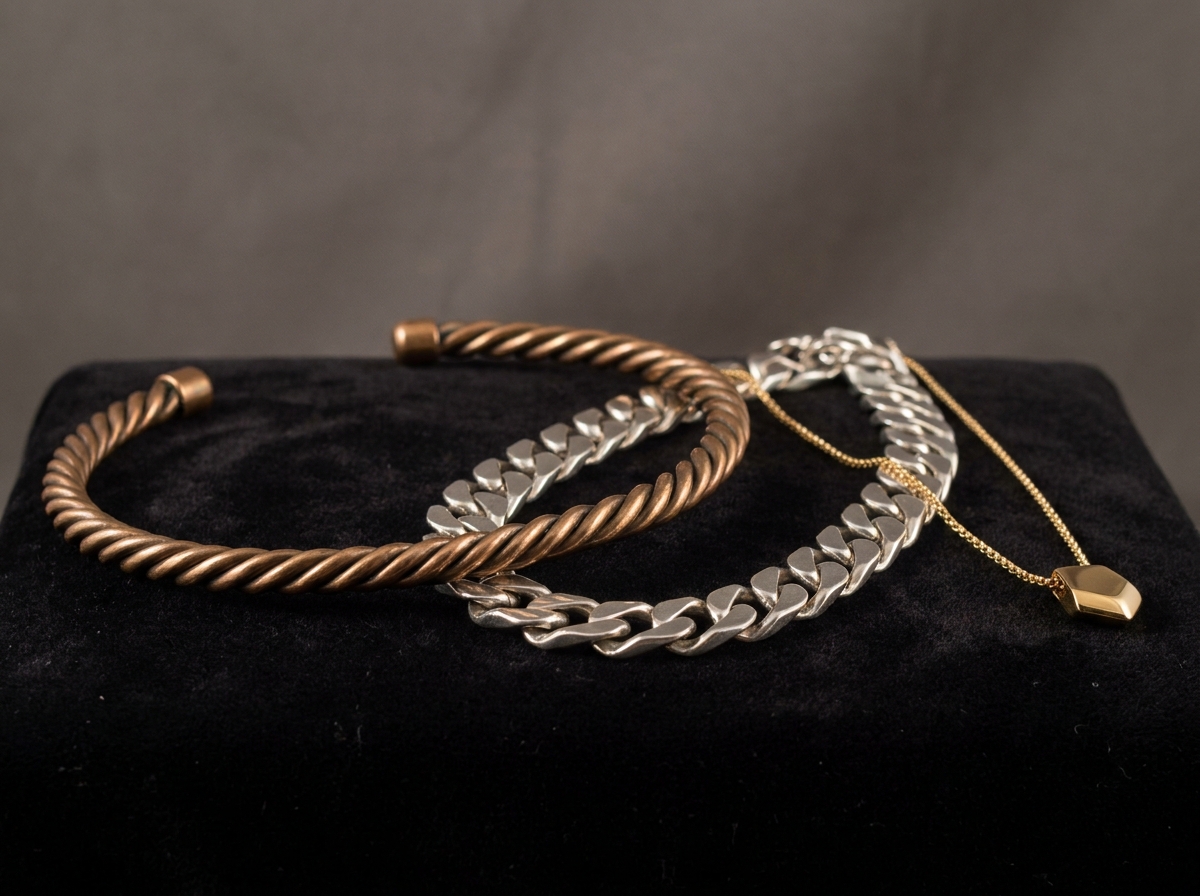 Anyone looking into Viking necklaces and pendants will quickly come across a range of technical terms. Here is an overview of the most important ones:
Torques (also spelled torques) refers to an open neck ring made of twisted or coiled metal of Celtic-Germanic origin. The word derives from the Latin torquere (to twist). The most impressive examples – such as the large Snettisham Torques – were crafted from solid gold or bronze and stand as testaments to Iron Age goldsmithing.
Collier comes from the French and originally referred to a multi-strand or flat necklace; in the High Middle Ages, this style was common at court and could be made of precious metal, pearls or enamelled links.
What other names are there for a necklace? The most common synonyms are: necklace, chain, amulet chain, choker, collier and neck jewellery. In a medieval context, terms such as ‘pendant’ (for combined chains with several pendants) and ‘pectoral’ (chest jewellery worn by the clergy) are also used.
The Singapore chain, on the other hand, is not a historical medieval style, but a modern chain pattern with a characteristic cord-like appearance created by closely intertwined links. Today, it is a popular chain for pendants because it has a simple look and shows off any pendant to its best advantage – even though its origins lie outside the medieval jewellery tradition.
Our range at a glance
Whether you’re looking for a single Thor’s hammer amulet for your first Viking outfit or an impressive torques to be the highlight of your re-enactment attire – browse through our range and be inspired by historical examples. You’ll also find matching medieval jewellery accessories in the shop, as well as our full range of medieval and Viking jewellery.
Frequently Asked Questions
Medieval necklaces ranged from simple bronze wire and link chains to leather chains with animal heads and elaborate torques – open neck rings made of twisted metal. Wealthy wearers such as the nobility and clergy wore gold and silver, whilst ordinary people made do with bronze or leather. Typical fastenings were hook and wrap closures.
A reliquary pendant (or reliquary) is a small container, usually made of metal, in which relics of saints were kept. Anyone wearing such a pendant hoped to receive the protection of the respective saint. Reliquaries were widespread in the High and Late Middle Ages and could be made simply from sheet metal or elaborately from precious metal.
Church pendants have various names: cross pendants or crucifixes for the cross, pectorals for the clergy’s pectoral cross, medallions for round pendants bearing the image of a saint, and reliquaries for containers holding relics. In everyday language, terms such as saint’s pendant or devotional item are also commonly used.
The Singapore chain is a modern chain pattern with a characteristic cord-like appearance, formed by closely intertwined links. It is not a historical medieval style, but a contemporary invention. In medieval reenactment circles, it is now often used as a chain for pendants because its simple appearance allows any pendant to stand out well.
For historically accurate Viking re-enactments, archaeologically attested pieces are suitable: Thor’s hammer pendants based on original finds from Ödeshög or Scania, lunula moon amulets, Vendel pendants featuring raven symbolism, and Gotland-style bead pendants. Leather chains with animal-head end caps or simple bronze chains with hook clasps are historically appropriate as pendants.
Discover related categories
 Viking bangles & bracelets
 Viking earrings
 Viking rings
 Medieval earrings
 Hair jewellery & beard beads
 Viking brooches
 Viking brooch chains
Viking hygiene cutlery


