




Nesting cords Incl. tips


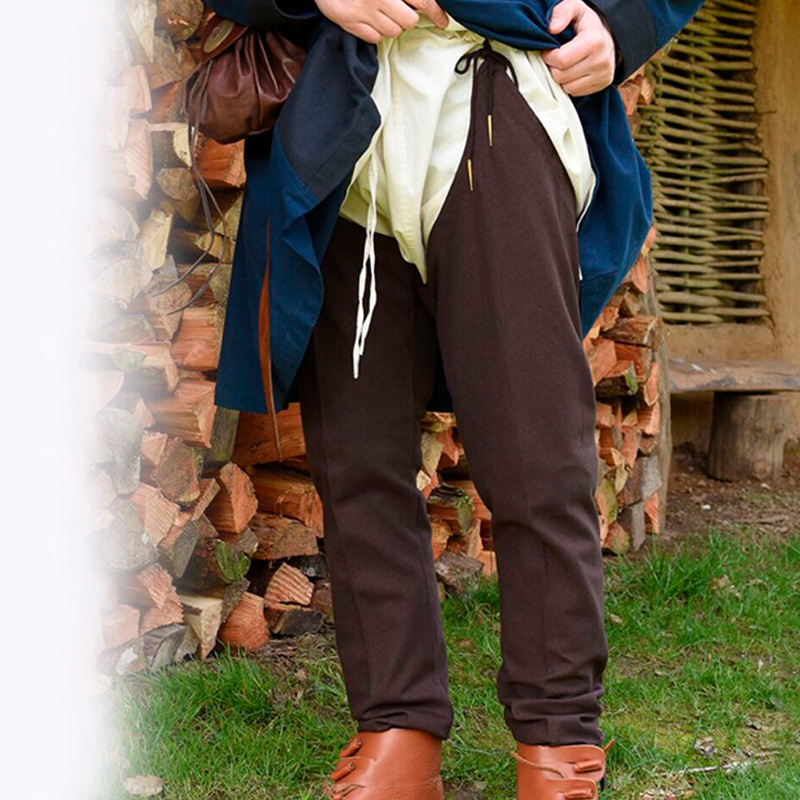
Tassel cords with brass tips are both functional and decorative details of a historically accurate costume — they fasten garments together whilst lending the outfit an authentic character, reflecting how such attire was actually worn in the Middle Ages.
What is a cord with tassels and what is it used for?

A cord — also known as a cord fastener or simply a cord — is a braided or corded string fitted with tips (known as cord tips) at both ends. Its main purpose is to fasten different garments together, a task now performed by a button, a zip or an elasticated waistband.
In the Middle Ages, there was no such thing as a modern trouser waistband as we know it today. Instead, trousers, leggings and other garments were fastened to tops, doublets or belts using cords — namely, nestels. The term ‘nesteln’ derives directly from this fastening process and has survived to this day in German: anyone who fiddles about with something is ‘nesteln’ with it.
The cord itself can be braided in a single colour or in multiple colours, round or flat — depending on the region, era and social status of the wearer. In our range, you will find single-colour cord ties with brass tips as well as two-colour cord ties with brass tips, both hand-knotted from cotton.
Function of the cord ends: More than just decoration

The cord ends — known as aglets — primarily serve a practical function: they make it considerably easier to thread the cord through the lacing holes in the garment. Much like the plastic tips on modern shoelaces, the metal sleeve prevents the cord from fraying and unravelling.
At the same time, the tip provides lasting protection against wear and tear at the end of the cord — particularly when the aglets are pulled through tight holes on a daily basis. When threading, it is advisable to provide aglet holes with a minimum diameter of around 4 mm so that the tips slide through smoothly.
Furthermore, cord ends have always had a decorative function. Brass adds subtle accents of shine and, in a medieval context, signalled care in one’s attire — a small but visible sign of neatness. Historically, the ends were either pressed directly onto the end of the cord or secured with small pins. Both methods have been found in archaeological discoveries.
History of the nestle cord: From the 12th century to the late Middle Ages
Emergence of the cord
With the spread of figure-hugging fashion in the High Middle Ages, the need arose to fasten close-fitting garments together. Tighter cuts could no longer simply be slipped on — laced fastenings became a necessity. The first laces were simple cotton or linen cords, often without lace.
Spread across all social classes
Lacing cords quickly became established across all social classes. Whilst ordinary citizens and peasants wore plain, single-coloured cords made of cotton or linen, the more affluent classes could afford multi-coloured braided or even silk lacing cords. Nestle tips made of non-ferrous sheet metal — primarily brass — became increasingly common, cut from sheet metal and hammered or pressed into shape.
The height of the tassel fashion
In the late Middle Ages, the tasselled cord reached its peak popularity. Figure-hugging fashion, detachable sleeves and complex garment constructions made several tassels per outfit the norm. Archaeological finds confirm brass as the most common material for tassel tips — durable, inexpensive to produce and visually appealing. Tin tips are also documented, though less frequently.
Using lacing cords correctly: Which garments are laced?
The most classic application: Medieval trousers and leggings were fastened to a doublet, a cotte or a belt using lacing. Braies (the lower leg garments) were often initially held together with a leather strap, with the leggings laced separately. Lacing holes should have a minimum diameter of 4 mm for this, preferably slightly more, so that the tips slide through cleanly.
Bodices, corsets and fitted tops were frequently fastened with lacing in the late Middle Ages — either at the front, back or sides. The lacing cord is threaded through paired holes and pulled tight like a shoelace. Depending on the width of the bodice neckline, lacing cords between 35 and 50 cm in length are recommended.
Detachable sleeves were widespread in the High and Late Middle Ages — they could be changed depending on the occasion or omitted entirely. They were attached via small lacing loops at the sleeve seam, through which a short lacing cord was threaded and knotted. Anyone sewing a historical medieval dress with detachable sleeves should plan for lacing holes right from the start.
Tight-fitting leggings were not simply pulled up, but fastened to a belt or trousers using lacing. To do this, eyelets were attached to the top waistband of the leggings, through which the lacing cord was threaded and then fastened to the medieval belt. This fastening remained secure even during movement and is equally suitable for re-enactment and LARP.
Single-coloured or two-coloured: which cord suits your costume?
- For simple, peasant or bourgeois costumes
- Classic in white, natural or black
- Discreet, blending seamlessly into the costume
- Historically well-documented for all social classes
- Ideal as a starter kit for beginners
- For colour-accented or aristocratic outfits
- Braided, e.g. in black/turquoise or other colour combinations
- Add deliberate colour accents to your outfit
- Historical examples also feature multi-coloured braided patterns
- Coordinate with trimmings, belts or the colour of the dress
When choosing colours, it is worth matching the cord to the overall outfit: high-contrast combinations such as black and turquoise look lively and stand out deliberately, whilst a white cord on a light linen shirt is barely visible but functionally correct. Historical images show both variations — cords were used both as a subtle accessory and as a visible design element.
A comparison of materials: cotton, linen, leather and silk
| Material | Suitability | Properties |
|---|---|---|
| Cotton | Everyday wear & LARP | A robust choice for everyday wear, widely available, washable, soft to the touch — as used in Vehi Mercatus |
| Linen | Historical | Early evidence, firmer and slightly stiffer feel, very durable, historically accurate for the Early Middle Ages |
| Leather | Heavy-duty fastenings | For trousers and heavier garments, less flexible, less decorative, but very sturdy |
| Silk | Reenactment nobility | Highest-quality variant, for noble attire, soft and lustrous, historically documented for the upper classes |
| Nestel lace Brass | Historical | Most commonly documented historically, durable, adds a touch of shine, more corrosion-resistant than tin |
| Tassel tip tin | Variant | Also historically documented, slightly softer, matt finish, can be hand-cast as a one-off |
For most applications in the lacing sector, cotton is the most practical choice: washable, pleasant to handle and sufficiently tear-resistant for daily use at markets and in LARP. Linen is the historically even earlier documented alternative — those who prioritise strict authenticity in medieval clothing tend to prefer it.
Whether for leggings, bodices or detachable sleeves — with the right drawstrings, including brass tips, your costume will not only fit better but also look more historically accurate. Browse through our range and find the perfect drawstring for your next outfit.
Frequently asked questions
The terms are often used interchangeably. Strictly speaking, ‘lacing cord’ refers to a round, corded or braided cord, whilst ‘lacing ribbon’ refers to flatter, woven ribbons. Both serve the same function as fastenings in medieval garments. In our range, you’ll find cotton lacing cords with attached brass tips.
For standard cord ties with brass tips, you should allow for cord holes with a minimum diameter of around 4 mm. For heavier cord ties or leather cord ties, the holes may need to be slightly larger. Ideally, the holes should be punched with an awl or reinforced with a leather eyelet tool to prevent them from tearing.
That depends on which garments you wish to attach lacing to. For leggings attached to a doublet or belt, you usually need 4–8 lacing cords (depending on the number of eyelet pairs). A bodice requires 4–10 pieces, depending on its length. For detachable sleeves, 2–4 lacing cords per side are usually sufficient. It is advisable to always have a few spare pieces to hand.
Yes, the brass tips on our lacing cords are firmly attached to the ends of the cord. They hold securely under normal use. With cheaper versions, the tips may come loose under heavy tension or mechanical pressure — but a quick squeeze with a pair of flat-nose pliers will easily secure the tip again. Historically, tips were either pressed on or secured with small pins.
In principle, yes — simple cord ends can be braided from cotton yarn using the finger-loop method. The cord ends can be purchased separately and then pressed onto the end of the cord. However, those without their own loom or braiding frame often prefer to use ready-made cord ends that are already fitted with tips and are ready for immediate use.