



Tassels


Tassels are among the oldest decorative elements in the history of textiles – and in a medieval context, they serve a purpose far beyond mere decoration. Whether on belt pouches and bags or on a paternoster: the right tassel adds the perfect authentic finishing touch to an outfit or accessory.
Tassel, pompom, bobble – what do these terms mean?

The term ‘quaste’ is derived from the Middle High German ‘quaste’, meaning ‘tuft’. It refers to a bundle of threads held together at the top by a knot, a bead or a cap, hanging freely downwards. The word ‘troddel’ is often used synonymously, but its usage varies regionally – in southern German and Austrian-speaking areas, ‘troddel’ is the more common form.
Fringes, on the other hand, are not the same thing: whilst fringes are arranged in a flat, linear pattern – for example, as the edge of a woven fabric or a scarf – a tassel is a discrete, hanging element. The two terms are therefore not synonyms, even though they are sometimes confused in everyday language.
Other related terms: ‘Bommel’ refers to a more rounded, spherical variant (typically found on pointed caps, for example), whilst ‘posament’ is the umbrella term for all kinds of textile embellishments – tassels, fringes, cords and braids all fall under this category.
Colour and decorative bead – how to find the right tassel
- Classic, timeless combination
- Complements both light and dark leather accessories
- Silver bead to match silver buckles and studs
- Versatile for use on trapezoid bags and paternoster bags
- Neutral and understated – goes with almost any outfit colour
- Gold bead adds a warm accent to dark leather
- Silver bead for a understated, elegant look
- Tip: Match the bead colour to existing metal fittings
The decorative bead is not merely a decorative element: it holds the thread knot securely together, protects the end of the tassel from coming undone and, thanks to its weight, ensures it hangs evenly. So if you’re using medieval bag and belt fittings made of brass or pewter, a gold-coloured bead is the most harmonious choice – for iron fittings or buckles, the silver-coloured version is recommended.
What are medieval tassels suitable for? An overview of possible uses
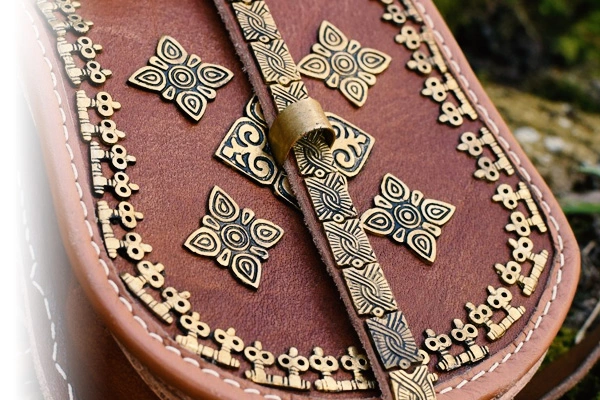
The most classic use for medieval tassels: belt pouches and trapezoidal bags are given an authentic, rounded look by one or more tassels on the lower edge or on the drawstring. Particularly on reconstructed medieval pouches, tassels serve as an atmospheric finishing touch that is well-documented historically.
On the paternoster – the medieval rosary or prayer cord – the tassel traditionally marks the end of the cord. It provides a dignified finish to the prayer chain and is a fitting accessory for both historically oriented re-enactors and LARP characters with a clerical focus.
Tassels can also be attached to medieval knives and knife sheaths – either directly to the handle or as the end of a strap. Historically, this use is documented for the upper classes and adds an extra layer of design to the ensemble.
Anyone who sews their own bags or assembles individual parts for bag-making will find tassels a rewarding design element. They can be easily integrated into ongoing projects – especially if they are threaded in before the final stitching. It is also possible to decorate camping gear such as pillowcases, sacks or tent accessories.
The decorative bead on the tassel can be used specifically as a design element: gold and silver-coloured beads add accents and create links to other metal parts on the outfit. If you combine several tassels, you can achieve a harmonious overall look by using beads of the same colour.
Attaching tassels – practical tips for bags, pouches and more

Tassels with a loop at the top are the most practical option: they can be easily threaded through eyelets, rings or the cord of a trapezoidal bag and secured with a simple knot or a loop. No tools, no glue – just thread and secure.
For a particularly rich look, it’s worth combining several tassels: two or three tassels at the bottom edge of a pouch look significantly fuller and more historically authentic than a single one. Make sure the colour and beads are consistent to achieve a harmonious overall look.
If you’re currently making a bag: ideally, the tassel should be threaded through before the final stitching – attaching it to finished seams afterwards is possible, but more labour-intensive. If you’re using a leather strap as the bag’s handle, you can also attach the tassel directly to it, for example using a small loop or a strip of leather.
Tassels in the Middle Ages – historical significance and use

In the Middle Ages, tassels were far more than mere decoration – they were symbols of status and affiliation. In ecclesiastical heraldry, for example, episcopal coats of arms featured green tassels in a specified number; the number of tassels revealed the bearer’s rank at a glance. Tassels were also common among the clergy on paraments, chasubles and liturgical vestments.
In the secular sphere, tassels were used on belts, pouches and knife sheaths – here, the quality and colour of the material signalled social status. Dark colours such as black and blue were widespread, as deeply saturated shades were costly to produce and were therefore regarded as a sign of wealth. Red and gold were also typical of the nobility.
Furthermore, tassels on bridles, flags and tents are historically documented – here they served both a decorative and a practical purpose, for example to protect fringes from fraying or to secure the ends of cords. The paternoster, the medieval prayer cord, was traditionally finished with a tassel that marked the end of the cord and prevented it from unravelling.
Making or buying tassels – an honest comparison
- Inexpensive to make from leftover wool
- Colour of your choice
- No decorative bead, so less dimensionally stable
- Significant time required for multiple pieces
- May look uneven
- Uniform, neatly finished appearance
- Metal bead provides dimensional stability and control of the tassel’s fall
- Ready to use – no effort required
- For re-enactment and markets: more durable and effective
- Matching colour and bead options available
If you only want to decorate a single item, you can make a tassel yourself – all you need is a piece of cardboard, some thread and a little patience. However, for regular use at markets, in LARP or during re-enactments, the ready-made tassel is well worth the investment: it sits evenly, retains its shape even after repeated use thanks to the metal bead, and simply looks better on the finished accessory.
Tassels are a small detail with a big impact – for your medieval outfit, your homemade pouch or your paternoster. Browse through the range and find the perfect combination of colour and decorative bead for your next project.
Frequently asked questions
Depending on the region, a tassel is also known as a ‘troddel’ – this term is particularly common in southern German and Austrian-speaking areas. Other related terms include ‘bommel’ (for a more rounded shape) and ‘posament’ as a general term for textile embellishments such as tassels, fringes and braids.
No, tassels and fringes are not the same thing. Fringes are flat and arranged in a linear fashion, for example as the edge of a woven fabric. A tassel, on the other hand, is a small, hanging element made from a bundle of thread ends, held together at the top by a knot, a bead or a cap.
The word ‘quaste’ is derived from the Middle High German ‘quaste’, meaning ‘tuft’. In the Middle Ages, tassels were not only decorative but also symbols of status: the colour, material and number of tassels indicated the wearer’s social rank – particularly evident in ecclesiastical heraldry, where episcopal coats of arms bore a fixed number of green tassels.
Medieval tassels are suitable for a wide range of accessories: they are most commonly attached to belt pouches, trapezoidal bags and rosaries. They are also used on knife sheaths, straps or as the end of a bag cord. If you sew your own bags, you can thread the tassels before the final stitching to integrate them neatly.
Black tassels are the most versatile and go with almost any garment colour. Dark blue tassels add a classic colour accent and look harmonious on both light and dark leather accessories. When choosing the decorative bead, it is advisable to match the bead colour to existing metal fittings such as buckles or rivets – gold-coloured for brass, silver-coloured for iron or pewter.