
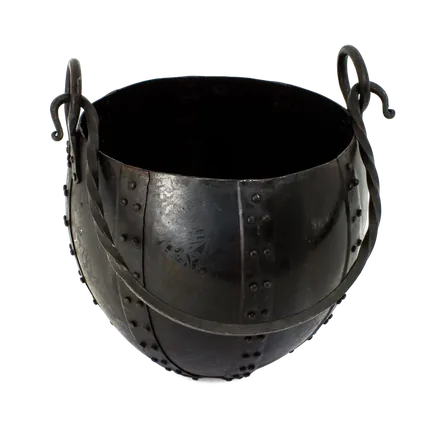
Miscellaneous
Sometimes what you’re looking for doesn’t fit into any particular category – and that’s exactly what this section is for. Here you’ll find hand-forged everyday items, historical trinkets, woollen socks made from genuine wool, leather straps and more: everything that completes an authentic medieval setup without fitting neatly into a single product group. From the Oseberg lamp to forged candlesticks and a canvas folding bucket – this category has everything that falls through the cracks elsewhere.
 Early Medieval500–1066
 High Medieval1050–1250
 Late Medieval1250–1500
 Renaissance1400–1600
Modern era
Renaissance1400–1600
Modern era
 Market-Medieval / Larptimeless
What’s behind ‘Miscellaneous’? A look at the range

The category brings together around 200 items that cannot be assigned to any clearly defined product group – and that is precisely where its value lies. Here you will find forged everyday tools such as fire steels, corkscrews and pipe tampers, as well as leather straps, woollen socks, lanterns, needle cases, medieval axes and dungeon props such as handcuffs or shackles. Prices range from around €10 for simple small items such as a fire steel or a needle case up to €168 for elaborately crafted sets such as the hand-forged surgeon’s kit with a bag. The range thus caters to both beginners and the more discerning tastes of the living history scene.
Why is this variety important? Anyone seriously involved in re-enactment, medieval markets or LARP knows that clothing alone does not create a convincing overall picture. It is the everyday objects – a candlestick on the camp table, a leather strap on the belt, a gleaming tinder on the pouch – that complete the impression. It is these small items that transform a camp or a re-enactment from a costume into living history.
Hand-forged everyday objects: function meets authenticity
A large part of the range is the result of genuine hand-forging craftsmanship. Forged candlesticks, carbon steel corkscrews, spring-loaded locks, pipe tampers – such items are not decorative mass-produced imitations, but functional accessories crafted according to historical models. The Oseberg lamp, for example, is a detailed replica of an antique iron lamp based on an archaeological find from the Viking Age. The sheet metal lantern with a cross pattern corresponds to an original now housed in a museum.
At medieval markets and re-enactment events, it is immediately noticeable when accessories do not match the rest of the ensemble. A hand-forged candlestick with a twisted stem and rolled feet looks completely different on a camp table than a modern industrial product – it attracts attention, invites conversation and conveys exactly the atmosphere that defines living history. Take a look at our forged goods for more handmade accessories.
What occasions are these small items suitable for?
In historical re-enactment, it’s all about the details. Everyday items such as canvas folding buckets, fire steels, spring-loaded locks for chests or forged lanterns complement costumes and encampments to create a harmonious overall picture. Many of the items here are based on museum finds or archaeological evidence – making them easy to incorporate into historically accurate re-enactments.
Whether at a market stall or around a campfire: candlesticks, leather straps, axe holders and lanterns prove their worth at every medieval festival. Functional small items such as the leather axe holder on a belt or the rawhide lantern for lighting a stall are not just decoration, but genuine everyday helpers for long market days.
For LARP players, props and atmospheric accessories are indispensable. Handcuffs, neck restraints, needle cases or a hand-forged corkscrew create credible game environments and enrich character portrayals. Many of these items are robust enough for outdoor use yet crafted with great attention to detail.
Not everyone who shops here is moving into a camp. Candlesticks, turned wooden needle cases, hand-forged corkscrews or an atmospheric rawhide lantern make for exceptional gifts for medieval enthusiasts, history lovers and anyone who enjoys decorating with unique items. You can find further ideas in our gift ideas for medieval enthusiasts.
Wool socks and small textile items: comfort beneath your garments
An often underestimated part of the range is woollen socks and knitted socks made from genuine natural fibres. Anyone who has experienced a long day at the market on cobblestones or a cold night in camp knows what a difference the right socks make. Historically accurate woollen socks also fit well under medieval shoes and add another layer of authenticity to the overall look.
| Material | Properties | Suitability |
|---|---|---|
| 100% wool | Historical | Maximum warmth, ideal for camps and re-enactments |
| 60% wool / 15% angora / 25% polyamide | All-round | Soft, retains its shape – for markets and everyday wear |
| 40% cashmere / 48% wool / 12% polyamide | Premium | Particularly fine, for colder nights in camp |
Natural fibre enthusiasts will find few synthetic alternatives in this range – and that is by design. Wool regulates temperature and moisture in a way that no synthetic fibre product can replicate, and it is true to historical models. Practical tip: Wool socks in simple, tapered cuts blend discreetly under lace-up ankle boots or boots.
Dungeon accessories and historical props: for re-enactment and decoration
Among the most striking items in this category are forged props from the world of dungeon accessories: iron handcuffs with keys, adjustable leg irons, forged metal neck irons and the heavy leg irons with iron balls. These items are intended for historical re-enactments, theatre productions, costumes and decorative purposes – they can be found in similar forms in museums, on stages and among living history groups seeking to depict everyday life in the Middle Ages as fully as possible.
Particularly noteworthy is the hand-forged surgeon’s kit (field surgeon’s set), a seven-piece set including a pouch. Such instruments demonstrate just how specialised medieval craftsmanship actually was – a far cry from the cliché of a primitive era. Functional as props, decorative as exhibition pieces: these items delight history enthusiasts and set designers alike.
Leather straps and belt accessories: the underrated small parts
Anyone who fits belts themselves, sews bags or makes fastenings for equipment needs reliable raw materials. Leather straps made from vegetable-tanned cowhide are a key product here: vegetable tanning means that no chemical chromium salts are used – this makes the leather more durable, easier to work with and more environmentally friendly. In practice, ecologically dyed straps differ from their industrially dyed counterparts in having a more natural depth of colour and a higher-quality feel.
In addition, there are axe holders, belt holders and other leather carrying gear – rustic, black-dyed pieces that securely hold axes, daggers or drinking horns to the belt. These small parts are what really complete a DIY project: anyone who likes to get stuck in and sew bags or fit belts will find here the raw materials that professionals in the scene have been using for years. It’s also worth taking a look at medieval buckles and belt fittings for complete DIY projects.
Medieval everyday objects: what really shaped history

What is typical of the Middle Ages? Anyone who delves into historical sources will discover an era shaped by craftsmanship, fire, leather and iron – no high-tech, but well-thought-out, practical solutions for the challenges of daily life. A fire steel made of high-carbon steel, a foldable canvas bucket with a capacity of 8.5 litres, a turned needle case made of dark wood: these are items that serve a genuine purpose in camps and at markets whilst simultaneously showcasing historical craftsmanship.
What really drove people in the Middle Ages? Hygiene, light, tools and food storage – all these needs were met using simple means that were often more ingenious than their reputation suggests. The spring-loaded lock, for example, was a sophisticated security mechanism; lanterns with rawhide or cross-patterned metal screens diffused light in a calculated manner. Among the persistent myths is the image of an unkempt, crude and primitive era: in fact, there was a sophisticated culture of hygiene, bathhouses and dental care. The notion that all medieval people were short is also too sweeping – height depended heavily on diet, region and social status. The historical picture is more complex than common clichés suggest, and it is precisely this complexity that is reflected in the everyday objects that re-enactors and hobbyists are bringing back to life today.
Those wishing to delve deeper into the subject will find further accessories for a complete historical setup in the Medieval Camp Supplies section, as well as a dedicated category for historical lighting in the Medieval Lamps and Lanterns section.
Whether you’re looking to complete your setup with a hand-forged candlestick, need reliable leather straps for a DIY project, or simply want some woollen socks for your next trip to the market – this category has what you’re looking for, even if it’s hard to find elsewhere. Have a look around and find that missing piece for your setup.
Frequently asked questions
Everyday life in the Middle Ages included items such as fire steel for lighting fires, wrought-iron candlesticks, wooden and leather containers for storage, and simple iron tools. Many of these objects were functional and crafted with great care – from simple spring-loaded locks for chests to oil lamps such as the Oseberg lamp. You’ll find such replicas and historically inspired pieces in this category for re-enactment and living history.
Medieval small items are suitable for many purposes: in historical re-enactment, they complement costumes and camps to create a cohesive overall look. At medieval markets, leather straps, axe holders or lanterns serve a practical everyday purpose. In LARP, forged props such as handcuffs or neck restraints create atmospheric play environments. And candlesticks, corkscrews or needle cases are equally suitable as gifts for history enthusiasts.
The woollen socks in the range are made from various natural fibre blends: from 100% wool for maximum warmth, through wool-angora blends, to high-quality cashmere-wool combinations. Synthetic fibres play only a minor role as a stabilising component. Natural fibres regulate temperature and moisture significantly better than pure synthetic fibres – a real advantage for long market days and cold nights in camp.
The forged handcuffs, leg irons and neck restraints are intended as props for historical re-enactments, theatre productions and costumes. Similar items can be found in museums and are used by living history groups that aim to recreate everyday life in the Middle Ages as faithfully as possible. They are fully functional (including keys) and are also suitable as decorative display pieces.
In vegetable tanning, raw hides are treated with natural tanning agents derived from plants (e.g. oak bark, oak bark extract), rather than with chemical chromium salts as in industrial tanning. The result is a leather that is easier to work with and dye, is more durable and behaves more naturally when exposed to moisture. For DIY enthusiasts who fit belts or sew bags, vegetable-tanned leather is the material of choice.
Discover related categories
 Hooks, fittings & locks
 Drinking horns & jugs
Cutlery sets
Drinking horns & jugs
Cutlery sets
 Film & theatre props
Hides & blankets
Film & theatre props
Hides & blankets


