
To pin on
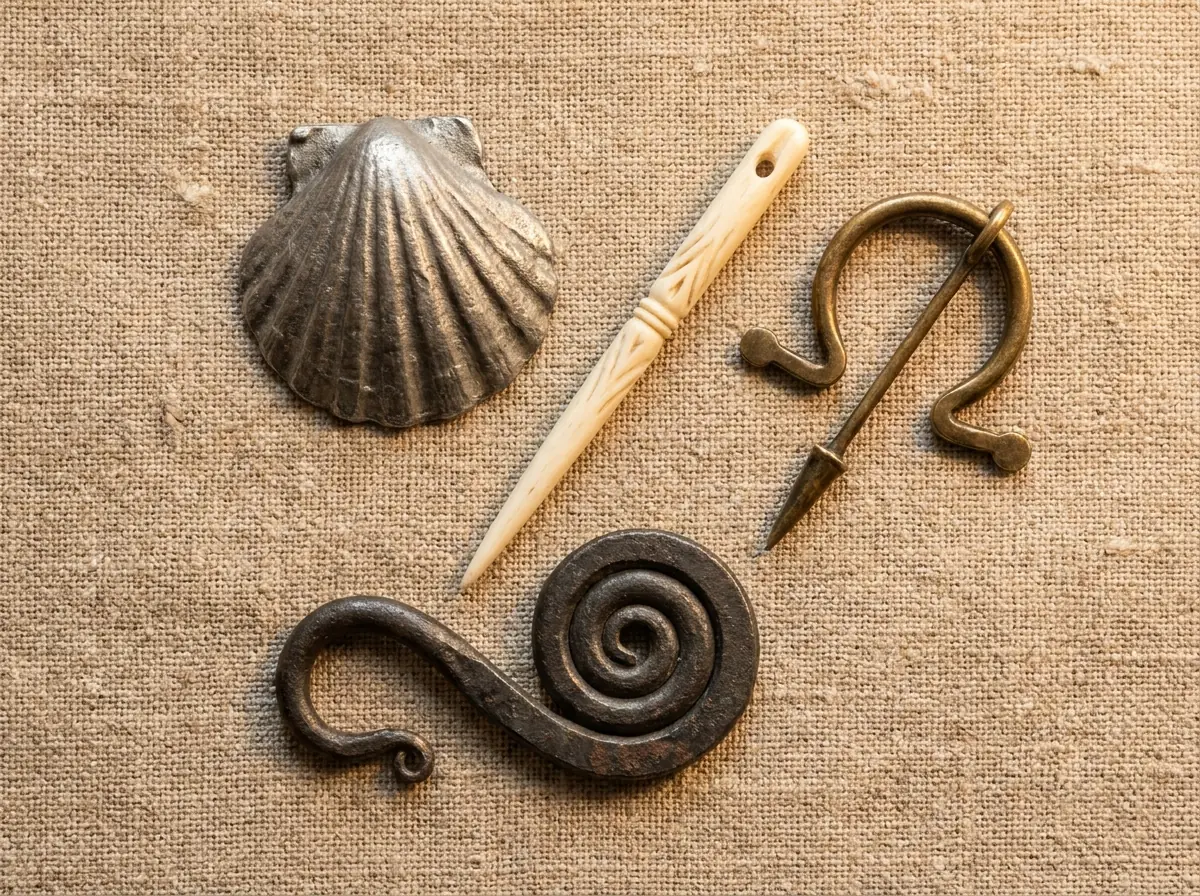
Whether pilgrim badges, brooches or calf-wrapping hooks – in a historical sense, pins are far more than mere jewellery: they signify affiliation, piety or social status, and are as much a part of an outfit as belts and shoes. This category brings together items to pin on for re-enactment, LARP and medieval markets – from handcrafted bone pins to silver-plated Hugin and Munin hooks.
 Ancient…–476
 Early Medieval500–1066
 High Medieval1050–1250
 Late Medieval1250–1500
 Market-Medieval / Larptimeless
What falls under the category of pins? An overview of the types

At first glance, brooches, pewter badges and calf-wrapping hooks seem to have little in common – yet the key factor is this: all are attached to or sewn into the garment. In doing so, they fulfil both a functional and a symbolic role.
A brooch (from the Latin fibula, meaning ‘clasp’) holds a cloak, outer garment or shirt together and was indispensable in both the Early and High Middle Ages. Pins and pilgrim badges were attached to hats, cloaks or bags and conveyed at a glance who someone was, what they believed in or which pilgrimage they had undertaken. Leg-wrap hooks, on the other hand, are a purely practical element of Viking-era costume: they are sewn onto the end of the leg wraps and hold the fabric securely in place on the leg.
In the shop, you will find these items in three subcategories: Medieval pewter badges, pilgrim badges and saint badges; medieval brooches, ring brooches and clasp brooches; as well as pin needles and hairpins. The range of materials extends from pewter and brass through to silver-plated brass and bone.
Pewter badges and pilgrim badges: history and significance
Pewter badges are among the most fascinating small finds from the Middle Ages. Their heyday was in the 14th and 15th centuries, although individual precursors are documented from earlier periods. Cast in simple moulds, they were affordable enough to be worn by ordinary people – and widespread enough to be considered a mass phenomenon.
The best-known group are the pilgrim badges: the scallop shell symbolised the Way of St James to Santiago de Compostela, St Christopher protected travellers on dangerous routes, and the Archangel Michael was regarded as the patron saint against evil. Anyone wearing such a badge on their hat or coat collar signalled that they had completed a pilgrimage – and enjoyed social prestige.
Alongside these were secular and chivalric tin badges: the Cross of the Knights Templar, jousting scenes featuring knights on horseback, or the Rose-en-Soleil motif, the house badge of Edward IV of England from around 1470. Professional symbols and heraldic emblems also appeared as badges.
A historically documented but often overlooked category in the modern context is that of erotic tin badges: running phalluses with bells, crowned vulvas on horseback with crossbows and flails. These objects were actually worn – presumably as apotropaic protective symbols, as symbols of fertility, or simply as a form of crude humour from the late Middle Ages. Originals of this kind regularly turn up in archaeological finds from the Netherlands and England. Anyone seeking to create a complete 14th- or 15th-century pilgrim’s ensemble should be familiar with this category.
Pewter badges were pinned through fabric with a small needle or pin and bent over at the back – not a permanent fastening, but a detachable one, which explains why so many originals have survived.
Fibulae, ring fibulae and brooches: the classic garment fastenings
The term ‘fibula’ is derived from the Latin fibula and simply means a clasp or fastener. In an archaeological context, it refers to any type of garment pin with a fastening mechanism. In the Middle Ages, this evolved into a wide range of forms.
The ring fibula is the simplest and most common form: a simple metal ring with a movable pin that is threaded through the fabric and hooked onto the ring. It was in use from the Early Middle Ages well into the Late Middle Ages and is ideal for fastening capes over the shoulder or at the neckline of a shirt. The disc fibula was flatter, often decorated, and could serve as a piece of jewellery. Finally, the brooch – also known as an agraffe – was more elaborately crafted and was typically worn at the neckline of outer garments, often featuring figurative or floral motifs.
Fibulae cover an extraordinarily long period: the historical record ranges from simple Viking-era ring fibulae of the 8th to 10th centuries to richly decorated late medieval agrafes of the 14th and 15th centuries. Different types are suitable for a Viking costume than for a High Medieval Crusader costume – the ‘Medieval Fibulae’ subcategory gives you a good overview of the available options.
Brooches by era and theme
Early Middle Ages & Vikings
Simple ring brooches made of brass or silver for fastening cloaks and outer garments. Also: Viking calf-wrap hooks with a Hugin & Munin motif in brass or silver-plated brass – unmistakably Nordic and to be sewn directly onto the end of the calf wrap.
High Middle Ages
Pilgrim badges become more common, with religious motifs dominating: scallop shells, St Christopher, and symbols of saints. Ring brooches remain in use, whilst the first more elaborate brooches begin to appear. Suitable for the medieval men’s attire of this period.
Late Middle Ages & LARP
Elaborate pewter badges featuring chivalric scenes (jousting, Knights Templar) and secular motifs (phallus, pelican, rose-en-soleil). For LARP, the following applies: the historical period is less strictly defined – the visual impression and the coherence of the overall look are what count. Medieval garment fastenings complete the picture.
Pewter badges vs. other pins: a comparison of materials
| Material | Typical use | Suitability | Care |
|---|---|---|---|
| Pewter | Pilgrim badges, insignia, devotional objects | Historical | Store in a dry place, polish gently with a cloth |
| Brass | Calf-wrap hooks, brooches, ring brooches | Historical | Treat occasionally with brass polish |
| Silver-plated brass | Decorative brooches, calf-wrap hooks (Hugin & Munin) | LARP | Do not scrub; use a soft cloth |
| Bone | Bone pins for needle binding, garment pins | Historical | Lightly oil, avoid moisture |
The complete costume: what goes where

The interplay of the various fastening elements only makes sense within the context of the complete costume. Here is a guide to what goes where:
Pewter badges are threaded through the fabric of a hat or coat collar using their pin or stud and bent slightly at the back. Multiple badges worn side by side are historically documented – pilgrims often carried a whole collection of badges from their completed pilgrimages. A pewter badge also looks good on a belt pouch or a bag.
Fibulae and brooches are worn as cloak fastenings over the shoulder or at the neckline of the outer garment. A ring fibula on the right shoulder secures the cloak without hindering the throwing arm. In depictions of women, the fibula is often worn centrally at the neckline.
Calf wrap hooks are sewn onto the end of the calf wrap. The set of two hooks (e.g. Hugin & Munin in brass) is used in pairs and ensures that the wraps do not come undone throughout the day. A neat execution of this small detail makes the difference between a well-thought-out Viking portrayal and an outfit that looks makeshift.
Bone pins are primarily used for needle binding – the historical technique for producing knitted fabrics prior to the invention of knitting – but can also be used as simple garment pins. Combined with a matching medieval or Viking belt, or complemented by medieval garment fasteners, they create a harmonious overall ensemble.
From the scallop shell on a pilgrim’s hat to the Hugin and Munin hooks on a calf wrap – choose the right piece for your character and pin it where it belongs. Browse through the subcategories or give us a call if you’re unsure about your choice.
Frequently asked questions
The term ‘fibula’ comes from the Latin ‘fibula’ and means a brooch or clasp. In the Middle Ages, it referred to garment fastenings with a locking mechanism – from the simple ring fibula to the elaborate brooch. Fibulae were used to fasten cloaks, outer garments or shirts, and were in use from the Early Middle Ages through to the Late Middle Ages.
These pins are called pewter badges or pilgrim badges. They were cast from pewter in the 14th and 15th centuries and featured religious motifs such as the scallop shell, Saint Christopher or the Archangel Michael. Pilgrims pinned them to their hats or cloak collars to document completed pilgrimages. Secular, chivalric and erotic motifs are also historically documented.
A ring brooch is the simplest form: a metal ring with a movable pin, ideal as a cloak fastener. A disc brooch is flatter and often richly decorated – it also served as a piece of jewellery. The agraffe (also known as a clasp) was more elaborately crafted, featuring figurative motifs, and was typically worn at the neckline of outer garments.
Calf-wrap hooks are a practical element of Viking-era costume. They are sewn onto the end of the calf wraps and prevent the fabric from coming loose during the day. Common designs include simple brass hooks or more elaborate sets featuring the Hugin & Munin motif (Odin’s ravens) in brass or silver-plated brass.
The word ‘brooch’ derives from the French ‘broche’ (skewer, pin) and originally referred to any kind of pin-style ornament. The term came into fashion in German-speaking regions, particularly in the 18th and 19th centuries. In a medieval context, it is more correct to refer to fibulae, brooches or garment pins. However, both terms refer to similar functional objects – jewellery with a pin mechanism for fastening to clothing.
Discover related categories
 Viking brooches
Medieval & Viking jewellery
Viking brooches
Medieval & Viking jewellery
 Medieval jewellery
 Medieval necklaces & pendants
 Medieval headwear
 Bags & belt pouches
Needle bindings
Bags & belt pouches
Needle bindings


