


Carnival costumes and fancy dress costumes


- Available
-
Delivery time: 2 - 3 working days* (US - int. shipments may differ)


- Available
-
Delivery time: 2 - 3 working days* (US - int. shipments may differ)


- Available
-
Delivery time: 2 - 3 working days* (US - int. shipments may differ)


Carnival and Fasching are synonymous with colourful costumes, a lively atmosphere and the fun of being someone else for a day – and few themes are as timelessly popular as the Middle Ages. Whether you’re a knight, a Viking, a damsel or a monk: a medieval costume works at any carnival party, any Fasching parade and even at a medieval festival. The Vehi Mercatus range covers the entire spectrum – from simple carnival costumes for beginners to full-length robes that will still have a place in your wardrobe even after the carnival season is over.
Which medieval characters make good carnival costumes?
The Middle Ages offer a huge selection of characters that make great carnival costumes. Here are the most popular ones – each available in women’s, men’s and children’s versions:
Knights & Crusaders
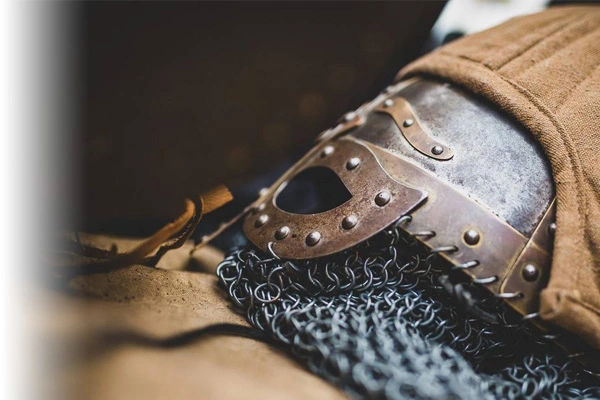
The knight is one of the best-known medieval figures. Typical features: chainmail-style armour, tabard and belt. For carnival, a medieval costume with a tunic and tabard is often sufficient – for re-enactment, it becomes significantly more elaborate.
Vikings & Viking women
Viking costumes are one of the most popular themes at carnival. Characteristic features: tunic, linen shirt, fur trim and striking accessories. Viking carnival costumes for men and women are available in many variations – from simple to elaborate.
Duchess, Witch & Elf
Classic female characters for carnival: the damsel in a dress with a bodice, the witch in a dark robe or the elf in flowing fabrics. Here you’ll find elf carnival costumes, witch carnival costumes and classic damsel looks.
Monk & Magician
Monk’s habit or magician’s cloak – both costumes are quick to put together yet still make a striking impression. The monk is a particularly beginner-friendly carnival costume, whilst the magician can be easily enhanced with accessories.
Pirate
Technically speaking, it’s the modern era, but stylistically closely related to medieval seafaring attire. Pirate fancy dress costumes for men and women are among the most consistently popular choices for carnival.
Medieval costumes for women, men and children
Typical outfits vary significantly depending on the occasion and personal taste. A brief overview of what women, men and children wear for Carnival:
- Duchess: long dress, bodice, veil or headband
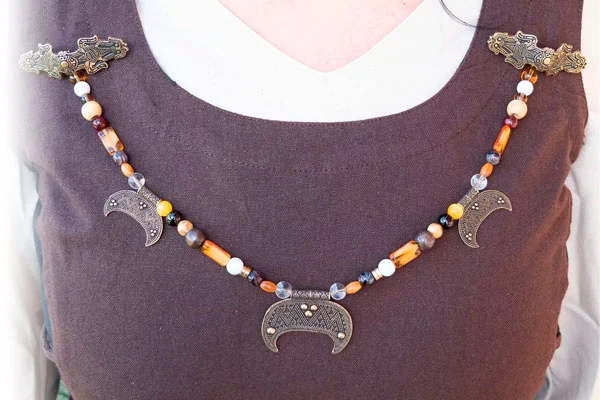
- Viking woman: over-dress, brooches, linen blouse
- Witch: dark robe, pointed hat, cape
- Elf: flowing fabrics, flower wreath, elf ears
- To go with it: medieval clothing for women, cape, medieval shoes
- Knight: tunic, tabard, belt, optional helmet
- Viking: tunic, linen trousers, fur trim, axe as a prop
- Monk: brown or grey habit with corded belt
- Mage: loose-fitting cloak, pointed hat, staff
- To go with it: Medieval clothing for men, belts, sturdy shoes
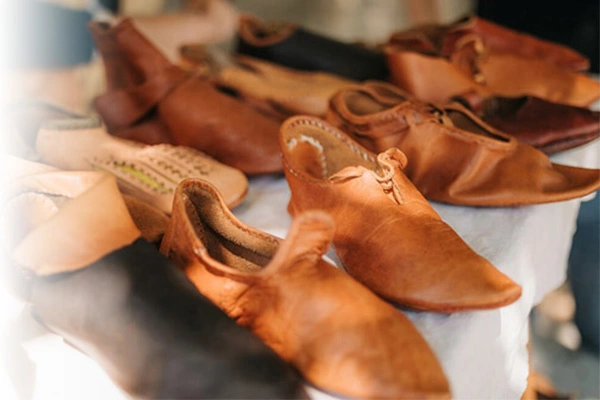
For children: simple, sturdy designs that allow freedom of movement. Medieval clothing for children is generally easy to care for and will survive the carnival parade unscathed. Matching medieval shoes and accessories complete the outfit.
Put together a simple medieval costume yourself
If you don’t want to buy a complete costume, you can put together a convincing medieval outfit yourself with just a few basic pieces. The advantage: the individual items can still be used after carnival – at medieval markets, at LARP events or in everyday life.
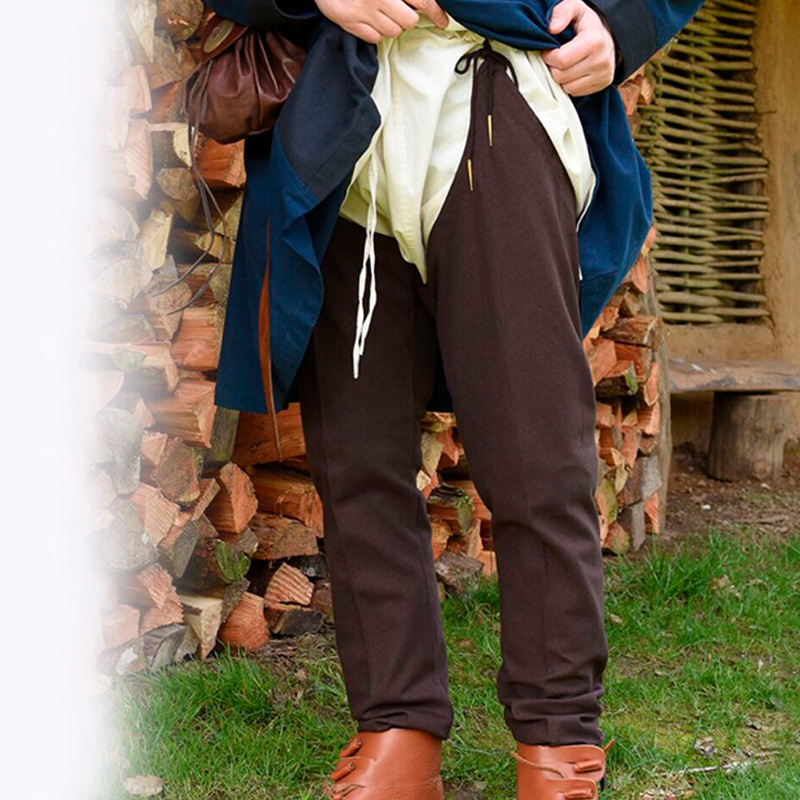
A simple medieval shirt or tunic combined with plain linen trousers or a long skirt already makes for a recognisable medieval costume. A wide leather belt completes the look – often, that’s all you need for a carnival party.
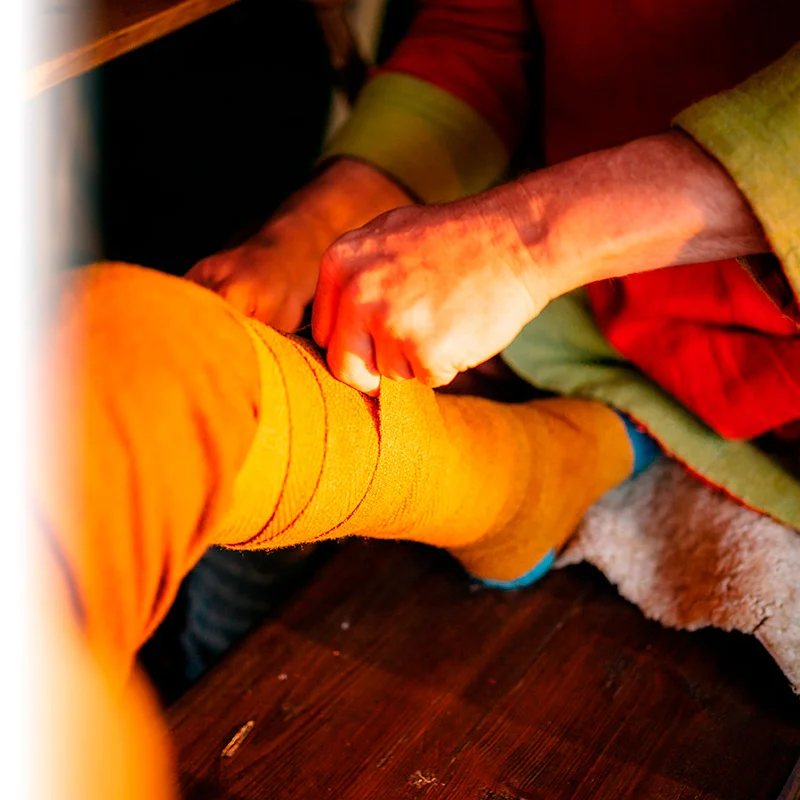
If you want to make a bigger impression, complement the basic outfit with a medieval cloak, a matching headdress and a belt pouch. For Viking outfits, add leg wraps and fibulae; for knights, a tabard. These items can be worn at markets just as easily as during Carnival.
If you’re planning a medieval market or LARP anyway, you can use the carnival costume as a starting point for the real thing. Higher-quality fabrics, suitable shoes and matching accessories turn the fancy dress into a proper outfit – one that can be reused year after year.
Tips for your medieval carnival costume
To ensure your outfit fits properly and you don’t encounter any nasty surprises at carnival, here are a few practical tips:
- Check the fit: Medieval cuts are often looser than modern clothing. Use the size charts in the shop and go by your bust and hip measurements.
- Consider the material: Natural fibres such as cotton, linen and wool fit better and are more skin-friendly than synthetic fibres – especially if you’re wearing the costume all day. Check the material details in the product description.
- Order in good time: Order volumes rise significantly in the run-up to Carnival – allow plenty of time for delivery, especially if there are several sizes to choose from.
- Plan your combination: Think in advance about which pieces you want to combine. A shirt from one category and a cape from another might go together perfectly – or they might not. If in doubt, take a look at the product images.
Fasching, Carnival or medieval festival – where do you wear the costume?

The beauty of a medieval costume is its versatility. Once purchased, it is suitable for numerous occasions:
- Carnival parties and parades: the classic occasion – a simpler outfit will do just fine here.
- School and nursery parties: Particularly popular with children, as medieval costumes are easily recognisable and safe.
- Medieval markets: Here, the costume is a must, or at least very welcome. If you want to play it safe, you’ll find over 500 events in German-speaking countries in the medieval market calendar.
- LARP events: Live-action role-playing games such as Conquest of Mythodea or the Drachenfest have their own costume requirements – consistency and quality are key here.
- Historical town festivals and re-enactments: Re-enactment events often have strict historical requirements regarding materials and cuts.
The difference between a carnival costume and a genuine historical garment lies primarily in the material, the precision of the cut and the level of craftsmanship. Carnival costumes are generally cheaper and designed for single use. Anyone who buys clothing made from natural fibres and carefully crafted by hand ends up with both: a carnival outfit and a historical garment that can also be worn at the next medieval market.
Which carnival costumes are problematic – and why the medieval theme is a safe choice

The social debate surrounding carnival costumes has intensified in recent years. Costumes that stereotypically portray living or historically marginalised groups are increasingly viewed critically – and rightly so. Particularly problematic are costumes that aim at cultural appropriation or caricature specific ethnic, religious or social groups.
Medieval costumes are a safe choice in this regard. They refer to a historical era and do not depict real, living groups. Knights, damsels, Vikings or monks – these are historical roles that are socially and culturally accepted. Anyone wearing a medieval costume at carnival is on safe ground: creative, respectful and appropriate for the festive occasion.
What was typical clothing in the Middle Ages – and what constitutes a costume?
Early Middle Ages
The basis of medieval clothing was the tunic – a simple T-shaped garment made of wool or linen, worn over trousers. This was complemented by leg wraps, simple leather shoes and a cloak. Viking clothing from this period is well documented archaeologically and differed little from the clothing of other Northern European peoples.
High Middle Ages
In the High Middle Ages, styles became more elaborate. The surcoat – a loose-fitting outer garment – came into fashion, as did the first button fastenings. The gugel (a hood-like head covering) and the cotehardie (a fitted garment) are typical items of this period. Re-enactors of this era pay close attention to historically documented materials and colours.
Late Middle Ages
The Late Middle Ages brought figure-hugging fashion, elaborate embroidery and the use of tassels (cords with metal tips). Carnival costumes often draw on elements of this era – simplified, made from cheaper materials and lacking the historical detail of genuine re-enactment attire.
What people call dressing up in medieval costume and fighting: In re-enactment, historical scenarios are recreated as faithfully as possible – using authentic materials, weapons and fighting techniques. In LARP (Live Action Role Playing), the focus is on the shared gaming experience; fantasy elements are also permitted here. Both fields rely on attire that goes far beyond the typical carnival costume – in terms of material, workmanship and historical accuracy.
Carnival costumes are often dominated by synthetic fibres such as polyester, as they are cheaper and easier to care for. Those who opt for natural fibres – cotton, linen, wool – however, get a costume that fits better, is more breathable and remains usable in the long term. Vehi Mercatus’s own brand deliberately avoids synthetics and relies exclusively on natural fibres.
Whether for a carnival parade, a carnival party or the next medieval market – with a medieval costume from the Vehi Mercatus range, you’ll be perfectly kitted out. Browse the subcategories now and put together your outfit.
Frequently Asked Questions
Appropriate attire is welcome at a medieval festival – it is usually only mandatory at re-enactment events. Typical outfits include a tunic with a belt and trousers for men, a dress with a bodice for women, and a cloak and matching shoes for both. If you’re attending for the first time, a simple basic outfit consisting of a shirt, trousers or skirt and a belt will go a long way. In the Vehi Mercatus Medieval Market Calendar, you’ll find over 500 events where you can try out your outfit.
The tunic was the basic garment of the Middle Ages – a simple, usually knee-length robe made of wool or linen, worn by men and women alike. Depending on social status and era, this was worn with a surcoat, cotehardie or tabard. Headwear such as hoods or bonnets, as well as simple leather shoes, completed the typical medieval outfit. Colours were derived from natural plant dyes and varied according to region and social status.
This is called re-enactment or medieval re-enactment. Historical scenarios are recreated as authentically as possible – with historically accurate clothing, weapons and fighting techniques. A related but distinct discipline is LARP (Live Action Role Playing), in which fantasy elements are permitted alongside historical ones. Both fields have their own requirements for costumes and equipment, which go far beyond the typical carnival costume.
There are no carnival costumes that are generally prohibited by law – however, costumes that stereotypically portray living or historically marginalised groups, or that aim at cultural appropriation, are increasingly viewed critically by society. These include, for example, stereotypical depictions of ethnic groups or religious minorities. Medieval costumes such as knights, Vikings or damsels, on the other hand, are uncontroversial: they refer to a historical era and do not depict real, living groups.
That depends on the quality of the costume. Simple carnival costumes made from synthetic fibres are often perceived as inappropriate at medieval markets and LARP events. However, if you specifically look for natural fibres, careful craftsmanship and historically accurate cuts, you’ll get an outfit that’s suitable for both – carnival and the market. At Vehi Mercatus, we offer clothing that’s deliberately made from cotton, linen and wool, meaning it has a place even after the carnival season.