Viking clothing for women - Early Middle Ages
Viking clothing for women combines early medieval styles from the 8th to the 11th century with natural materials such as wool and linen — and is now in equal demand for re-enactment, LARP and medieval markets. With over 180 items from brands such as Battle Merchant, Leonardo Carbone and Burgschneider, as well as our own range, this category covers the full spectrum: from simple entry-level options for your first market visit to historically accurate garments for authentic re-enactments. Prices range from €16.80 to €104.96.

What Viking women really wore: an overview of historical attire

Early medieval women’s clothing followed a clearly structured layering principle that is well documented archaeologically: a long-sleeved underdress (serk) made of thin linen worn directly against the skin, and over this a sleeveless strappy dress (hangerock) made of wool or coarser linen. The shoulders of the hangerock were fastened with two brooches — these were not jewellery, but a functional part of the attire. Without them, the strappy dress simply would not stay in place.
The textile finds from the trading centre of Haithabu (8th/9th century) are particularly revealing regarding cut and construction, with the numerous product names in the range serving as a reference. The finds attest to coarsely woven woollen fabrics for outer garments and finer linen for undergarments — a pattern that runs throughout the Scandinavian Viking Age. Depending on the wearer’s social status and wealth, the quality of the fabric, colour intensity and level of decoration varied considerably: woven trims on hems and sleeves, elaborate embroidery and carefully dyed wool characterised the clothing of wealthy women. The simple peasant woman dressed more functionally in natural linen or undyed wool — but no less dignified.
Fabrics and materials: a comparison of wool, linen and cotton
The choice of fabric not only determines the historical authenticity of your Viking attire — it also determines comfort, ease of care and suitability for different occasions.
| Material | Suitability | Properties |
|---|---|---|
| Wool | Re-enactment | Keeps you warm even when wet, breathable, historically well-documented — ideal for outer garments and cold seasons |
| Linen | Reenactment | Cooling and skin-friendly, historically accurate — the first choice for the serk (undergarment) |
| Cotton | LARP / Market | Easy-care, affordable, good colour fastness — ideal for beginners and suitable for frequent washing |
Wool and linen are clearly attested archaeologically for the Viking Age; cotton has established itself as a more affordable reconstruction option for LARP and market visits and is available in many well-designed cuts. Our own brand, Vehi Mercatus, relies exclusively on natural fibres — cotton, linen and wool — and deliberately avoids synthetics. The fabrics are manufactured in weaving mills to our own specifications; the trims, hems and straps that adorn many garments are also produced according to in-house patterns.
Quality levels at a glance: From medieval markets to re-enactment
Cotton dresses such as the Haithabu overdress — available in many colours (green, blue, brown, saffron) and sizes from S to XXL. Ready to wear, easy to care for and affordable. Ideal for a first visit to a market or occasional events where atmosphere and appearance are the main focus.
Linen or woollen dresses such as the Jodis strappy dress (wool, burgundy or autumn green) and the Frida strappy dress (100% uncombed cotton, sea blue and blue). Sturdier cut, more colour options, suitable for LARP. Battle Merchant and our own brand Vehi Mercatus are well represented here.
Wool or linen with embroidered trimmings on the hem and sleeves, historically accurate cuts. Brands such as Leonardo Carbone and Burgschneider set the standard in this segment. For groups and clubs that value historically accurate re-enactment.
The price range in the collection extends from €16.80 to €104.96, ensuring that both beginners and experienced re-enactors can find a suitable item. Battle Merchant (73 items), Leonardo Carbone (53) and Burgschneider (52), together with our own brand, cover the entire spectrum.
Complete your Viking outfit: matching accessories and fittings
A harmonious Viking dress outfit is created through the interplay of all its components. Viking brooches are not an optional extra — they are the functional fastening for the hanging skirt. In the range, you’ll find oval, animal-head and ring brooches in various designs, as well as medieval brooches in Viking style.
A Viking belt defines the silhouette and serves as a practical place to carry pouches and cutlery. Viking bags and belt pouches complement the look with authentic practicality. Viking shoes and Viking leg wraps form the basis of the footwear. Viking jewellery — bangles, necklaces, pendants and earrings — rounds off the overall look as a stylish addition. For colder seasons, Viking capes and coats provide warmth without compromising the historical look.
Colours of the Viking Age: More colourful than films suggest
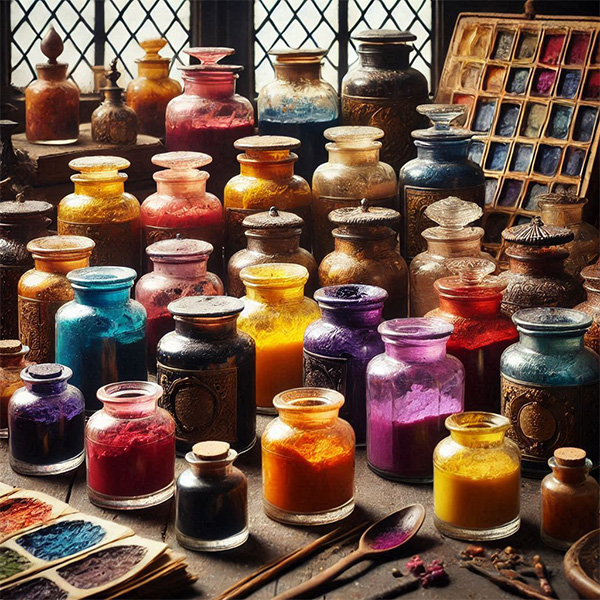
Early medieval Scandinavia was more colourful than films and TV series often suggest today — plant and animal dyes enabled a broad spectrum of colours, which Viking women made deliberate use of. Woad provided deep blue, madder a vibrant red, reseda a warm yellow and walnut shells an earthy brown. Genuine purple from purple snails was indeed expensive and a status symbol — but colour variety as such was not a privilege of the upper classes. Even ordinary households dyed their fabrics with locally available plants.
For re-enactment performances, natural, somewhat muted tones based on historical evidence are recommended; for LARP and medieval markets, colours may be stronger and more vibrant — this was entirely realistic historically. In our range, you will find garments ranging from natural to vividly dyed: green, blue, saffron, burgundy, brown and autumnal tones are among the most common colours.
Authentic vs. LARP-suitable: What distinguishes the two areas of use?
- Historically documented materials: wool and linen
- Source-based cuts based on archaeological findings
- Muted, natural shades
- Embroidered trimmings on hems and sleeves
- Woven trims based on historical models
- Greater flexibility in choice of materials and colours
- Focus on durability and ease of care
- Cotton as a practical and affordable option
- Strap dress can be combined with a gambeson as a protective layer
- Shieldmaiden outfits: dress plus armour pieces and Viking weapons
If you want to put together a combat-focused shield maiden outfit, combine the classic strappy dress with a gambeson underneath and armour pieces on top. In the armoury, you’ll find helmets, shields and axes for the Norse warrior.
Popular styles in the range: Haithabu, Jodis, Frida & Co.

The Haithabu over-dress is the best-selling model in the category: inspired by finds from the 8th and 9th centuries, made from coarse-woven cotton, available from approx. €25, in green, blue, brown and saffron, and in sizes S to XXL. It is suitable as a straightforward starter piece as well as a base for a more elaborate outfit.
The Jodis wool strappy dress (burgundy, autumn green, approx. €42) offers a more authentic strappy dress experience for LARP and re-enactment. The Frida strappy dress made from 100% uncombed cotton (sea blue, blue) is beginner-friendly and easy to care for. With Gudrun and Lagertha, further model names are represented in the range, covering different cuts and materials. In total, the category comprises 184 items — including 124 dresses, 52 over-dresses and 28 strappy dresses.
The Viking outfit, layer by layer: combining layers of clothing correctly
Serk — the underskirt
A long-sleeved linen dress forms the basis of the outfit. Thin fabric, floor-length, often in natural white or natural beige. Forms the visible base that peeks out from under the straps of the hangerock — and is available separately in the underdress subcategories.
Hangerock — the strappy dress
Sleeveless over-dress made of wool or coarse linen, fastened at the shoulders with oval brooches, animal-head brooches or disc brooches. Length and cut vary depending on the model and depiction — brooches are indispensable as a functional fastening.
Belt, coat & accessories
A leather belt defines the silhouette and serves as a place to carry pouches, knives and hygiene utensils. In cool weather, a woollen coat complements the outfit. Calf wraps and matching shoes complete the overall look.
Whether you’re planning your first medieval market, kitting out a LARP adventure or putting together a historically accurate early medieval re-enactment — choose your Viking dress based on material, cut and intended use, and combine it with brooches, belts and shoes to create a cohesive overall look. With 184 items, the range offers the perfect starting point for every requirement and budget.
Frequently asked questions
Viking women wore a two-piece garment system: a long-sleeved serk (undergarment) made of thin linen worn directly against the skin, and over this a sleeveless hangerock (strap dress) made of wool or coarser linen, fastened at the shoulders with two brooches. The outfit was complemented by a belt from which pouches, knives and hygiene items hung, as well as a woollen cloak in cooler weather. For special occasions, embroidery, woven trims and jewellery were added.
The typical two-layered Viking dress consists of the serk (also serkr), the long-sleeved linen undergarment, and the hangerock, the sleeveless woolen strappy dress. In the modern range, these pieces are often referred to as an over-dress, a strappy dress or simply a Viking dress — the model names Haithabu, Jodis or Frida frequently refer to archaeological sites or Nordic first names.
For historical re-enactment, wool and linen are the most authentic materials — both are clearly attested archaeologically for the Viking Age. Wool is particularly suitable for outer dresses and coats, whilst linen is the first choice for the underdress (serk). Cotton is not historically documented for the Viking Age, but has established itself as a more affordable reconstruction option for LARP and market visits.
A simple starter outfit with a cotton dress is available from around €25. If you also buy shoes, a belt, brooches and a bag, you can expect to pay around €100–200 for a complete market outfit. For an authentic re-enactment outfit made of wool and linen with embroidered decorations, you should budget for several hundred euros — this is an investment in pieces that will last for many years.
Wool dresses should be washed as cold and gently as possible — hand washing or a wool cycle at 30°C prevents shrinkage. Do not spin dry; instead, gently squeeze out the water and lay flat to dry. Linen dresses can withstand slightly higher temperatures (up to 40°C), but they do tend to crease — this can be easily smoothed out by ironing whilst slightly damp. Neither material should be put in the tumble dryer.
Discover related categories
 Viking clothing for men
 Viking dresses for women
Viking helmets
Viking dresses for women
Viking helmets
 Viking axes
 Viking necklaces & pendants
 Viking outfits
Viking hygiene cutlery
Viking outfits
Viking hygiene cutlery
 Viking shields & bucklers