Early medieval knife
In the Early Middle Ages, the knife was not merely a tool – it was a constant companion, a status symbol and, in the case of the Sax, a formidable weapon. If you want to create an authentic Early Medieval re-enactment or Viking costume, you’ll find an overview here of types, materials and ways of carrying knives, which will help you make your choice.
What is a sax – and what defines the Viking knife?
The term ‘sax’ derives from the Old High German and Old Norse words for ‘knife’ or ‘short sword’. In early medieval usage, it referred to a wide range of single-edged blades – from a handy utility knife to an almost sword-like cutting weapon. A well-known variant is the scramasax (also spelled scramasax or seax), which was particularly widespread in the Frankish and Anglo-Saxon regions.
It is important to understand that not every Viking knife is automatically a sax. Small utility knives with a blade length of 10–15 cm were used for everyday tasks – eating, carving, and simple handicrafts. The long sax, on the other hand, could have blade lengths of up to 60 cm and was regarded as a fully-fledged weapon, comparable to a short sword. Between these two extremes lie medium-sized belt knives, which are documented as typical everyday knives of the Viking Age.
The sax was by no means a purely Scandinavian phenomenon: archaeological evidence attests to its use by the Germanic tribes, the Franks, the Anglo-Saxons and many other peoples from the Migration Period right through to the High Middle Ages. The finds are correspondingly diverse – ranging from plain iron blades from simple warrior graves to richly decorated examples from princely tombs.
Types at a glance: From the neck knife to the long sax
Small utility knife & neck knife
The neck knife was worn around the neck on a cord or leather strap. It was the most common of all knives – used for eating, carving and simple tasks. Popular with beginners and for bringing camps to life.
Medium belt knife
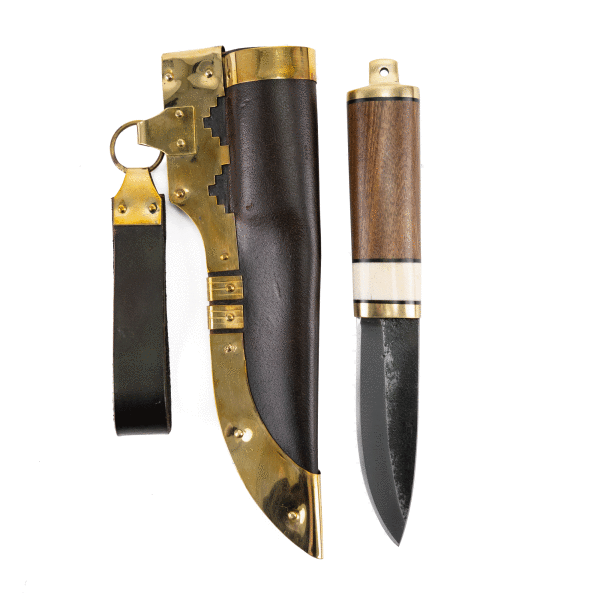
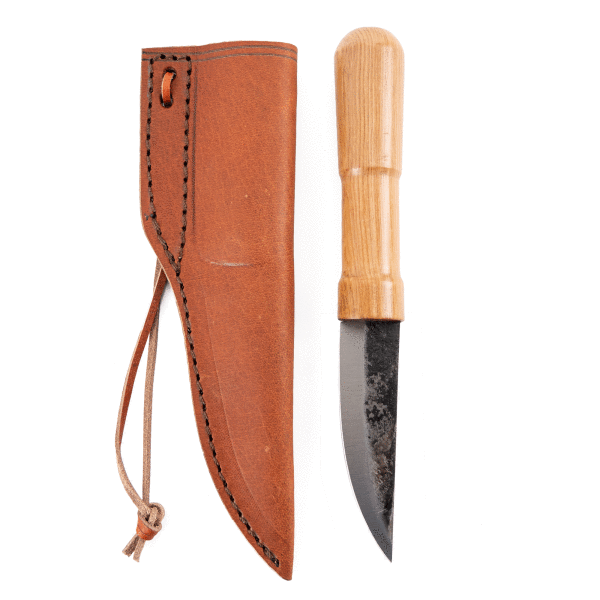
The typical Viking everyday knife. Comfortable to hold, versatile and worn on a belt. Most hand-forged models with wooden or bone handles and leather sheaths fall into this category.
Short & long sax
The short sax (scramasax) served as both a combat and utility knife. The long sax resembled a short sword and was a formidable weapon. For high-quality re-enactments or as a collector’s item.
A special variant is the pocket knife with a folding mechanism – sporadically attested archaeologically and an interesting curiosity for collectors from early medieval knife culture.
Materials: Blade, handle and sheath in historical comparison
| Material | Suitability | Special feature |
|---|---|---|
| Carbon steel | Historically accurate | Keeps its edge well, oxidises when exposed to moisture – must be oiled after use. Finds from Haithabu and Birka show similar alloys. |
| Stainless steel | LARP / Beginners | Easy to maintain, oxidation-resistant, less authentic. Good for beginners or long-term use without extensive maintenance. |
| Damascus steel | Premium / Collectors | Multi-layered blades (often 256 layers), visible pattern, functional and decorative. Sensitive to acids and moisture. |
| Wooden handle (walnut, ash) | Historically documented | Walnut for a warm appearance, ash for robustness. Both have been archaeologically documented on numerous occasions. |
| Bone / Bone | Historically documented | A typical handle material from the Viking Age. Often combined with wood or brass fittings for stability. |
| Leather sheath with brass fittings | Variant found | Attested by finds from Haithabu: leather scabbards with brass fittings and a mouthplate as the typical carrying style. |
How was the sax carried? Carrying methods and scabbard types
The carrying methods of the sax are well documented archaeologically and varied depending on the blade length. Small and medium-sized utility knives were carried horizontally on the belt – with the cutting edge facing upwards. This carrying method is clearly documented by grave finds from Haithabu, Birka and other Scandinavian and Frankish sites: the position of the scabbard fastenings shows that the knife lay across the front of the abdomen or on the hip.
Longer saxes were carried vertically on the left side, similar to a short sword, and hung from loops or straps on the belt. The neck knife hung from a cord or a narrow leather strap around the neck – a simple and practical method of carrying, which is particularly attested for small blades.
Regarding the sheath: Historical sheaths were made almost exclusively of leather, often moulded around a wooden core and sewn at the edges. Brass or bronze fittings at the mouth (mouthplate) protected the leather when the blade was sheathed. The interplay between knife, sheath and belt was no coincidence – it was a well-thought-out system that combined comfort and quick access.
Price ranges: entry-level, mid-range and hand-forged highlights
Simple hand-forged knives made of stainless steel or carbon steel with a twisted handle – some include a simple leather sheath. Well suited for first-time reenactments and beginners who do not yet wish to invest a large budget. Examples: forged Early Medieval or Viking knives with leather sheaths from approx. €21, neck knives from approx. €15.
Hand-forged carbon steel blades with wooden or bone handles and leather sheaths – the centrepiece of this category. These knives are sharp, robust and ideally suited for active re-enactment and market demonstrations. Examples: Gotland Viking knife with leather sheath, Viking knife with bone handle, Viking pocket knife made of carbon steel with bone handle.
Handcrafted Damascus steel knives with multi-layered blades (up to 256 layers), intricate wood-and-bone combination handles and decorated leather sheaths. Some feature raven or knot motifs. Collectors’ items and the right choice for demanding reenactments. Examples: Viking knives made of Damascus steel with wood/bone handles from approx. €117, version with knot pattern up to approx. €168.
Care and handling of early medieval knives
Carbon steel is historically the most authentic choice – but it requires care. After each use, you should carefully wipe the blade dry and rub it lightly with weapon oil or a neutral cooking oil. Never put it in the dishwasher! Moisture and acids (e.g. from food) significantly accelerate oxidation.
Damascus steel is even more sensitive in this regard: the multitude of layers and the characteristic surface structure react quickly to moisture and fingerprints. The blade should be wiped down and oiled after every time it is handled. The beauty of the pattern can be preserved by occasional light polishing.
The leather sheath also requires attention: regular rubbing with leather grease keeps the leather supple and prevents cracking. Dry, brittle leather breaks more easily and offers poorer protection for the blade. A small cloth is sufficient for applying leather grease – apply sparingly and allow it to soak in.
Sharpening: A simple whetstone is the historically correct and practical method. Carbon steel blades sharpen well and retain a fine edge. If the blade is not to be used for a prolonged period, it is best to lightly oil it and store it in a dry place – not in the sheath if the leather is damp.
Authenticity vs. practicality: What suits your purpose?
- Carbon steel for maximum historical accuracy
- Wooden or bone handle based on archaeological models
- Leather scabbard with brass fittings as a replica of an archaeological find
- Sharply ground blade, ready for use
- Suitable for men’s Viking clothing or Germanic attire
- Stainless steel: oxidation-resistant, low maintenance
- Well suited for kitchen and camp use
- Durable even without regular oiling
- Can be combined with LARP costumes and stage performances
- Also available: accessories for medieval knives such as whetstones and care oils
If you wish to incorporate your knife into a cohesive overall look, you will find further suitable items in the Germanic Knives and Medieval Knives sections. For longer saxes, it is also worth taking a look at Viking Saxes as a separate subcategory.
Whether you’re looking for a simple throat knife for your first Viking re-enactment or a hand-forged Damascus steel sax for your discerning re-enactment collection – in this category you’ll find suitable items for every need and every budget. Take your time to browse or give us a call if you need a personal recommendation.
Frequently asked questions
The term ‘sax’ derives from the Old High German and Old Norse words for ‘knife’ or ‘short sword’. In the early Middle Ages, it referred to a wide range of single-edged blades – from small utility knives to long saxes with blade lengths of up to 60 cm, which were considered fully-fledged weapons. The Scramasax is a particularly well-known variant that was widespread mainly in the Frankish and Anglo-Saxon regions.
Vikings usually carried one or more knives on their belt or around their neck. The most common was a medium-sized utility knife with a blade length of 15–25 cm, made of iron steel with a wooden or bone handle and a leather sheath. In addition, neck knives (small knives on a cord) and, in a military context, longer saxes are archaeologically attested – including finds from Haithabu and the Scandinavian burial grounds of Birka.
Small and medium-sized saxes were usually carried horizontally on the belt, with the blade facing upwards – this method of carrying is clearly evidenced by the position of the scabbard and belt fastenings in grave finds. Longer saxes hung vertically on the left side, similar to a short sword. Neck knives were worn around the neck on a cord or leather strap.
Carbon steel is much closer to historical reality, as early medieval smiths worked with iron and carbon alloys that modern stainless steel does not replicate. Carbon steel blades rust in damp conditions and must be oiled regularly. Stainless steel is easier to maintain and resistant to oxidation, but less suitable for demanding re-enactments.
Simple hand-forged knives with leather sheaths are available from around €15–22, such as neck knives or simple early medieval knives with twisted handles. For hand-forged carbon steel blades with wooden or bone handles and leather sheaths, the price typically ranges between €30 and €60. High-quality Damascus steel versions with multi-layered blades and decorated handles start at around €100–120.