
Medieval glasses
Glasses are a medieval invention – and with these late medieval wooden frames, you can bring this history to life as part of your own outfit. Whether for re-enactments of the 14th to 16th centuries or as an authentic detail for LARP: here you’ll find handcrafted replicas based on historical finds, which add an often-overlooked but historically documented accessory to your costume.
The invention of spectacles in the Middle Ages: from riveted spectacles to wooden frames
The first riveted spectacles
In northern Italy – probably in Pisa or Venice – the first binocular visual aids were created: two lenses connected by a rivet. These so-called rivet spectacles were held in front of the eyes or balanced on the nose; there were no temples yet. Incidentally, the name ‘spectacles’ is derived from the semi-precious stone beryl, from which early lenses were cut.
Oldest pictorial representation
A fresco is painted in the Monastery of San Niccolò in Treviso, depicting Saint Cardinal Hugh of Provence wearing rivet spectacles – the oldest known pictorial record of this visual aid. It demonstrates that spectacles were already widespread among the learned classes by the mid-14th century.
From rivets to springs
The design of spectacles continues to evolve: alongside riveted frames, so-called spring spectacles emerge, in which a curved spring holds the two halves of the frame together and generates a certain amount of clamping pressure. The frames are made of wood, horn or bone, the lenses of ground glass or rock crystal.
More stable saddle-bridge constructions
In the late Middle Ages and early modern period, frames became technically more sophisticated: saddle-bridge constructions improved the fit on the nose, and workmanship became more precise. Wood – particularly cherry wood – became the preferred material. The replicas in our range cover this period.
What did spectacles look like in the Middle Ages? Designs and materials
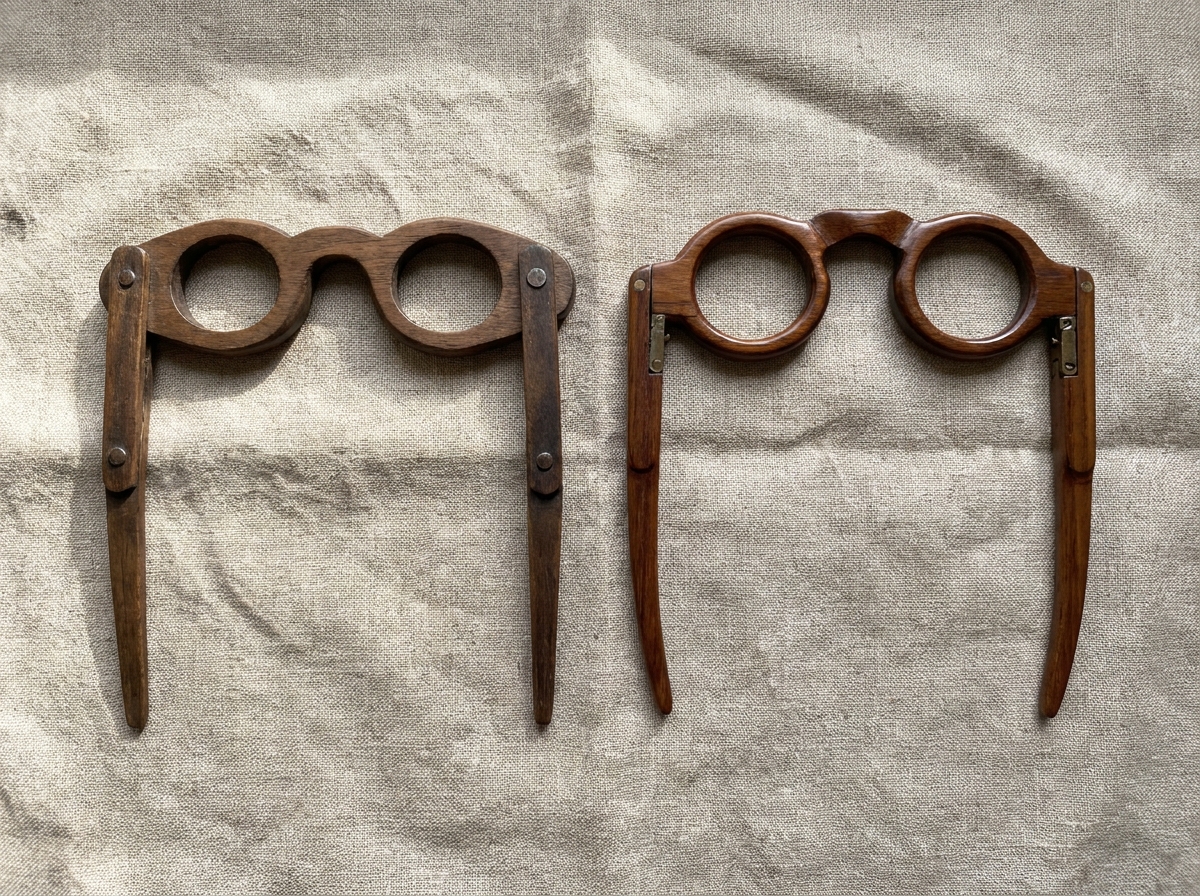
The classic medieval spectacle consists of two round frames connected by a central rivet or spring – hence the terms ‘rivet spectacles’ and ‘spring spectacles’. Temples or ear hooks, as we know them today, did not exist: the spectacles were either held in front of the eyes or balanced on the bridge of the nose, which limited their use to quiet reading and writing situations.
Various hardwoods were used as materials – cherry wood was particularly common – as well as horn and bone. The lenses were made from cut glass or rock crystal. In the early stages, these were almost exclusively convex lenses for long-sighted people; corrective lenses for short-sighted people only appeared later. So anyone wearing spectacles in the Middle Ages was generally reliant on a reading aid – a good indication of the wearer’s social status.
Historical models: The spectacle frames and their original finds
Bergen op Zoom
One of the best-known archaeological sites for medieval spectacle frames. The find from Bergen op Zoom served as a direct model for several replicas in the Late Medieval range and illustrates the typical arched shape of early wooden frames.
Freiburg im Breisgau
Further original finds from Northern European urban excavations, including Freiburg im Breisgau, attest to the prevalence of medieval spectacles in German-speaking regions. The finds reveal differences in bridge shape and frame design compared to the Dutch pieces.
Northern European urban excavations
Later finds from various Northern European urban excavations demonstrate the development towards more robust saddle-bridge constructions. The replicas in the range cover this period with four different models and adhere as closely as possible to the dimensions of the original finds.
The perfect overall look: how to incorporate the glasses effectively
The spectacles are suitable for depictions of the late Middle Ages, i.e. roughly 1350 to 1520. Historically documented wearers included merchants, monks, doctors, scribes and scholars – in other words, professional groups who read or wrote a great deal. For LARP characters, the spectacles are therefore suitable for bourgeois, clerical or magical figures who embody education or scholarship.
For a cohesive overall look, we recommend belt pouches and bags for writing implements, a medieval knife on the belt, as well as hygiene cutlery or combs. Medieval accessories such as pewter badges or fibulae also round off the look. You can find the blog article “Medieval Accessories: These 10 Details Complete Your Outfit” in the Medieval Knowledge section of the shop.
A suitable base outfit consists of a medieval shirt, a doublet and appropriate headwear – a hood for a monk, a simple cap for a merchant. The spectacles fit into this overall look as the final detail and take the portrayal to another level.
The spectacle frames from the Vehi Mercatus range: what you get

The range features four models made from cherry wood, crafted as replicas based on historical finds from the 14th to 16th centuries. Each model is based on a different archaeological prototype and differs in bridge shape, frame width and overall proportions – a distinction that can be relevant for re-enactment if you wish to depict a specific era or region.
All four frames are manufactured under our own brand, Vehi Mercatus, with product design and pattern creation carried out in-house. The price is a standard €37, making these replicas accessible to both beginners and experienced re-enactors. The frames are supplied without lenses – see below for more on glazing.
Who wore spectacles in the Middle Ages? Social and historical context

Glasses were expensive and rare in the Middle Ages. Cut glass and the craftsmanship involved in making the frames made them a luxury item that only certain social classes could afford. Typical wearers were scholars, monks, scribes and merchants – in other words, professional groups with a high need for reading and a corresponding income.
Iconographic tradition often depicts saints and Church Fathers wearing spectacles – not necessarily because they were all long-sighted, but because spectacles were regarded as a symbol of learning and wisdom. Anyone depicted wearing spectacles in the visual arts was a man of letters. This is an important point for re-enactments: spectacles are not a general accessory, but a specific character trait for bourgeois, clerical or scholarly figures of the late Middle Ages.
Medieval glasses with prescription lenses: How the lenses work
- Frames are open-backed and can be fitted with modern lenses by an optician
- Round frames require the lenses to be cut to a circular shape – it is recommended to check with the optician in advance, as not everyone is familiar with this
- Lightly tinted lenses are also available for a historical look
- Combination of historical look and modern vision correction ideal for active performers
- Frames can also be worn entirely without lenses
- Historically authentic: many original finds have also been preserved without lenses
- Clear lenses are also available as a purely decorative option
- No need to visit an optician – ready to use immediately after purchase
Choose your perfect wooden spectacle frame directly from our range and add the final authentic detail to your late medieval costume. If you have any questions regarding lenses or historical accuracy, the team in Rinchnach or our telephone support will be happy to assist you.
Frequently asked questions
Riveted spectacles were invented between 1285 and 1289 in northern Italy, probably in Pisa or Venice. They consisted of two lenses connected by a central rivet and had to be held in front of the eyes, as there were no temples at that time. The oldest known pictorial representation of such spectacles dates from 1352 and is located in the Monastery of San Niccolò in Treviso.
Medieval spectacles consisted of two round frames made of wood, horn or bone, connected by a rivet or a spring. There were no temples – the spectacles were either held in front of the eyes or balanced on the bridge of the nose. The lenses were made of ground glass or rock crystal, mostly as convex lenses for long-sighted people.
The early form of spectacles was known as rivet spectacles or spring spectacles, depending on their construction. The term ‘spectacles’ itself is derived from the semi-precious stone beryl, from which the first lenses were cut. The term ‘spectacles’ first appeared in writing in the 16th century, whilst the design itself had already been in existence for over two centuries.
Yes, the frames in our range are designed so that an optician can fit them with modern lenses. As the frames are round, the optician must cut the lenses to a circular shape – not every optician’s workshop is familiar with this, so it is advisable to enquire in advance. Those who do not require corrective lenses can also wear the frames without lenses, which is historically authentic as well.
In the Middle Ages, spectacles were a luxury item and were worn primarily by scholars, monks, scribes and merchants – professional groups with a high need for reading and the corresponding financial means. In iconographic tradition, spectacles stand as a symbol of scholarship. For re-enactment portrayals, spectacles are therefore particularly suitable for bourgeois, clerical or scholarly characters of the Late Middle Ages (c. 1350–1520).
Discover related categories
 Canteens & pilgrim flasks
 Pins & hairpins
Medieval accessories
Pins & hairpins
Medieval accessories
 Wool socks made from sheep’s wool
 Pewter & pilgrim badges
Gown clasps
Pewter & pilgrim badges
Gown clasps
 Brooches & ring brooches
Cutlery sets
Brooches & ring brooches
Cutlery sets


