



Germanic belts


- Item out of stock


- Item out of stock
Germanic belts were far more than just a practical item of clothing – they signified rank, tribal affiliation and craftsmanship. Whether a simple leather strap with an iron ring or a richly studded replica based on archaeological finds: here you’ll find a selection suitable for Germanic attire, re-enactment and LARP alike.
What defines a Germanic belt? Historical background

Belts were part of the basic kit for almost everyone among the Germanic peoples – men and women alike. They served a threefold purpose: they held tunics and trousers together, acted as a means of carrying knives, pouches and tools, and signalled the social status of the wearer. This pattern runs throughout the entire period from the Iron Age deep into the Migration Period (c. 100–500 AD).
Archaeological finds paint a clear picture: simple leather straps with iron buckles or iron rings dominate everyday finds, whilst warrior elites were buried with elaborately decorated belts. The fittings were mostly made of bronze or brass, occasionally of silver – depending on the region and the wealth of the deceased. Particularly telling are grave finds from the North Germanic and East Germanic regions, which demonstrate how strongly belt ornamentation functioned as a mark of rank.
Materials and workmanship: leather, iron and brass
| Material | Characteristics | Typical use |
|---|---|---|
| Full-grain cowhide | Historically documented | Straps, belt base |
| Iron ring / iron buckle | Historically documented | Fastening without a pin – robust, simple |
| Brass (fittings, buckles) | Historically documented | Decorative rivets, buckles, strap ends |
| Embossed surface (knot pattern) | Suitable for LARP | Decorative design, Celtic-Germanic cultural sphere |
Full-grain, vegetable-tanned cowhide leather is the core material for both historical and modern replicas: it is stiff enough to bear weight and develops a characteristic patina over time. The iron ring fastening is one of the oldest and best-documented methods – the free end of the strap is threaded through the ring and hangs down at the side or front. This technique requires no punching and is therefore particularly durable. For care, we recommend a good leather grease or beeswax paste, applied after every intensive use and before prolonged storage.
The right belt for your Germanic outfit
The long belt with iron ring in 160 cm is the ideal starting point: simple, historically plausible, available in brown, black, green and red. It goes well with a simple Germanic tunic and trousers without any further accessories and is also suitable for children and teenagers.
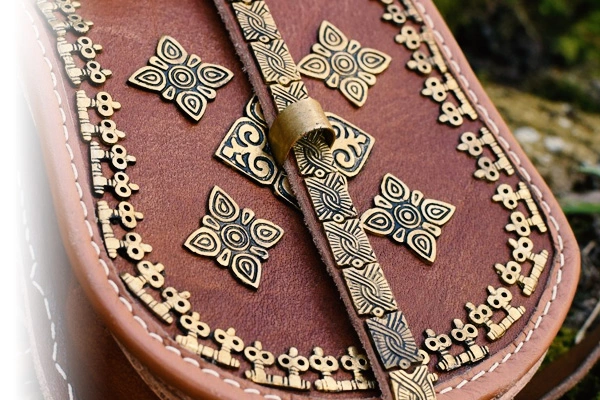
The long belt with a Celtic knot pattern offers greater detail: the embossed surface and iron ring fastening make it an eye-catcher at the medieval market. Available in 160 cm and 190 cm – the longer version allows the end to hang down decoratively.
The Sutton Hoo belt is aimed at discerning re-enactors: meticulously detailed brass fittings modelled on the princely grave find from Sutton Hoo, crafted with great attention to detail. Suitable both as a collector’s item and for high-quality re-enactments.
All three versions can be easily combined with matching Germanic bags, Germanic shoes and Germanic knives from the Germanic Shop.
Germanic belt fittings: From the excavation site to the replica

Belt fittings are particularly valuable finds for archaeologists because they are preserved in the ground, whilst the leather often rots away. Two archaeological sites have significantly shaped our understanding of Germanic belt styles: the Thorsberg Moor in Denmark, which yielded exceptionally well-preserved grave goods from the 2nd–4th centuries, and the Anglo-Saxon Sutton Hoo in England, a princely ship burial from the early 7th century containing one of the richest collections of belt fittings in Northern Europe.
The fittings recovered there display motifs typical of the Germanic cultural sphere: animal ornamentation (entwined animals, bird heads), interlacing and geometric patterns. These ornaments are not merely decorative – they conveyed symbolic meaning and identified the wearer as a member of a specific social group. Replicas such as the Sutton Hoo belt, with its detailed brass fittings, draw on these models and enable an authentic historical representation that goes far beyond simple costume.
An overview of types of Germanic belts
Long belt with iron ring
The most common type in this category: the strap is threaded through the ring, with the end hanging freely. No hole system, no pin – robust and quick to fasten. Historically documented for broad sections of the population; narrow width for everyday use.
Belt with knotted pattern embossing
The embossed surface with knotwork motifs draws on designs that were widespread in the Celtic-Germanic cultural sphere. Iron ring fastening, enhanced decorative effect. Suitable for market and encampment reenactments from intermediate skill level upwards.
Replicas with extensive fittings
The Sutton Hoo belt represents high-end craftsmanship: brass fittings based on archaeological models, wider leather strap. Width and the abundance of fittings were historically indicators of the wearer’s status and wealth.
Germanic belts in re-enactment and at medieval markets

The belt length determines how it can be worn: a 160 cm belt is suitable for slim to average body sizes and sits snugly over the tunic. The 190 cm belt is the right choice for larger waist sizes or if the free end is to hang down decoratively – a style of wearing that is frequently documented in illustrations and grave finds.
Historically, the belt was used as a central carrier: leather pouches and bags were attached to it, as was the knife in its sheath. Anyone wishing to use their belt for carrying accessories will find suitable belt holders for knives, drinking horns and more in the range.
There are no strict historical guidelines regarding colour choice – brown and black are the most common colours and suit almost any depiction. Green and red are less common, but can be useful for specific scenarios or to coordinate colours with Germanic clothing. Those planning a complete outfit will find matching components in the Germanic Shop – from tunics and trousers to shoes and jewellery.
For the medieval market, the following applies: a belt with an iron ring can withstand even intensive, continuous use. The seamless construction prevents tearing, which is common with cheaper riveted belts. If you wear your belt regularly, it is best to treat it after every market with a suitable leather care product – this significantly extends its lifespan and maintains the suppleness of the leather.
Whether you’re looking for your first Germanic belt or a detailed replica for serious re-enactment – browse through the selection and find the belt that suits your portrayal.
Frequently asked questions
Typical of Germanic belts is a leather strap made from vegetable-tanned cowhide with an iron ring as a fastening. The free end is threaded through the ring and hangs down – a technique without perforations that is very well documented historically. More elaborate versions featured additional fittings and decorative rivets made of brass or bronze.
A 160 cm belt suits slim to average body types and sits snugly over the tunic. If you have a larger waist circumference or wish to let the end hang down decoratively, it is better to choose the 190 cm version. With an iron ring fastening, the exact length matters less than with belts featuring holes – you can choose the position freely.
The long belt with an iron ring is simple and historically documented for broad sections of the population – ideal for beginners or simple re-enactments. The belt with a knotted pattern features additional decorative detailing typical of the Celtic-Germanic cultural sphere and is well-suited for market and camp re-enactments requiring a little more detail.
The Sutton Hoo belt is based on finds from the Anglo-Saxon ship burial of the same name in England (early 7th century), one of the most significant burial finds in Northern Europe. The original featured elaborate brass fittings with animal ornamentation and interlacing. The replica is aimed at re-enactors seeking to portray a high-ranking warrior or prince, as well as collectors of historical replicas.
It is best to treat your leather belt with a good leather grease or beeswax paste after intensive use or before prolonged storage. This keeps the leather supple and prevents it from tearing easily. Heavy soiling can be removed with a damp cloth – always re-grease afterwards. Avoid direct sunlight and prolonged exposure to moisture.