



High Middle Ages shoes


Footwear in the High Middle Ages: What archaeology tells us
 The High Middle Ages – roughly the 11th to 13th centuries – mark an important phase of development in the history of European footwear. Archaeological finds show the transition from simple, shapeless boot-style shoes to more clearly defined leather shoes with a recognisable foot structure. The most important sources for re-enactors are the London leather finds at the Museum of London, as well as Scandinavian archaeological sites such as Jorvik (York), which provide an exceptionally high concentration of well-preserved medieval shoes.
Technically, the High Middle Ages were dominated by the so-called turned shoe technique and simple stitched constructions. The upper leather was sewn together inside out and then turned – the result is a smooth, seam-free surface on the outside. The materials used were predominantly cowhide and calfskin; for higher-quality versions, goatskin or the coveted Cordovan leather was used, which takes its name from the Moorish city of Córdoba and was regarded as a mark of quality in the Middle Ages. These findings form the technical basis for the replicas worn in re-enactments today.
Which shoes for which occasion: re-enactment, market and everyday life
Children’s versions of the London style (from size 26) and simple nailed leather soles for adults. Ideal for a first visit to a medieval market or as an addition to a family outfit. The simple nailed sole offers solid grip without breaking the bank.
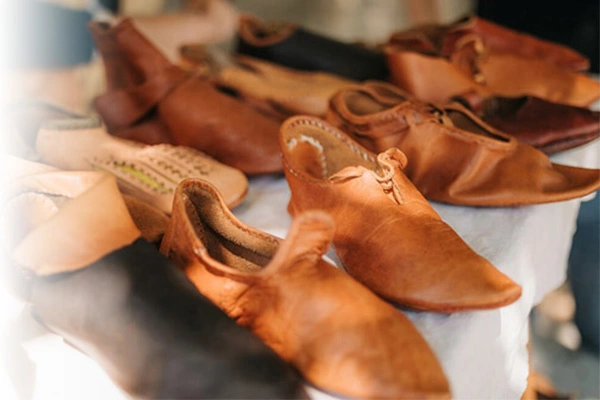
Medieval London-style shoes with a simple nailed sole in natural brown or cordovan red – the most popular entry-level choice for historical footwear. Comfortable for extended wear, robust enough for uneven terrain and changeable market weather.
Nailed double sole for frequent use and demanding costumes. The additional layer of leather protects against moisture and significantly extends the lifespan – recommended for anyone who regularly attends events. It’s also worth taking a look at the Medieval Boots category for higher leg coverage.
Colours and finishes: natural brown, dark brown and cordovan red
| Colour | Character | Historical classification |
|---|---|---|
| Natural brown | Introduction | Undyed and ungreased – reveals the raw character of the leather. Changes with care and use, developing a unique patina. Suitable for simple styles and rustic attire. |
| Dark brown | Market | Hand-dyed for an antique look – the dyeing is carried out in-house in Rinchnach. Gives a worn and matured appearance, without compromising historical accuracy. |
| Cordovan Red | Historical | Historically documented as being worn by the upper classes and nobility. Corduan leather, made from goatskin, was a mark of quality in the Middle Ages and was regarded as a status symbol. In the High Middle Ages, wealthy citizens and nobles wore red or dyed footwear as a visible sign of their status. |
The choice of colour is therefore not merely a matter of taste – it conveys historical information. Those portraying a noble or wealthy character should opt for Corduan Red; those playing craftsmen, farmers or ordinary travellers are well advised to choose natural brown.
Construction and soles: what makes the difference
- A single layer of leather, nailed directly to the upper
- Lighter and more flexible to wear
- Sufficient for occasional use at markets
- More affordable entry-level price
- Reverse stitching technique possible: smooth outer seam, historically documented
- Two layers of leather – more robust and durable
- Profiled nails prevent direct leather abrasion on the ground
- Better protection against rising damp
- Recommended for frequent use and multi-day events
- Heavier, but with a significantly longer lifespan
The turned-seam technique – in which the shoe is sewn together on the inside and then turned out – results in a smooth outer seam with no protruding seam edges. It is well documented archaeologically and is considered the most characteristic feature of High Medieval footwear. The combination of the turned-seam technique and a nailed sole is found in almost all preserved London finds from this period.
An overview of High Medieval shoe types
London type
Named after mass finds from medieval London, the London type is the best-documented shoe of the 11th–13th centuries. Characteristics: simple low shoe with side lacing or buckle fastening, widely prevalent in Central Europe. Available with a simple or nailed double sole, in natural brown, dark brown and cordovan red.
Jorvik Type
Originating from the early medieval Viking-era finds at Jorvik (York), this shoe type dates back slightly earlier but was still in use during the transition to the High Middle Ages. Suitable for Viking re-enactment and early medieval attire. Those wishing to focus specifically on this period will also find complementary models in the Viking Shoes category.
Cuff shoe & knight’s shoe
Alongside the classic low shoe, the High Middle Ages saw the existence of low boot styles and lace-up shoes with strap fastenings. The latter were particularly common amongst the artisan and travelling classes. For those portraying knights and members of the higher classes, knight’s shoes with a suitably stately cut are also available.
Care and breaking in: How to make High Medieval shoes last
Freshly delivered leather is still stiff and unformed. Initially, only break in new High Medieval shoes for a few hours at a time – ideally at home on a soft surface. Before your first long medieval market event, the shoes should already have been worn for several hours so that the leather can mould to your foot. If you start straight away with a camp lasting several days, you risk getting pressure sores.
Work leather grease or leather care products into the leather regularly – this prevents the upper leather from drying out and cracking. Natural brown shoes are deliberately delivered ungreased; an initial treatment with leather grease immediately upon receipt is recommended. Dark brown and Cordovan red variants have already been treated, but also benefit from regular care.
Leather shoes may get wet – this is unavoidable at markets. It is important to dry them correctly afterwards: not in direct heat (no radiators, no sun), but slowly in the air. Grease them immediately afterwards to prevent the leather from becoming brittle. Regular care significantly extends the lifespan of your shoes.
Check the studs and leather soles regularly for wear – especially after events lasting several days on hard surfaces. On double soles, the studs protect the lower leather layer from direct abrasion. If individual studs are sticking out or the sole is starting to come away, this should be repaired by a cobbler as soon as possible. You can find suitable care products in the Shoe Care and Accessories category.
High Medieval shoes combine traditional craftsmanship with the needs of modern re-enactors – whether for your first visit to a medieval market or as an integral part of a detailed costume. Browse through the range and find the right style for your role, your era and your budget.
Frequently asked questions
In the High Middle Ages (11th–13th centuries), most people wore simple leather low shoes made using the welted construction technique. The so-called London type – named after mass finds in medieval London – is the best-documented shoe type of this era. In addition, there were lace-up shoes with strap fastenings and low-cut boot styles. The soles were always made of leather, often with a nailed construction.
In the High Middle Ages, nobles and wealthy citizens frequently wore shoes made of cordovan leather – a fine goatskin that originally came from the Moorish city of Córdoba and was regarded as a mark of quality. Red or dyed footwear (cordovan red) was a visible status symbol and clearly distinguishable from the simple, undyed leather shoes of the lower classes. In the late Middle Ages, this tradition gave rise to the pointed shoes worn by the upper classes.
In the Vehi Mercatus range, children’s versions of the London style start at around €50, whilst adult shoes with a simple nailed sole start at around €80. The more robust double-soled version is available from around €97. Handmade bespoke shoes from specialist shoemakers can be significantly more expensive – for the majority of the re-enactment community, the ready-made models offer the best value for money.
The simple nailed leather sole consists of a single layer of leather; it is lighter and more flexible – well suited for occasional use at markets. The nailed double sole has a second layer of leather; the profile nails protect against direct abrasion on the ground and the construction is significantly more moisture-resistant. For regular use at events lasting several days, the double sole is clearly recommended.
New leather should be broken in gradually – do not wear them straight away at long markets. Regular application of leather grease prevents drying out and cracking. Allow wet shoes to dry slowly in the air (not on a radiator) and then grease them immediately. Check the soles and studs regularly for wear, especially after multi-day events on hard surfaces.