




Late medieval helmets


- Available
-
Delivery time: 2 - 3 working days* (US - int. shipments may differ)


- Item out of stock


- Available


- Available
-
Delivery time: 7 - 8 working days* (US - int. shipments may differ)


- Available
-
Delivery time: 2 - 3 working days* (US - int. shipments may differ)


- Available


- Available


- Available
-
Delivery time: 2 - 3 working days* (US - int. shipments may differ)


- Available
-
Delivery time: 2 - 3 working days* (US - int. shipments may differ)


- Available


- Available
-
Delivery time: 2 - 3 working days* (US - int. shipments may differ)


- Available


- Available
-
Delivery time: 7 - 8 working days* (US - int. shipments may differ)


- Available


- Available


- Available
-
Delivery time: 2 - 3 working days* (US - int. shipments may differ)


Helmets from the late Middle Ages are among the most fascinating objects in the history of armour: in hardly any other period did protective equipment evolve as rapidly as between the 14th and early 16th centuries – from the simple basin helmet, through the characteristic dog-head helmet, to the fully articulated Schaller. This category comprises 107 replicas and reconstructions, ranging from affordable entry-level models to combat gear suitable for re-enactment battles.
An overview of late medieval helmet styles
Beckenhaube & Hundsgugel
The basin helmet is the central helmet type of the late Middle Ages: a hemispherical cup, deep neck protection, optionally combinable with a visor, flip-up visor, nasal guard or chainmail coif. The Hundsgugel is its best-known variant – recognisable by its pointed, egg-shaped cup and elongated, snout-like visor. Until around 1420, it was the preferred helmet shape of European knights.
Schaller & Barbuta
The Schaller largely replaced the basin helmet during the 15th century: wide neck protection, narrow eye slit, no movable visor front. Varying regionally – German, English (Coventry) and Gothic. The Barbuta is the Italian counterpart: open, with a characteristic T-shaped face opening, in a Mediterranean-antique style.
Pot helmet & iron cap
The pot helmet, with its cylindrical shape and fully enclosed face protection, is regarded as the epitome of the knight’s helmet – historically attested, for example, by the model of the Rieter von Kornburg in Nuremberg around 1375. The iron cap, on the other hand, is the working armour of the foot soldier: umbrella-like rim, simple construction, robust protective effect.
The basin helmet and its variants
The origins of the bascinet
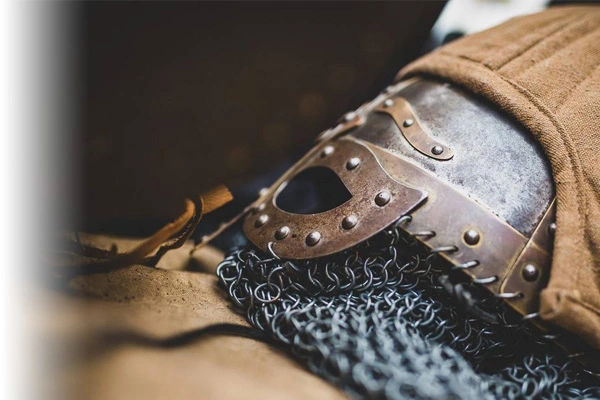
The bascinet developed from the ring mail and the pot helmet as a lighter, more flexible alternative. The early forms are simple: a hemispherical steel shell, deep neck protection, often worn in combination with a chainmail coif or an attached aventail.
Visor and folding visor
From the mid-14th century onwards, visors were increasingly added – initially fixed nasal visors, then folding designs. The bascinet with a folding visor offers full facial armour whilst maintaining mobility. In combination with a chainmail aventail attached to the lower edge of the helmet, it provides complete head protection.
Dog-muzzle
The dog-muzzle helmet is a special development of the basin helmet: the cup tapers to a point at the top, the visor is elongated and tapers to a point at the front – hence the name (dog’s muzzle). It originated around 1360/70 and spread rapidly throughout Europe. The Churburg specimen from the late 14th century is considered one of the best-known surviving originals.
Grand Bascinet – Large basinet
Around 1400, the so-called Grand Bascinet (large bascinet) emerged from the bascinet: a solid, fully enclosed visor helmet that rendered the aventail and neck guard superfluous. Predominantly found in Italy and Western Europe, it is the heaviest and most complete stage of development within the bascinet family.
What to look for when buying
Measure your head circumference with a tape measure at forehead level – approx. 1–2 cm above the ears. Most helmets in this category are available in sizes such as S (54–56 cm), M (57–59 cm) and L (60–62 cm). Note: Late medieval helmets sit lower on the head than modern headgear. A helmet that is too small will chafe, whilst one that is too large will wobble dangerously in combat. If in doubt, it is better to choose a size larger and adjust the inner lining.
An inner lining is not an optional accessory – it cushions impacts, prevents chafing and significantly improves the fit. Many helmets in this category are supplied without a lining; a leather lining or a woven fabric band can easily be fitted at a later date. A sturdy lining is essential for re-enactment combat – without sufficient padding, even a well-fitting helmet can lead to head injuries.
Not every helmet is suitable for combat use. Look specifically for the phrase ‘suitable for exhibition combat’ in the product description – this indicates that the helmet has been tested for sufficient wall thickness (usually 2 mm / 14 gauge), solid workmanship and a secure visor lock. Decorative models made from 1.6 mm steel (16 gauge) are suitable for light training, but not for full-contact combat or tournaments with defined safety standards.
Bare steel rusts quickly when exposed to moisture. After each use or contact with rain, wipe the helmet dry; if necessary, rub in a thin layer of light oil (gun oil or neutral oil). A helmet stand is recommended for storage – this prevents the inner lining from becoming misshapen and allows the helmet to breathe. Early signs of rust can be removed with fine steel wool before it penetrates deeper.
Material thicknesses and suitability for re-enactment
| Thickness | Suitability | Typical use |
|---|---|---|
| 1.6 mm (16 gauge) | Beginners / Display | Living history, light training, display, collectors |
| 2 mm (14 gauge) | Exhibition fighting | Tournament, full contact, re-enactment with combat |
| Leather inlay | Quality feature | Comfort, abrasion protection, better fit during combat |
| Brass fittings | Historical | Aesthetic quality, attention to detail in collector’s items |
The wall thickness directly influences weight and protective effect: a 2 mm Schaller weighs noticeably more than its 1.6 mm counterpart, but sits more securely and is designed for regular re-enactment events. For decoration and display, 1.6 mm is entirely sufficient – the helmets look identical, but are not designed to withstand the stresses of combat.
Helmet and armour: creating a harmonious overall look
A late medieval helmet only looks truly convincing when combined with the right armour. The choice of period determines the appropriate additions.
- Aventail made of chain mail on the rim of the helmet
- Neck guard as neck protection under the helmet
- Gambeson as an under-armour beneath the chainmail
- Chainmail as the main armour
- Limited plate armour: arm and leg guards as supplementary protection
- Regional: German and English styles predominate
- More complete plate armour: breast, arm and leg plates
- No longer need for an aventail – helmet design encloses the neck
- Breastplate and armour as central elements
- Gambeson still used as shock absorber beneath the plate armour
- Gothic variants (Germany), Milanese style (Italy)
- English forms: Coventry schaller as the standard type
Schaller, pot helmet and iron hat: the other main types
The Schaller
The Schaller is the typical helmet shape of the second third of the Late Middle Ages: a bell-shaped helmet flaring outwards at the back with broad neck protection and a narrow slit for vision. Regional variants differ significantly – the German Schaller is angular and deep, the English Schaller from Coventry rounder and more compact, the Gothic Schaller finely crafted with curved lamellae at the nape. The bellows-style Schaller from around 1490 is a special variant with ribbed decoration – visually striking and technically demanding to craft.
The pot helmet
The pot helmet is the cylindrical prototype of the closed knight’s helmet: full face protection, with only narrow ventilation slits. One of the historical models for the replicas in this category is the pot helmet of the Rieters of Kornburg, Nuremberg, circa 1375 – a well-documented original with a characteristic transverse slit and solid workmanship. Heavy, hot, but historically authentic for 14th-century tournament re-enactments.
Iron Cap & Barbute
The iron cap (also known as the chapel-de-fer) is the most practical helmet design of the late Middle Ages: an all-round brim, open face, lightweight and well-ventilated – ideal for archers and foot soldiers. Variants with cheek flaps or straps offer additional protection. The barbuta is the Italian counterpart: a helmet closed at the top with a T-shaped face opening, modelled on ancient designs and particularly widespread in northern Italy around 1440.
Which helmet is suitable for which use?
Miniature helmets, decorative versions and models made from 1.6 mm steel without stage combat certification are ideal for display cabinets, as gifts or for exhibitions. Brass fittings and leather inlays are often particularly richly detailed on these models. A helmet stand significantly enhances the presentation.
1.6 mm models are ideal for living history re-enactments, markets and LARP events involving light combat. They are easier to wear, look authentic and are sufficient for most event formats without full contact. They can be combined with a gambeson and chainmail to create a coherent overall look from the 14th or 15th century.
For tournaments, historical exhibition combat and full-contact reenactment, only models made from 2 mm steel with explicit exhibition combat approval are suitable. This category includes basin helmets, dog-head helmets, Schaller helmets and pot helmets in exhibition combat-grade quality – crafted according to historical models, with movable visors and brass fittings as a mark of quality. Complete the helmet with matching shoulder plates and armour for a full suit of armour.
Whether you’re looking for a Schaller helmet suitable for stage combat at your next tournament or a detailed Hundsgugel for your late medieval re-enactment – in this category you’ll find 107 helmets ranging from affordable entry-level options to sturdy combat gear. Take your time to browse, and if you have any questions about the selection, the Vehi Mercatus team is here to help.
Frequently asked questions
The basin helmet is the basic form: a hemispherical steel shell with deep neck protection, which was widespread from the early 14th century onwards and was combined with either a visor, a flip-up visor or a chainmail coif. The dog-head helmet is a variant of this – recognisable by its characteristic pointed, upward-tapering shell and the elongated, snout-like visor. It originated around 1360/70 and was the most popular helmet shape among European knights until around 1420.
For re-enactment combat and full-contact tournaments, a wall thickness of 2 mm (14 gauge) is generally recommended. Helmets with this thickness are explicitly marked as ‘suitable for exhibition combat’ in the product description. Models made from 1.6 mm steel (16 gauge) are suitable for light training, living history and decoration, but are not designed for regular combat events with defined safety standards.
Measure your head circumference with a flexible tape measure at forehead level – approximately 1–2 cm above the ears. This measurement generally corresponds to the helmet size: S fits approx. 54–56 cm, M fits 57–59 cm, L fits from approx. 60 cm. Late medieval helmets sit lower on the head than everyday headgear; if your measurements are on the borderline, we recommend the larger size in combination with a fitted inner lining.
For a re-enactment of the early 14th century, a simple bowl-shaped helmet with a chainmail coif is suitable. For the mid-14th century, a bowl-shaped helmet with a flip-up visor or a dog-head helmet is appropriate. In the 15th century, the Schaller (German, English, Gothic) and the Barbuta dominate. The pot helmet is historically rooted in the 13th to early 14th century, but is also frequently used for late medieval tournament re-enactments.
An inner lining is strongly recommended for regular use. It cushions impacts, prevents pressure points and significantly improves the fit. Many helmets are supplied without a lining – a leather lining or a woven textile band can be fitted at a later date. For re-enactment combat, adequate cushioning is not optional, but a safety requirement.