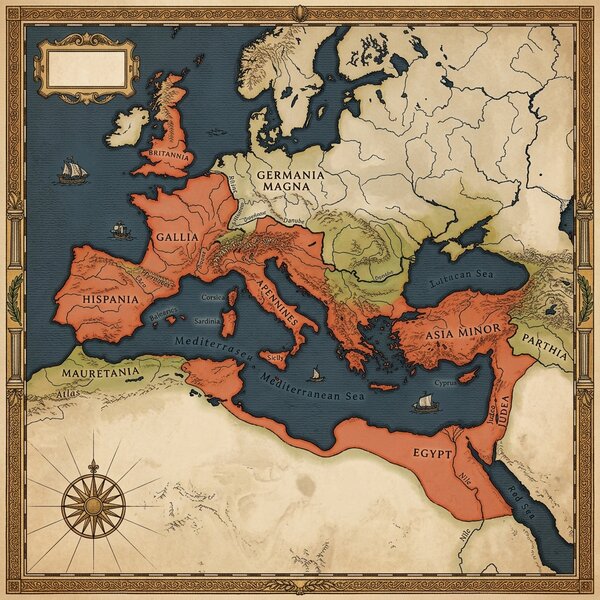

The Middle Ages are divided into the sub-epochs Early Middle Ages, High Middle Ages and Late Middle Ages. It was the age that followed the ancient world and the then dominant Roman Empire. In this article we tell you when the Middle Ages ended and what came after. Have fun reading.

What awaits you in this article
- The end of the Middle Ages is worth discussing
- A chronology of the events that heralded the end of the Middle Ages
- The historical 100 years war
- The invention of printing - a historical event
- Europe discovers America through Christopher Columbus in 1492
- Luther's Theses and Reformation of the Church
- The German Peasants' War - End of the Middle Ages?
- What came after the Middle Ages? The era of the Renaissance - early modern times
- Summary to the end of the knights
 Reading time approx. 6 min.
The end of the Middle Ages is worth discussing
The end of the Middle Ages is a controversial topic among historians. Some consider the end of the 15th century, when Christopher Columbus discovered America, as the end point, while others consider the ongoing 16th century, with the Reformation of Martin Luther and the invention of printing, as the end. Although there is no clear answer, we can say that the Middle Ages was a period of great upheaval that changed the world forever.
A chronology of the events that ended the Middle Ages
Since there were many events that ended the Late Middle Ages, we chronologically enumerate for you the most important points below.
The historical 100 years war
The reign of Charles IV, the last of the Capetian rulers, ended when he died in 1328. Since there was no clear heir, France and England (at that time not yet nation states in the modern sense) fell into a conflict that lasted 116 years. This conflict became known as the Hundred Years War and ended the Middle Ages for many. The war began with a dispute over who should be the rightful king of France: the French claimant or the English king Edward III.
The conflict escalated when Edward III invaded France and attempted to seize the throne by force. This led to a series of devastating battles in which both sides suffered heavy losses. One of the most famous battles was the Battle of Agincourt in 1415, in which a small English army led by Henry V defeated a much larger French army. The English victory was short-lived, however, as the French regained control of most of the country within a few years.
The Hundred Years' War finally ended e in 1453 with the Treaty of Paris. In this treaty, the English King Henry VI was recognized as the rightful ruler of France, but he only had control over a small part of the country known as the Pale of Calais. In reality, power had shifted to the local princes and nobles, who were now effectively independent rulers. The Hundred Years' War thus marked the end of centralized monarchical rule in France and England and heralded the beginning of the modern age.
The invention of printing - a historical event
The invention of letterpress printing by Johannes Gutenberg around 1450 was a decisive factor in the spread of knowledge and education in Europe. Letterpress printing made it possible to produce books faster and more cheaply, which led to an increasing demand for literary works. The new technology also changed the way books were read and studied. Before letterpress printing, texts had to be copied by hand, which took time and effort. With the letterpress, however, books could be printed in large quantities, making them more accessible. Gutenberg's letterpress printing was a crucial innovation that helped lead Europe into a new era of education and culture.
Europe discovers America through Christopher Columbus in 1492
Columbus discovered America in 1492 when he sailed his ship west. He hoped to find a new route to India. On his voyage through the Caribbean, he saw many islands, but none of them was India. One day he landed on an island that is now called Hispaniola. He thought he had arrived in India, but he was wrong. Columbus discovered America, but he did not find the route to India that he was looking for. Nevertheless, his discovery changed the world. America became a new continent with new people and new cultures.

Luther's Theses and Reformation of the Church
Martin Luther was a German theologian, professor, pastor and church reformer. He is considered a pioneer of the Reformation. In 1517, Luther published 95 theses against grievances in the church. He posted the theses on the church in the town of Wittenberg, sparking a major controversyBy Luther's writings and sermons, he unintentionally initiated the division of the Christian church. Together with other reformers, such as Philipp Melanchthon, Martin Luther left a lasting mark on the Protestant Church. His teachings are still present in the Christian church today and influence the daily lives of many people. Martin Luther has been a key figure of the Reformation, which has significantly contributed to the emergence of the Evangelical Church.
The German Peasants' War - End of the Middle Ages?
The German Peasants' War was an uprising of peasants in the territories of Swabia, Franconia, Thuringia and Upper Saxony in 1524-1525, which at that time were parts of the Holy Roman Empire of the German Nation (HRRDN). The peasants were dissatisfied with their social and economic situation and wanted to bring about change. They demanded more rights and freedoms from the nobility and the church. The uprising was eventually crushed by the forces of the ruling class, but it left a lasting impression on German history. The German Peasants' War was an important step in the development of modern democracy.
What came after the Middle Ages? The era of the Renaissance - early modern times
With the end of the Middle Ages the epoch of the modern times was introduced. A part of this time epoch which reaches until today, is the Renaissance. The Renaissance was a time of great cultural and economic change in Europe. It began in Italy in the 14th century and spread to other parts of Europe in the 16th century. The Renaissance was a time of rebirth of classical art, literature and learning. It was also a time of great advances in science and technology. Politically and socially, however, it was a chaotic period in which feudalism failed but no replacement system was in place. The printing of books enabled the dissemination of knowledge, but also of works such as the Hexenhammer. The Renaissance had a profound influence on the course of European history. It marked the end of the Middle Ages and the beginning of the modern era.
Summary
There are many events that could mark the end of the Age of Knights. Ultimately, it is probably the sum of events from the late Middle Ages that caused such a huge change in society that one can say an era ends and the early modern era begins.
The exact date on which the Middle Ages, and thus the time of the knights, ended is still disputed and the subject of debate today. The fact is that with the 15th-16th century the Middle Ages ended and a new era began - the modern age. With the printing of books, information suddenly became more easily accessible, and Luther stood up against the grievances of the church with his theses. Wars shifted the balance of power in Europe. The discovery of America was also a major turning point and brought new countries, cultures and ideas to Europe.


Letters from the trading house
New arrivals, market dates and offers, straight from Rinchnach. Unsubscribe any time with one click.
Subscribe to the newsletter