

The Middle Ages are often seen as a time of stagnation – an era in which people never left their villages and the world ended just beyond the next hill. The reality is quite different: pilgrims, merchants, monks and rulers covered astonishing distances – albeit under conditions we can scarcely imagine today. Those who travelled did so not out of boredom, but out of necessity, faith or business acumen. This article shows how travel really worked in the Middle Ages: actual distances, real dangers and surprisingly clever solutions.
What to expect in this article
- The most important points at a glance
- Who actually travelled – and why?
- How far could you travel in a day? Specific distances and examples
- How dangerous was travelling in the Middle Ages really?
- How did people protect themselves on the road? Clothing, escorts and travelling groups
- On the road: routes, modes of transport and a typical daily routine
- Where did people stay overnight? Monasteries, inns and simple hostels
- Travel planning in the Middle Ages: When did people set off and how did they prepare?
- Frequently asked questions about travelling in the Middle Ages
 Reading time approx. 12 mins.
Key points at a glance
- On foot: 20–40 km per day in good conditions; 25–30 km was typical from spring to autumn
- On horseback: 40–60 km for ordinary riders; messengers with fresh horses covered over 100 km, couriers in exceptional cases up to 200 km
- By cart: 20–30 km daily, depending on road conditions and load
- By river: Up to 150 km per day possible downstream (Rhine, Danube); upstream only 15–20 km using towboats
- Dangers: Robbers, poor roads, disease and weather were real threats – but manageable thanks to travelling groups, escorts and monasteries
- Travel season: Spring to autumn preferred; winter only when absolutely necessary
Most people in the Middle Ages rarely travelled further than the nearest market. Yet certain groups – pilgrims, traders, monks, rulers and craftsmen – were constantly on the move and kept the dense network of trade routes and pilgrimage routes alive.
Who travelled at all – and why?
The lives of the rural population in the Middle Ages (c. 500–1500) were tied to the farm, the fields and the village. Most peasants left their homes only for short journeys to church, the mill or the market. A real journey – that is, a trip involving at least one overnight stay – was the exception for them, sometimes the event of a lifetime.
The situation was quite different for certain groups:
| Reason for travel | Typical examples |
|---|---|
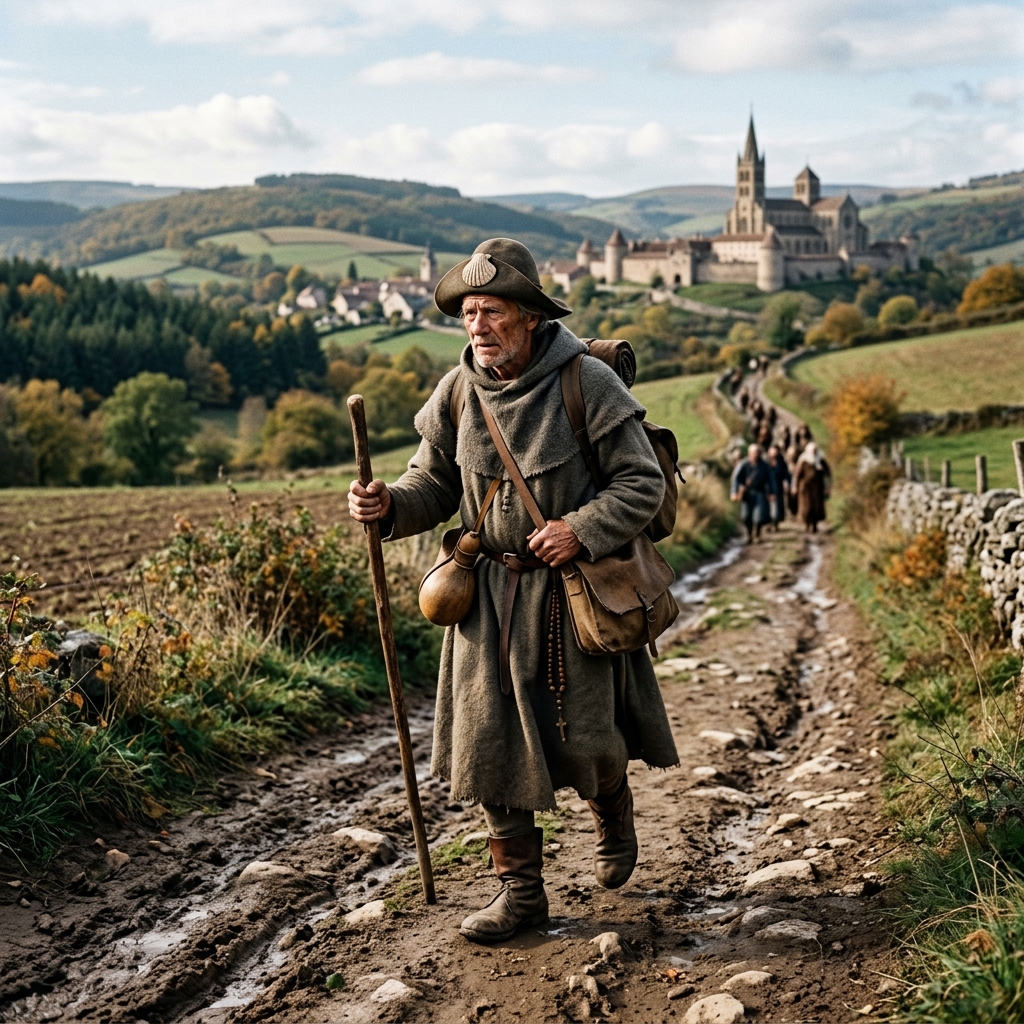
| Pilgrimages | Santiago de Compostela, Rome, Jerusalem |
| Trade journeys | Trade fairs in Frankfurt, Leipzig, Champagne |
| Royal journeys | Travel within the Holy Roman Empire |
| Military campaigns | Crusades, German kings’ campaigns in Italy |
| Educational journeys | Students to universities, journeymen on their travels |
The social groups on the move were diverse: kings on inspection tours of their palatinal estates, bishops and monks on missions, urban merchants, travelling artists and minstrels, poor pilgrims and refugees fleeing war or famine. From the High Middle Ages (11th/12th century) onwards, the volume of travel increased significantly. The founding of towns, the trade boom and the Crusades brought more people onto the roads – and the establishment of universities drew students across Europe.
How far could one travel in a day? Specific distances and examples
The question of daily travel distances cannot be answered with a single figure – too much depended on the mode of transport, the weather, the terrain and the season. Here are the specific figures from historical sources.
On foot
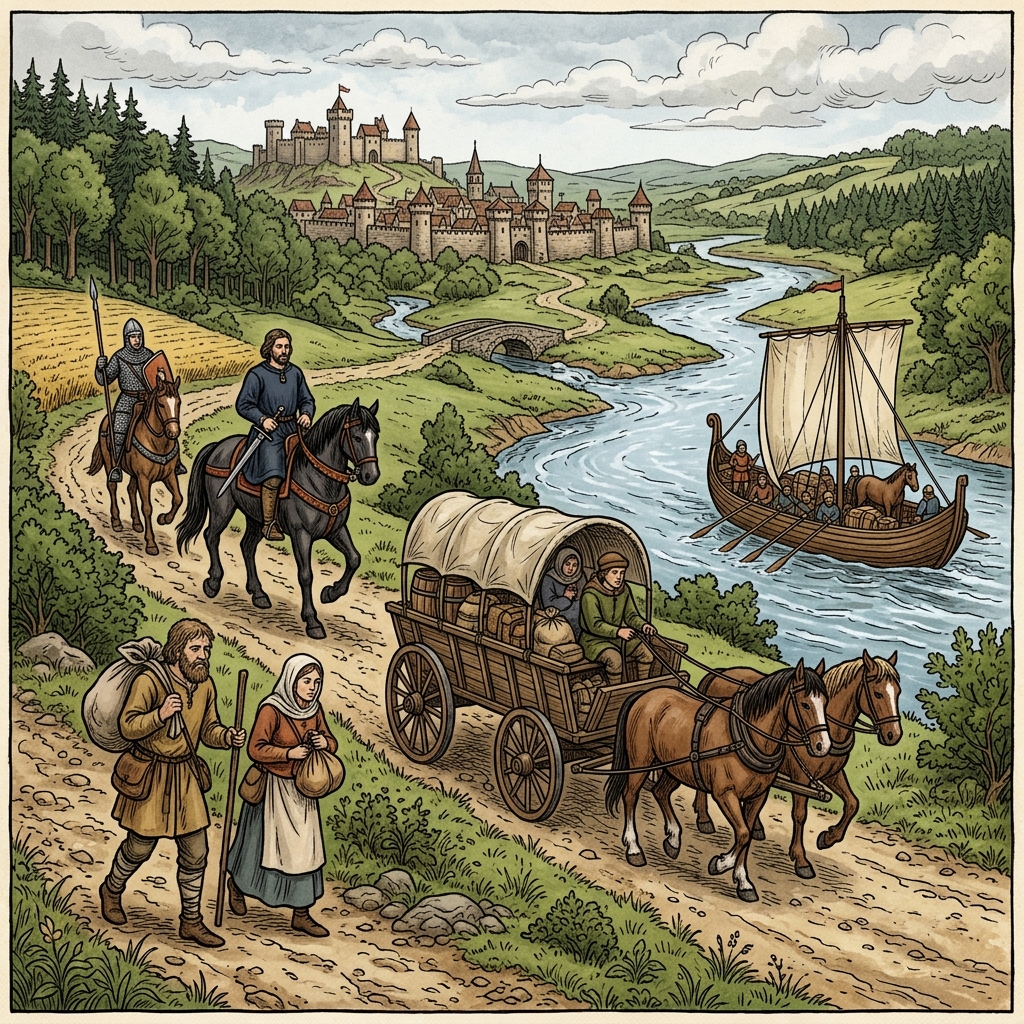
The majority of people travelled on foot. Under normal conditions, 20–30 km per day was realistic; on good paths and with light equipment, up to 40 km. The Hellweg – an important trade route in what is now North Rhine-Westphalia – was divided into sections of 15–30 km, which corresponded roughly to a day’s stage. A weekly distance of 80–120 km was achievable, as Sundays were considered days of rest. A documented pilgrimage from 1483 records the route from Oppenheim to Venice: 750 km in 15 days – around 50 km daily, an ambitious but feasible pace.
By cart and draught animals
Loaded ox or horse-drawn carts could only manage 20–30 km per day. Poor road conditions and the weight of the load significantly reduced the speed. Typical journey times for trade routes:
| Route | Distance | Duration |
|---|---|---|
| Cologne – Utrecht | approx. 200 km | 5–7 days |
| Wrocław – Vienna | approx. 450 km | 10 days |
| Augsburg – Milan | approx. 500 km | 12 days |
| Nuremberg – Venice | approx. 650 km | 14 days |
On horseback
Average riders covered 40–60 km per day, provided the horse was spared. Mounted messengers using relay stations covered well over 100 km daily – papal couriers are known to have covered 110 km. In extreme cases, such as with the French or Spanish courier services, which provided fresh horses every few hours, distances of up to 200 km were even possible. The Mongolian relay system is said to have reached 375 km – however, such figures were absolute exceptions under extraordinary conditions.
On rivers
Rivers such as the Rhine or the Danube served as the transport arteries of the Middle Ages. Downstream, with the current, 100–150 km could be covered in 24 hours, at a speed of around 7 km/h. Upstream, the situation was quite different: with draught horses (tugboats), one could cover 15–20 km, and with human power only 10–12 km per day.
At sea
The distance covered at sea depended heavily on wind and currents. Coastal shipping could cover 120–200 km daily in favourable conditions. However, calms, storms and long waiting times in ports significantly extended the overall journey time. A pilgrimage from Denmark to Palestine in the 13th century was estimated to take a full year – including wintering in Spain.
How dangerous was travelling in the Middle Ages really?

The popular image of the deadly dangerous Middle Ages, in which robbers lay in wait around every bend, is greatly exaggerated. There were real risks – but millions of pilgrims, merchants and messengers reached their destination. Otherwise, the dense network of trade routes, pilgrimage sites and monasteries could never have developed.
Crime and robbers
Highwaymen were a danger, but their presence varied greatly by region and period. Along major trade routes, rulers enforced the peace and offered safe-conduct. Major trade routes were comparatively safe, as the economic benefits justified their protection. In remote areas, dense forests or in the aftermath of wars, the risk increased significantly. Feudal border regions and periods of political instability were particularly dangerous.
Natural hazards
Nature often posed a greater challenge than robbers:
- Muddy, rutted paths that literally swallowed up the carts
- Falls from horses on uneven, slippery paths
- Dangerous mountain passes such as the Brenner or Fern Pass in bad weather
- Floods and raging rivers without bridges
- Unreliable ferries and rickety river crossings
Weather and climate
Cold, snow, fog and sudden changes in the weather posed an immediate threat to travellers. Winter journeys were risky – yet, paradoxically, sometimes easier than in the muddy spring, when frozen ground provided a firm footing.
Disease and hygiene
In overcrowded hostels and towns, the risk of infection was ever-present. With poor hygiene, even minor wounds could become infected and life-threatening. Pilgrims and traders carried pathogens over long distances, acting as unwitting vectors for epidemics – a circumstance that had devastating consequences in the age of the great plague outbreaks.
Political instability
Local feuds, wars and marauding mercenary bands posed real dangers in certain regions and periods. Periods of relative stability – such as under the Peace of God or an enforced truce – offered tangible protection, however.
Conclusion: Risky, but not a certain death
Travelling was arduous and riskier than it is today – but by no means a certain death. Survival rates were high enough to allow for repeated journeys by students, merchants and envoys. This is demonstrated by the very fact that a dense medieval network of trade routes, places of pilgrimage and monasteries was able to develop and be maintained over the centuries.
How did people protect themselves on the road? Clothing, escorts and travelling groups
The best protection on medieval journeys was inconspicuousness and community – not the sword.
Unobtrusive clothing and little visible wealth
Prudent travellers wore simple, sturdy woollen clothing. Wealthy individuals avoided lavish fabrics and conspicuous jewellery. Valuables were carried as close to the body as possible or hidden in luggage – modesty was the best protection.
Travel groups
Safety lay in numbers. Pilgrims formed brotherhoods, merchants formed caravans or organised guild journeys. The advantages were obvious:
- Mutual assistance in the event of breakdowns, injuries and illness
- A deterrent to potential robbers
- Shared knowledge of safe routes and known danger spots
- Recommendations for trustworthy inns along the route
Escorts and letters of safe conduct
Kings, princes or towns offered armed escorts – usually for a fee. Letters of protection and letters of recommendation ensured legal protection in foreign territories. This support was primarily affordable for wealthy travellers, but could also benefit merchants who were members of a guild.
Weapons and information exchange
Ordinary travellers carried sticks and knives, whilst the wealthy travelled with armed servants. Open combat, however, was generally a last resort – it was more important to avoid known danger zones. Innkeepers, monasteries and other travellers shared valuable information about unsafe routes, closed passes or areas affected by epidemics. This oral exchange of travel knowledge was irreplaceable.

On the road: routes, transport and the typical daily routine
The choice of transport depended on money, cargo and the landscape. Most people had little choice – they walked.
Paths and roads
Old Roman highways were still in use or being maintained in the High Middle Ages. Alongside these were countless dirt tracks, sunken lanes and footpaths, which shifted depending on the weather. Paved roads, as we know them, were nowhere to be seen across most of medieval Europe.
Walking as the norm
Around 90% of travellers went on foot, often with a rucksack or a carrying basket. A typical day looked like this:
- Setting off before dawn
- Main march in the morning (4–6 hours)
- Break during the hottest part of the day
- A shorter stage in the afternoon
- Arrival at monasteries or hostels in time for vespers
Pack animals, carts and wagons
Donkeys, mules, horses and oxen carried goods and luggage. Trade caravans comprised several carts. Carriages in the modern sense did not appear until the late Middle Ages, when improved roads in certain regions made this possible.
Travel by water
Rivers such as the Rhine, Danube and Inn served as the motorways of the Middle Ages. Raftsmen, ferrymen and boatmen transported both goods and people. The advantages were enormous: large loads, often significantly faster than overland routes. However, everything depended on the water level and the season. Important routes also ran across the sea – albeit with considerable risks due to wind, waves and unpredictable weather.
The annual cycle of travellers
| Season | Conditions |
|---|---|
| Spring | Roads dry out, mountain passes passable again |
| Summer | Long days, good supplies, pleasant temperatures |
| Autumn | Fairs and markets, harvest produce available for trade |
| Winter | Only when absolutely necessary; mountain passes closed, dangerous seas |
Where did people stay overnight? Monasteries, inns and simple hostels

There were no hotels in the modern sense. Where one slept depended heavily on one’s social standing and financial means.
Monasteries and religious institutions
Monasteries offered pilgrims and the poor accommodation and simple meals as part of Christian hospitality. Dedicated guesthouses – hospitals and hospices – sprang up mainly along long-distance routes and pilgrimage paths. The Cistercians, for example, restricted their outlying estates to within 23 km of the abbey to allow for daily supervision – an indication of how closely monastic life was linked to travel.
Guesthouses and taverns
A professional inn-keeping industry developed from the High Middle Ages onwards. In trading towns such as Regensburg, there were already dozens of inns by around 1300. Typical features included large dormitories with communal beds – privacy was a rare privilege.
Accommodation for the nobility and rulers
Nobles travelled with entourages and used their own castles or were accommodated by peers. Kings in the Holy Roman Empire practised what was known as ‘itinerant kingship’ and moved regularly between over 50 palaces and monasteries – for them, ruling and travelling were one and the same.
Ordinary travellers and urban networks
Those with little money stayed with farmers, shepherds or slept outdoors. Hospitality was considered a religious duty, but was limited in terms of time and resources. Barns, stables or attics served as places to sleep. In larger towns, guilds, brotherhoods and universities provided their members with accommodation networks – itinerant craftsmen, students and merchants benefited considerably from these structures.
Travel planning in the Middle Ages: When did people set off and how did they prepare?
Successful journeys required careful preparation. Simply setting off without a plan could spell the end – literally.
Provisions and equipment
- Bread, cheese and dried food in a provisions bag
- Drinking vessels made of clay, wood or leather
- Clothing suitable for the weather and sturdy footwear
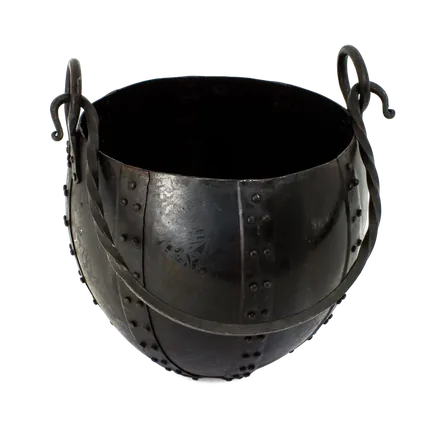
- For longer journeys: cooking utensils and tools for the road
Legal and organisational preparations
Astute travellers obtained letters of recommendation and letters of safe conduct, coordinated with guilds, pilgrim or merchant groups, and set out their stage destinations. Monasteries and markets along the route served as landmarks. Navigation relied on local knowledge, verbal information, natural landmarks such as rivers and mountain ridges, and simple sketches. Precise maps only became available from around 1300 with the portolan charts for seafaring.
Allow for time buffers and uncertainties
Breaks for religious services, market days, repairs or changes in the weather had to be firmly factored into the schedule. Historical travel accounts show just how much journey times could be extended by unforeseen events. A journey of 300 km could take several weeks – depending on the mode of transport, the weather and the political situation. This meant not only physical exertion, but also a considerable financial risk for anyone leaving their family and farm behind.

Frequently asked questions about travelling in the Middle Ages
Could ordinary peasants travel at all?
Peasants were closely tied to their farms by tax obligations and field work. Short trips to the market, church or mill were normal, but journeys lasting several weeks were rare. They usually only took place on special occasions: a pilgrimage as a once-in-a-lifetime event, a marriage in another village, or fleeing from war and famine. The daily rhythm of work in the countryside left little scope for prolonged absences.
Was there such a thing as tourism in the Middle Ages?
Travelling purely out of curiosity or for pleasure was alien to the Middle Ages. Pilgrimages came closest to modern-day tourism – they combined piety with adventure, curiosity and social interaction. Luxury journeys to other estates were reserved for a very few nobles, undertaken for political or family reasons. The modern notion of simply wanting to see something new played hardly any role.
How did people find their way without modern maps and navigation devices?
Directions were provided through local knowledge and word of mouth. Rivers, mountain ridges and familiar places served as natural landmarks. Merchants and pilgrims relied on practical knowledge, simple sketches or early travel accounts such as the Codex Calixtinus for the Way of St James. Monasteries and towns acted as landmarks – whoever reached the next church tower knew where they were.
How much did a journey cost in the Middle Ages?
The costs depended on duration, distance, mode of transport and social status. Poor pilgrims lived on alms and the simplest of provisions. Merchants and nobles had to pay for escorts, tolls, accommodation and food for their entourage. A pilgrimage to Santiago de Compostela could cost a peasant his entire annual income – and a long trading journey tied up considerable capital, with the risk of losing everything in the event of misfortune.
Were children often taken along on journeys?
Young children rarely took part in long, arduous journeys. Exceptions were made for migrations or refugee movements, during which entire families were on the move. Older teenagers travelled more frequently – as apprentices, journeymen or in the retinue of their masters. Pilgrim groups could also include teenagers, but hardships, illness and dangers made such journeys a serious ordeal for children of all ages.


Letters from the trading house
New arrivals, market dates and offers, straight from Rinchnach. Unsubscribe any time with one click.
Subscribe to the newsletter

