

In films and TV series, the Middle Ages are often portrayed as a dark era in which people were constantly fighting for their lives. But is this an accurate picture? The following fact check examines the cliché of a ‘perpetual state of war’ using specific historical examples and the latest research – and shows just how much more nuanced the reality actually was.

What to expect in this article
- Was there really “constant war” in the Middle Ages?
- What was actually understood as “war” in the Middle Ages
- Everyday life in war: gruelling physical labour rather than constant battle
- Structures of violence: feuds, honour and the lack of a monopoly on the use of force
- Rules of violence, the Church and social differences
- Reasons for wars and conflicts in the Middle Ages
- Strategies, tactics and the role of knights
- From the Middle Ages to the Early Modern Period: When did ‘modern warfare’ begin?
- Conclusion: How violent was the Middle Ages really?
- Frequently asked questions on the topic of ‘war in the Middle Ages’
 Reading time approx. 9 mins.
Key points at a glance:
- No constant large-scale battles: Although there was plenty of violence in the Middle Ages (c. 500–1500), there were not continuous, empire-wide field battles. Many regions experienced decades of peace without major military campaigns.
- A different understanding of “war”: There was no modern definition of war. Many conflicts were feuds, raids and disputes of honour between noble families – not organised wars between states.
- Violence was concentrated among the elite: it was primarily the nobility and professional soldiers who fought directly. The general population suffered more from military campaigns, looting and levies than from daily combat.
- Changing forms of conflict: From the Early through the High to the Late Middle Ages, forms of conflict changed considerably. ‘Total war’ with mass armies belongs more to the Early Modern period.
Was there really “constant war” in the Middle Ages?
The widespread image of a perpetual state of war does not correspond to historical reality. Historians such as Gerd Althoff have shown that this cliché is based on selective historical accounts.
- The Middle Ages span almost 1,000 years – from the fall of the Western Roman Empire in 476 to around 1500. Within this long period, there were repeated periods of peace in various regions.
- Contemporary chronicles primarily recorded extraordinary events such as major battles or sieges. Everyday life did not seem newsworthy to the chroniclers – which creates a distorted, violence-focused picture.
- Most conflicts were local in scope: feuds between noble families, disputes between town and country, or conflicts between lords and vassals. Empire-wide wars remained the exception.
- In the Holy Roman Empire, feuds were frequent in the 13th–15th centuries, but parts of Swabia and Franconia also experienced decades-long periods of peace without major military campaigns.
- For most people, being “constantly threatened by violence” meant unpredictable outbreaks of violence caused by marauding gangs or passing armies – not daily battles on their doorsteps.
What was actually understood as “war” in the Middle Ages
People in the Middle Ages had a completely different vocabulary for conflicts. The modern concept of “war”, with its implications under international law, simply did not exist.
- The modern concept of war – organised violence between sovereign states – only emerged in the 16th–17th centuries, particularly in the context of the Thirty Years’ War (1618–1648).
- In the Early and High Middle Ages, terms such as ‘military expedition’, ‘campaign’, ‘feud’ or ‘strife’ were used. A clear distinction between ‘private’ and ‘public’ did not exist due to the lack of statehood.
- Kings, dukes and bishops viewed military campaigns as an expression of personal power and honour – not as a matter of state in the modern sense.
- Many conflicts were legally sanctioned feuds. From the perspective of contemporaries, they represented legitimate forms of law enforcement.
Prof. Martin Clauss and other historians emphasise how difficult it is to translate medieval forms of conflict into modern terms. The available sources require a nuanced understanding.
Everyday life in war: gruelling physical labour rather than constant battle

Life as a warrior in the Middle Ages had little in common with romanticised film portrayals. Those who fought performed gruelling physical labour under extreme conditions.
- A full suit of plate armour in the 15th century weighed 20–30 kg. Together with a helmet, gauntlets and weapons, every battle demanded an enormous display of stamina and strength.
- Knights were not mere commanders, but actively fighting warriors. A warhorse alone cost as much as several farms – not to mention the armour and upkeep.
- Daily life in war consisted of long marches (20–30 km a day), horse care, camp life, illnesses such as dysentery and often miserable rations. The moment of battle was only a small part of it.
- Large-scale field battles accounted for perhaps 1% of military operations. More common were smaller skirmishes, raids, pillaging and sieges of castles or towns, which could last for months.
- Famous battles such as Hastings in 1066 or Crécy in 1346 were exceptions that went down in history precisely because of their rarity.
Structures of violence: feuds, honour and the absence of a state monopoly on violence
Violence in the Middle Ages was organised differently from today because there was no state monopoly on the use of force in the modern sense. The right to bear arms and use force lay with the elites.
- In the High and Late Middle Ages, armed self-help (feuds) was a recognised means of enforcing rights. Nobles with their own retinues could make legal use of this.
- A large proportion of conflicts concerned matters of honour: they revolved around rank, reputation and symbolic humiliation – not merely land or money. An insult at a feast could trigger vendettas lasting years.
- Gun ownership was heavily concentrated among the nobility. Peasants and the urban lower classes suffered primarily as victims of military campaigns, looting and forced labour.
- Mediators played a central role: relatives, bishops, abbots and even the Pope or princes acted as arbitrators. The aim was reconciliation, not total annihilation.
- The ritual of submission (deditio) – a public plea for mercy accompanied by symbolic gestures – and ‘satisfaction’ through penance or payments restored wounded honour.

Rules on violence, the Church and social differences
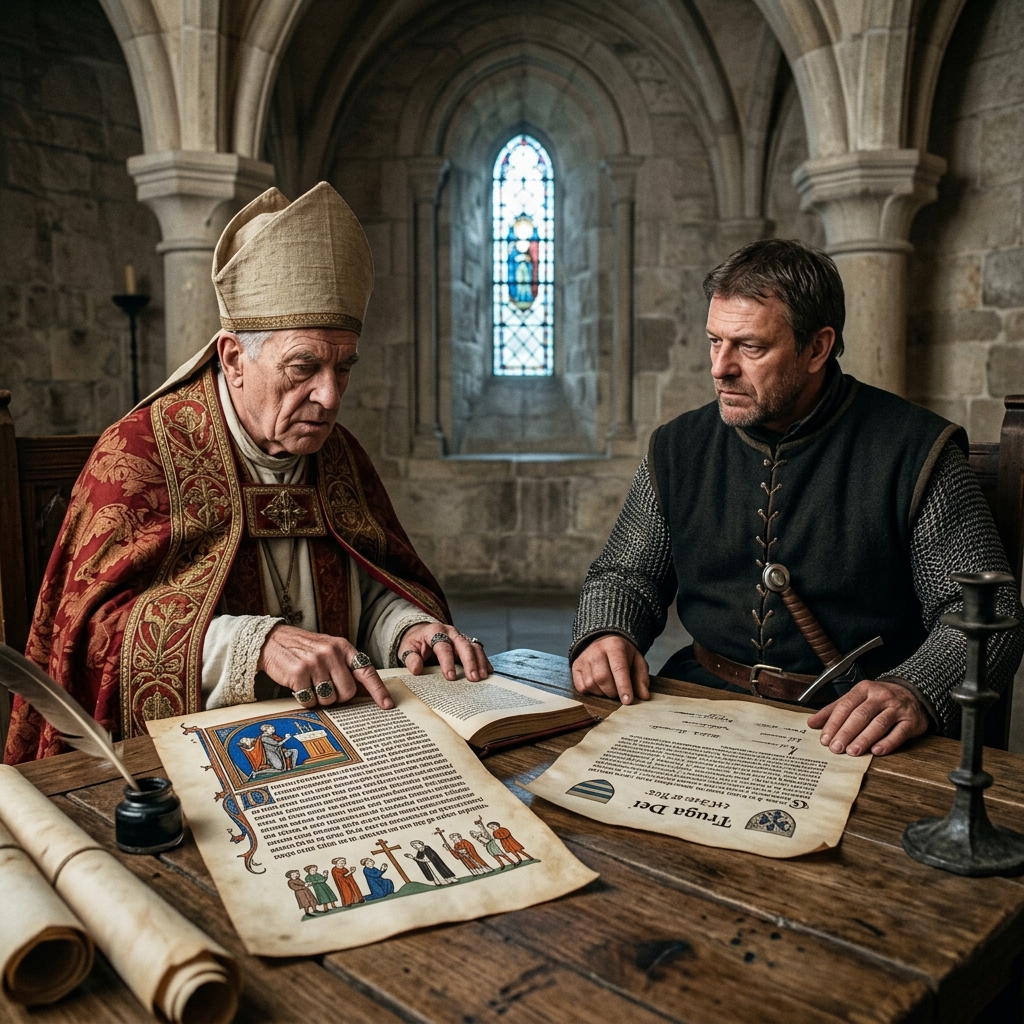
Violence in the Middle Ages was widespread, but by no means completely unregulated. The Church and the nobility developed codes that, at least in theory, set limits.
- Among the nobility, informal codes of honour existed: knightly prisoners were released in exchange for ransom rather than killed. Certain individuals, such as clerics or pilgrims, typically enjoyed protection.
- The Church initiated peace movements: the ‘Peace of God’ (Pax Dei from 989) and the ‘Truce of God’ (Treuga Dei from 1027) prohibited fighting on Sundays, public holidays and against certain groups.
- Penitential manuals laid down precisely what penance was to be performed for killing in war – an indication of moral regulation by the Church.
- The role of the Church was ambivalent: on the one hand, it curbed violence through mediation and regulations; on the other, it could also promote violence – for example, through the Inquisition and the associated use of torture.
- These rules were primarily effective within the upper classes. Ordinary people, serfs or the urban poor had far less protection.
- Conflicts among Christians tended to be more strictly regulated. The Crusades or battles against ‘heathens’, by contrast, often displayed extreme brutality without such restrictions.
Reasons for wars and conflicts in the Middle Ages
The causes of conflicts were complex and multifaceted. It is rarely possible to isolate a single cause.
| Cause | Example |
|---|---|
| Dynastic disputes | Succession dispute in the Holy Roman Empire 1198–1215 (Hohenstaufen vs. Welf) |
| Feudal tensions | Conflicts between lords and vassals over services and tributes |
| Religious motives | The Crusades from 1095, the Reconquista until 1492 |
| Economic interests | Control of Hanseatic trade routes and customs duties |
| Territorial ambitions | Succession disputes between royal houses |
As a rule, several reasons occurred in combination – religious legitimacy, dynastic claims and economic advantages often merged in a single conflict.
Strategies, tactics and the role of knights
The popular image of charging knights obscures the actual diversity of medieval warfare. In reality, siege warfare dominated for long periods.
- Sieges were more important than open-field battles: castles, city walls, starvation tactics and siege engines such as trebuchets characterised the scene.
- The ‘shock tactics’ of heavily armoured knights (12th–13th centuries) had clear limitations. At Courtrai in 1302 (the Battle of the Golden Spurs), 10,000 Flemish militiamen defeated 2,500 French knights with walls of pikes.
- Archers, crossbowmen and, in the 14th–15th centuries, early artillery fundamentally changed the nature of warfare. At Crécy in 1346, English longbowmen decimated the French knighthood.
- Knights were an elite class of warriors who owned land and held judicial functions – they embodied the fusion of military and political power.
- In the late Middle Ages, professional warriors and mercenary armies (e.g. Landsknechts) became increasingly common, putting pressure on the traditional ideal of knighthood.

From the Middle Ages to the Early Modern Period: When did ‘modern warfare’ begin?

Many things we associate with ‘war’ today belong more to the early modern period than to the classical Middle Ages.
- In the late Middle Ages (14th–15th centuries), a greater centralisation of power began. The first standing armies emerged, such as the French Ordonnance companies from 1445 onwards.
- In the 16th–17th centuries, “states” in the modern sense emerged, capable of waging wars on a larger logistical and financial scale.
- The Thirty Years’ War (1618–1648) marks a turning point: a major conflict driven by religious and political motives, resulting in 4–8 million deaths and massive devastation across the Holy Roman Empire.
- Mass armies, high civilian casualty figures and systematic state financing of wars characterise the Early Modern period more strongly than the Middle Ages.
The image of the Middle Ages as a period of ‘constant warfare’ actually shifts phenomena of the Early Modern period backwards in time and obscures important historical differences – a mistake found in many popular accounts.
Conclusion: How violent was the Middle Ages really?
War and violence were part of medieval life – but not in the form of uninterrupted large-scale battles. The reality was a succession of many small, locally confined conflicts, interspersed with periods of relative calm.
Large sections of the population were primarily affected indirectly: through looting, taxes, forced labour and general insecurity. Alongside all the violence, there were also periods of intense trade, cultural flourishing and legal peace in many towns and regions.
A nuanced understanding of this era helps to place modern wars in a better historical context – rather than labelling them as entirely new or, alternatively, as ‘medieval’. The research of historians such as Gerd Althoff and Prof. Martin Clauss offers valuable insights here.
For those who want to experience the Middle Ages beyond the pages of a book: at vehi-mercatus you’ll find historically accurate equipment for re-enactment, LARP and medieval markets – from armour to everyday clothing.
Frequently asked questions on the topic of ‘War in the Middle Ages’
Were there periods in the Middle Ages entirely without war?
Yes, in many regions there is evidence of decades-long periods without major military campaigns or sieges. Peace was often unstable, but it had real significance. Treaties, truces, marriage alliances and the Peace of God were able to effectively curb conflicts. Examples: relative stability in parts of the Empire under Emperor Frederick II (1220–1250) or in towns with strong municipal rights.
To what extent were peasants and ordinary people involved in the war?
Ordinary people rarely fought as fully equipped warriors, but were deployed as porters, supply carriers or light infantry. The main burden lay in taxes, quartering, looting and forced labour. Uprisings such as the German Peasants’ War (1524–1525), which claimed around 100,000 lives, show just how severely the lower classes were affected by the consequences of war.
Was war in the Middle Ages more brutal than in the modern era?
A direct comparison is difficult, as the available sources and forms of warfare differ greatly. There were many cruel practices in the Middle Ages, but also attempts to limit violence. Modern mass battles and industrial-scale destruction – the Second World War claimed around 70 million lives according to current estimates – represent an entirely different dimension.
What role did women play in medieval wars?
Women rarely appeared formally as combatants, but were involved in many ways. Noblewomen organised defences against sieges or, as rulers – such as Isabella of Castile – led military campaigns. Furthermore, women served as hostages in peace treaties or organised logistics in military camps. Research on this topic has increased significantly in recent years.
How reliable are our sources on war in the Middle Ages?
Much of the information comes from chronicles, documents and literary texts – all with their own interests and perspectives. Battles were often exaggerated, whilst everyday violence and minor conflicts remained underrepresented. Modern historians combine different types of sources – archaeological finds, administrative records, letters – to gain a more realistic overall picture.


Letters from the trading house
New arrivals, market dates and offers, straight from Rinchnach. Unsubscribe any time with one click.
Subscribe to the newsletter

