


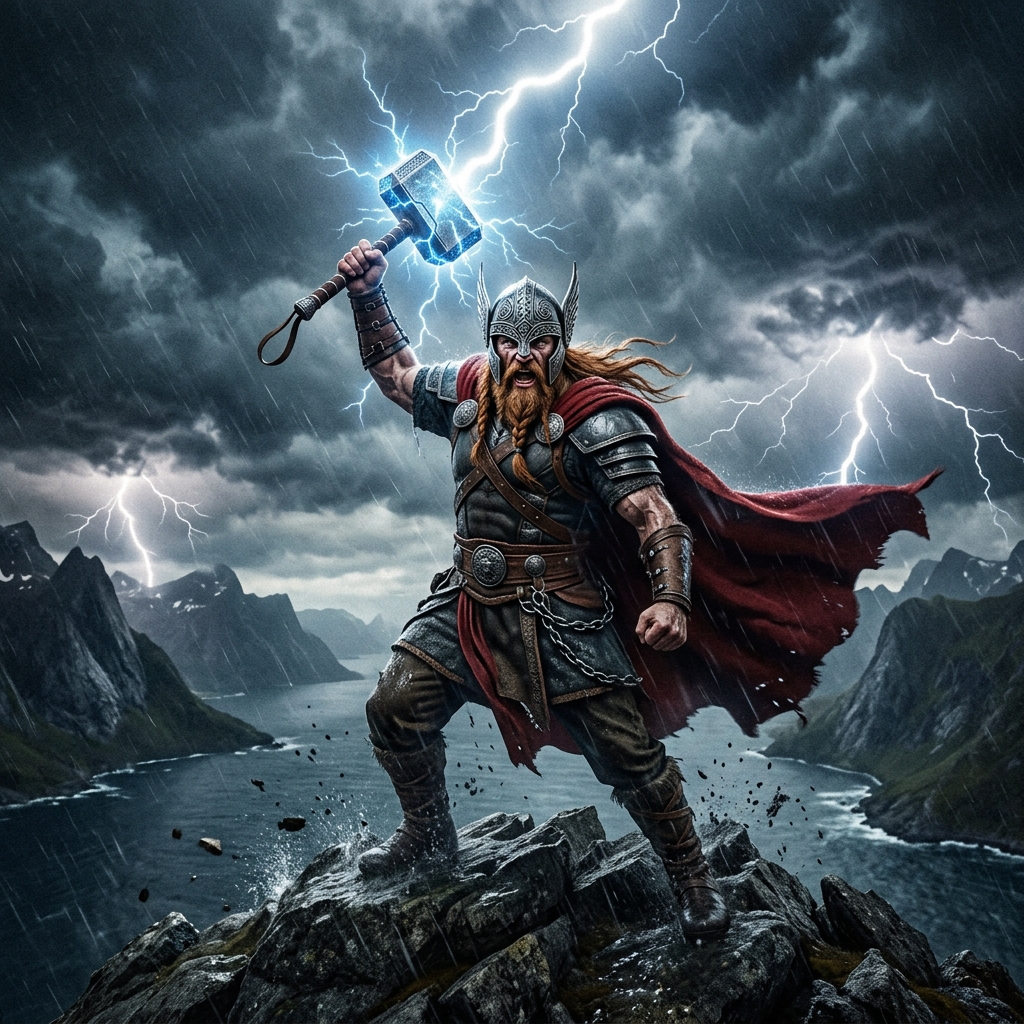
Thor is the god of thunder in Norse mythology – one of the most popular gods in the Germanic-Scandinavian pantheon and, for the Vikings, one of the most important protectors of all. With his hammer Mjölnir, his immense strength and his unshakeable fighting spirit, he embodies protection, order and the defence of the world against chaos.
What you can expect in this article
- Thor in Norse mythology: Who he is
- Thor’s magical equipment
- Thor’s most important adventures
- Thor’s family
- Thor and the World Tree Yggdrasil
- Thor among the Vikings: worship in everyday life
- Thor in LARP and re-enactment
- An overview of the most important figures associated with Thor
 Reading time approx. 8 mins.
Thor in Norse mythology: Who he is
This article reveals who Thor really is – not as a film character, but as a deity of the ancient Eddas: his origins, his magical weapons, his adventures, his family and his significance to the Vikings.
Key facts at a glance:
- Thor is the son of Odin and the earth goddess Jörð – making him half Aesir, half Jötunn.
- Mjölnir, his hammer, was forged by the dwarves Brokkr and Sindri and returns to him after every throw.
- His main enemies are the Jötnar (giants) and the Midgard Serpent Jörmungandr – with whom he will both perish in Ragnarök.
- Among the continental Germanic peoples, he was known as Donar – his name is still found today in the German word ‘Donnerstag’.
- Mjölnir amulets are among the most common archaeological finds from the Viking Age.
Thor is one of the Aesir – the main group of Norse gods who rule in Asgard and watch over the nine worlds. As the son of the god-father Odin and the earth goddess Jörd, he unites two worlds within himself: the divine order of the Aesir and the primal power of the earth. This heritage explains his extraordinary strength – he is the physically mightiest god of Asgard.
Thor is not the cunning strategist like his father Odin. He is direct, brave, sometimes impulsive – and that is precisely what makes him the favourite god of warriors and ordinary folk. Whilst Odin was revered above all by princes and skalds, Thor was the god of farmers, seafarers and fighters.
Among the continental Germanic peoples, he was known as Donar. The day of the week ‘Thursday’ (from Thor’s day) still serves as a reminder of his worship to this day.
Thor’s magical equipment

Thor possesses three magical objects that allow his power to be fully unleashed:
| Object | Old Norse name | Meaning / Function |
|---|---|---|
| The Hammer | Mjölnir | Forged by the dwarves Brokkr and Sindri; unleashes lightning and thunder; returns after every throw; symbol against evil forces |
| Belt of Strength | Megingjörð | Doubles Thor’s already immense strength |
| Iron gloves | Járngreipr | Enable Thor to wield the glowing hammer safely |
Thor’s chariot is drawn by two billy goats: Tanngnjóstr (‘Teeth-grinder’) and Tanngrisnir (‘Teeth-barer’). These goats have a special ability: Thor can slaughter and eat them in the evening – as long as the bones remain intact, they come back to life the next morning.

Thor’s most important adventures
Thor and the Midgard Serpent (Jörmungandr)
Jörmungandr is Thor’s arch-enemy – a gigantic serpent that encircles the entire Middle Realm, holding its own tail in its mouth. It is a child of Loki. In one of the best-known stories, Thor goes fishing with the giant Hymir and uses an ox’s head as bait. When Jörmungandr bites, Thor pulls the giant serpent almost out of the water – until Hymir, in a panic, cuts the fishing line. The actual confrontation takes place in Ragnarök: there, Thor and Jörmungandr kill each other. Thor strikes the serpent with Mjölnir, but then collapses under its venom after nine steps.
The Stolen Hammer (Þrymskviða)
The giant Thrym steals Mjölnir and demands the goddess Freyja as his bride. When Freyja refuses, Loki devises a ruse: Thor disguises himself – very reluctantly – as the bride, and Loki as the bridesmaid. At the wedding feast, the disguised ‘Thrym’ is handed the hammer for the ritual blessing of the bride. At that moment, Thor casts off his disguise and slays Thrym along with his retinue. The story is one of the most humorous in the Edda.
The Battle Against Hrungnir
The giant Hrungnir boasted in Asgard that he was invincible and challenged Thor to a duel. In the fight, Thor’s Mjölnir strikes Hrungnir’s whetstone hammer – the stone shatters, and a splinter remains lodged in Thor’s forehead forever. Hrungnir falls nonetheless. The story shows that Thor is vulnerable – but invincible.
The Journey to Utgard
In Utgard, the realm of the giant Utgard-Loki, Thor is faced with seemingly impossible trials: he is to drink from a horn, lift a cat and wrestle with an old woman. He fails – or so he believes. In the end, Utgard-Loki reveals the truth: the horn was connected to the World Sea, the cat was the Midgard Serpent, and the old woman was Old Age itself. Thor’s ‘failure’ was in reality a barely comprehensible display of power.
Thor’s family
Father: Odin
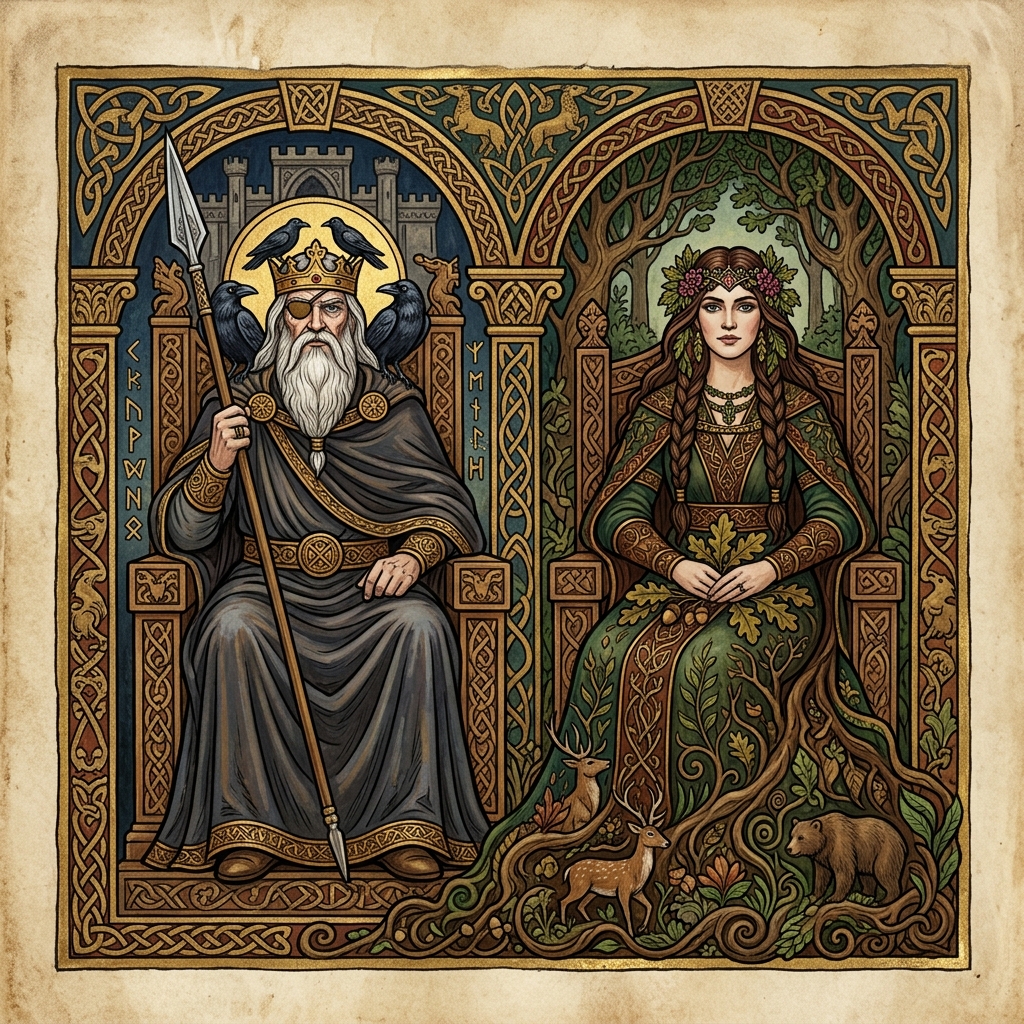
Odin, the father of the gods, is Thor’s father and his most important ally. Their relationship is characterised by mutual respect, but also by differing values: Odin is the cunning, far-sighted strategist – Thor the direct, fearless warrior. Both need each other. Odin rules through knowledge, Thor protects through strength.
Mother: Jörd
Thor’s mother is Jörd, whose name literally means ‘Earth’. She belongs to the Jötnar – the race of giants – and is a personification of the Earth itself. Through her, Thor has a deep connection to nature: he protects not only the gods, but also the fertile Earth and the life it sustains.
Siblings
Thor’s most important siblings among Odin’s sons:
- Baldur – god of light and purity; his death, caused by Loki’s scheme (a mistletoe branch thrown by the blind Hödur), marks the beginning of Ragnarök. Baldur is said to rise again after Ragnarök.
- Hödur – Baldur’s blind brother; unwittingly used by Loki as a tool for Baldur’s death; later killed by Váli in revenge.
- Víðarr – son of Odin and the giantess Gríðr; god of silence and vengeance; in Ragnarök, he kills the wolf Fenrir, who had devoured Odin; survives and helps shape the new world after Ragnarök.
- Váli – begotten by Odin specifically as Baldur’s avenger; kills Hödur.
- Meili – little is known; mentioned in the sources as Thor’s brother.
Loki – not a brother, but a constant companion
Loki is not Thor’s biological brother, but Odin’s blood brother – and thus part of the divine family. His relationship with Thor is one of the most dynamic pairs in Norse mythology: Thor strikes, Loki schemes. Loki regularly gets Thor into trouble – and then helps him resolve it. The theft of Mjölnir by Thrym, for example, began with a mess caused by Loki and was resolved through Loki’s cunning. It is only with Baldur’s death and Ragnarök that the trickster becomes a true enemy.
Wife: Sif
Thor’s wife Sif is known for her legendary golden hair. Loki once cut it off – a grave offence. Thor then forced him to have the dwarves forge new, magical hair from real gold. Sif is associated with fertility and the flourishing of crops.
Children
- Magni (with the giantess Járnsaxa) – ‘the Strong’; survives Ragnarök and, together with his brother, inherits Mjölnir
- Modi – ‘the Brave’; also a survivor of Ragnarök and co-heir to Mjölnir
- Thrúd (with Sif) – ‘Strength’; daughter of Thor, an independent mythological figure
Thor and the World Tree Yggdrasil
Yggdrasil, the gigantic ash tree that connects all nine worlds, is the cosmic centre of Norse mythology. The dragon Níðhöggr gnaws at its roots, thus threatening the order of the worlds. Thor’s role as protector of the cosmic order is closely linked to this image: he maintains the boundaries between the worlds by repelling the Jötnar, who repeatedly attempt to subjugate Asgard and Midgard.
Thor among the Vikings: Worship in everyday life

For the Vikings, Thor was not an abstract myth – he was an ever-present protector. Sailors prayed to him before stormy crossings. Warriors wore his hammer as a protective amulet. Farmers invoked him to ask for rain and fertility.
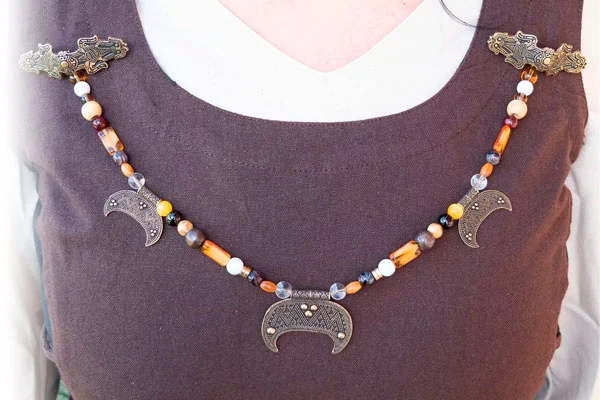
- Mjölnir amulets are one of the most common archaeological finds from the Viking Age – in graves, dwellings and as isolated finds throughout the Nordic region
- Wedding rite: Thor’s hammer was placed in the bride’s lap – a ritual for fertility and protection
- Temples: Archaeological finds in Norway – including a discovery from the year 2024 in the Gjellestad region – provide evidence of temples dedicated to Thor and other gods
In modern popular culture, Thor has achieved worldwide fame – through films, comics and games. These depictions differ considerably from the mythological sources in some respects, but have helped to rekindle interest in Norse mythology worldwide.
Thor in LARP and re-enactment
Anyone playing a Norse warrior, a Viking or a follower of the old faith moves in a world steeped in Thor. The Mjölnir amulet around the neck, the belief in Thor’s protection at sea and in battle, the knowledge of Ragnarök and the fate of the gods – all this gives characters in an early medieval setting a historically grounded depth.
At vehi-mercatus.de you’ll find clothing and accessories for historically accurate Viking portrayals – from wool tunics to Mjölnir amulets.

An overview of the key figures surrounding Thor
| Character | Relationship to Thor | Role in the myths |
|---|---|---|
| Odin | Father | Father of the gods, strategist; dies in Ragnarök at the hands of Fenrir |
| Jörd | Mother | Earth goddess, Jötunn; Thor’s connection to nature |
| Sif | Wife | Goddess with golden hair; fertility |
| Járnsaxa | Companion | Giantess; mother of Magni |
| Loki | Companion / later enemy | Trickster; companion and instigator of adventures; adversary in Ragnarök |
| Jörmungandr | Archenemy | Midgard Serpent, son of Loki; mutual death in Ragnarök |
| Magni & Modi | Sons | Heirs to Mjölnir after Ragnarök; survivors of the final battle |
| Thrúd | Daughter | Goddess of strength |
| Baldur | Half-brother | God of light; his death heralds Ragnarök; resurrection thereafter |
| Víðarr | Half-brother | Avenges Odin’s death in Ragnarök; Survivor |


