

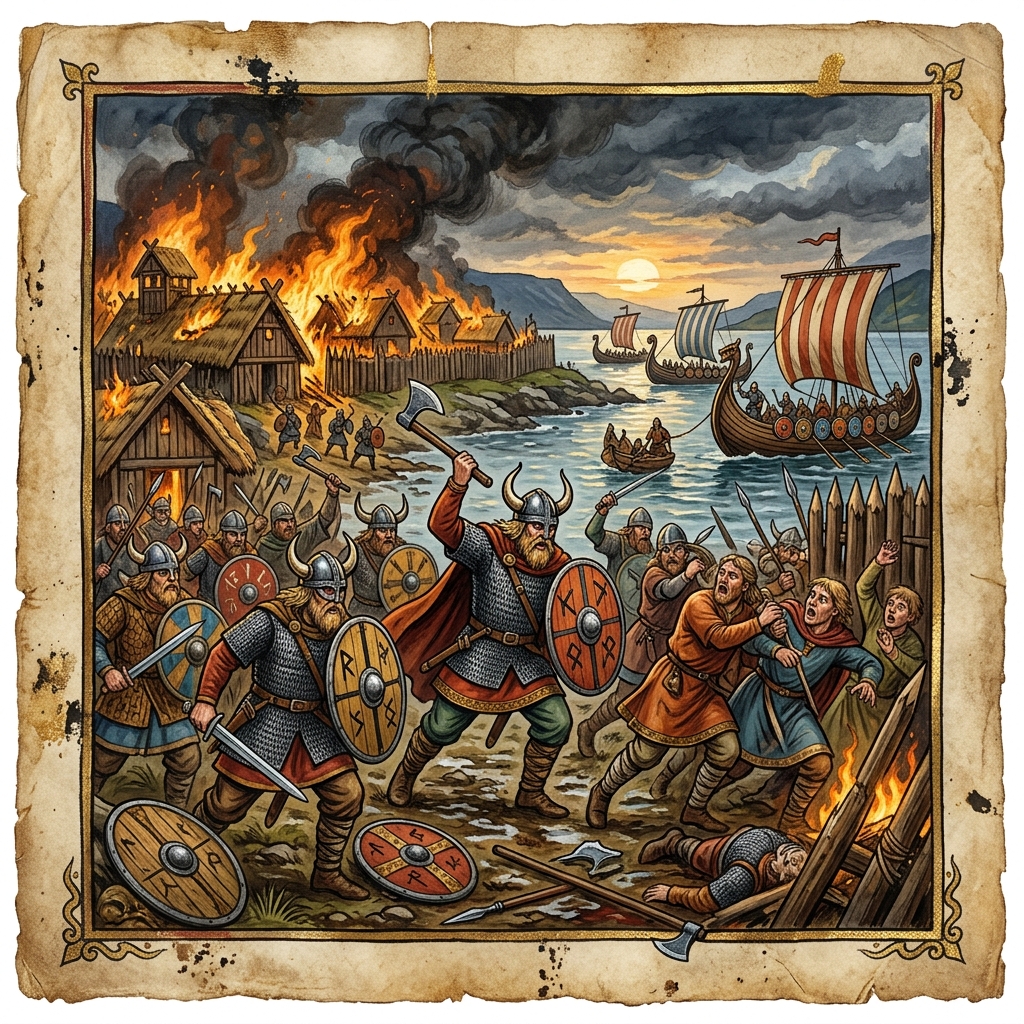
Horned helmets, bloodstained axes, burning villages: when we think of Vikings, the same scene usually plays out in our minds. Yet the history of these Nordic seafarers is full of surprises that have little to do with this cliché. This article delves into the most bizarre and fascinating aspects of everyday Viking life – from artfully filed teeth to board games on the high seas and an astonishingly sophisticated personal hygiene routine.
Here’s what you can expect in this article
- Key points at a glance
- Just how wild were the Vikings really?
- Filed teeth and body modification
- Games on the longship: board games to beat boredom at sea
- Daily life on board: the longship as a floating home
- Surprisingly clean: Viking hygiene and fashion
- Myths, intoxicants and rituals
- Viking women: traders, warriors, gamblers?
- Runes, codes and secret messages
- The Vikings as explorers: from Vinland to the Caliphate
- Fact-check: What is myth, and what is verifiable?
- Curious finds in Viking settlements and graves
- Why do Vikings still fascinate us today?
- Museums and archaeological sites to explore for yourself
- Frequently asked questions
 Reading time approx. 14 mins.
Key facts at a glance
- Over 130 male skeletons from the Viking Age show signs of deliberately filed teeth – presumably a distinguishing mark of certain social groups, rather than a general characteristic of all Vikings.
- A double-sided game board was found in the Gokstad ship burial (c. 900 AD): this proves that board games on longships served to entertain the crew and foster team spirit.
- Vikings attached great importance to personal hygiene: combs, tweezers and ear spoons were part of their basic kit, and there is evidence that they bathed regularly.
- The theory that drugs were responsible for the berserker frenzy is scientifically controversial and is explicitly regarded as speculation – some researchers consider henbane to be a more plausible explanation than the often-cited fly agaric.
- Women also played a significantly greater role in everyday Viking life than had long been assumed – as demonstrated, amongst other things, by the graves at Oseberg and Birka.
Just how wild were the Vikings really?

Imagine a longship around the year 900: Salt water splashes over the gunwale, the wind tugs at the sail, and between the rowing benches sit warriors with distinctive grooves in their front teeth – not from sharpening swords, but bent intently over a board game. What sounds like a scene from a modern TV series is archaeologically proven.
Our image of the Vikings often stems from films, TV series and popular documentaries. Yet the historical facts are, in some cases, more surprising than any fiction. The so-called Viking Age is generally considered to span from 793 to 1066 AD – from the raid on Lindisfarne Monastery on the English coast to the Battle of Hastings. Far more happened during this period than just plundering and raids. This article focuses not on the classic themes of battle and politics, but on the curious details: filed teeth, game pieces, hygiene and secret runic messages.
Filed teeth and body modification
One of the most unusual finds of recent decades: across Scandinavia, archaeologists have so far identified over 130 male individuals with deliberately modified teeth, a good half of them on the island of Gotland alone. At the Kopparsvik burial ground alone, 46 burials with filed teeth have been found. The modifications consist of horizontal grooves in the upper – and sometimes lower – incisors, usually applied with remarkable craftsmanship.
Chronologically, most of the finds date from the height of the Viking Age between the 10th and 11th centuries, whilst the earliest examples from Uppland date back to the very beginning of this period. It has been established that the grooves were made during the individuals’ lifetimes, presumably using a fine file. It is not certain whether they were additionally highlighted with paint or soot.
Exactly what lay behind this practice remains unclear to this day. Several explanations are being discussed in academic circles: a distinguishing mark for a particular social group or trading network, a fashion statement amongst men, an intimidating effect in battle, or an initiation rite. What is striking is that many of the individuals in question show no signs of combat experience, such as bone trauma or weapons found as grave goods. This suggests that they were not exclusively warriors. Filed teeth were apparently the hallmark of a specific group, not a general characteristic of all Vikings.
In addition to the teeth, there were other forms of body modification. In the 10th century, the Arab traveller Ahmad ibn Fadlan described Nordic traders on the Volga as being tattooed from their fingertips to their necks with dark trees and figures. As skin decays over the centuries, this description cannot be directly confirmed archaeologically – it remains a written source, not physical evidence. Added to this were braided beards, elaborate hairstyles and jewellery made of gold, silver, bronze and amber, which also served as a status symbol.
Games on the longship: board games to combat boredom at sea
In the Gokstad ship burial in Norway, dated to around 900 AD, a double-sided game board was found alongside horses, dogs and a peacock: on one side, a 13×13-square board for a game of Tafl; on the reverse, a board for Nine Men’s Morris. This find shows that board games were an integral part of Viking life on board.
The Vikings’ favourite board game was Hnefatafl. Unlike in chess, the balance of power here is deliberately uneven: a king with few defenders must break free from the encirclement of a numerically superior attacking force. The game requires strategy and foresight and is even mentioned in Old Norse poetry, for example in the Völuspá, where Tafl appears as one of the gods’ pastimes.
The game pieces themselves tell a story of trade and prosperity: they were made of glass, bone, walrus tusk or amber. Over a hundred game pieces have been found at the ancient trading centre of Birka in Sweden. It is easy to picture the scene: warriors sitting on the rowing benches, the ship rocking in the swell, and between them lies a simple game board carved into wood. On voyages lasting weeks, the game served not only as entertainment but also helped to maintain the crew’s morale and cohesion – for boredom and restlessness in such confined quarters could quickly become dangerous.
Daily life on board: the longship as a floating home
Viking ships were technical masterpieces. A typical longship measured 20 to 30 metres in length, had a shallow draught and was constructed using clinker-built methods from thin, tough and elastic wooden planking – a design that gave the ships remarkable flexibility on rough seas. At the same time, the slightly concave hull made them seaworthy enough to cope with heavy waves.
The ships could be sailed or rowed: when there was no wind, the crew would take to the oars; when the wind was favourable, the sail would be hoisted. If necessary, the men would even carry their boats overland to link rivers and lakes – a technique known as portage. Because the flat-bottomed boats could easily be hauled onto the beach, rapid landings were possible on almost any coastline.
Life on board was cramped, hard and, at the same time, remarkably organised:
- The crew slept under the open sky or under canvas tarpaulins, huddled close together.
- Meals were cooked on a sand-filled hearth on board or on the shore when they landed.
- Animals travelled with them: horses, sheep, falcons and dogs have been found as grave goods in ship burials.
- Millstones and round stones served as ballast and could be thrown overboard in case of danger.
Discipline held the group together, whilst stories, music and humour helped them endure the hardships of the journey. Legends of gods and heroes were told in the evenings – a tradition that fostered a sense of community, even when conditions at sea became threatening.

Surprisingly clean: Viking hygiene and fashion


The cliché of the filthy barbarian does not stand up to archaeological reality. Compared to many of their contemporaries in Europe, the Vikings were considered remarkably hygiene-conscious. Combs were the most commonly found personal care items: in Birka alone, over 700 combs made of horn, bone and other materials were excavated. These were joined by ear spoons, tweezers and beard trimmers – a veritable hygiene kit that was evidently part of the basic kit.
How regularly they bathed cannot be directly deduced from archaeological finds, but it can be inferred from written sources: In the 12th century, the English chronicler John of Wallingford complained that the Danes combed their hair daily, bathed every Saturday and changed their clothes frequently – and in this way even seduced married women and the daughters of the nobility. The Old Norse name for Saturday, ‘laugardagur’, literally means ‘bathing day’ and lives on to this day in the Scandinavian languages. Personal hygiene was thus also an expression of wealth and social status.
When it came to fashion, Vikings favoured colourful clothing made of wool and linen, adorned with narrow woven trims and metal clasps. Women wore oval brooches, whilst men wore magnificent belts and arm rings. The contrast is striking: warriors with filed teeth and possibly tattoos, who were at the same time freshly combed and smartly dressed.
Myths, intoxicants and rituals
Belief in Odin, Thor, Freyja and Loki was not an abstract concept, but permeated everyday life, even on board. Offerings were made before dangerous voyages, and runic inscriptions on shields or weapons were intended to provide supernatural protection.
One of the most controversial questions in Viking research is whether the legendary battle frenzy of the berserkers was triggered by intoxicants. For a long time, the fly agaric (Amanita muscaria) was considered the most likely candidate. The ethnobotanist Karsten Fatur challenged this assumption in 2019: according to his argument – which he explicitly described as speculative – the active profile of henbane (Hyoscyamus niger) is a better fit for the traditionally reported symptoms, such as disinhibition, reduced sensitivity to pain and mental drowsiness lasting for days, whilst the fly agaric tends to have a sedative-hallucinogenic effect. As evidence, Fatur points, amongst other things, to a Danish woman’s grave dating from around 980 AD, in which a pouch containing henbane seeds was found – possibly the grave of a healer or seer. This is not conclusive evidence for the ‘berserker drug theory’: neither the sagas nor contemporary travel accounts explicitly mention the deliberate consumption of fly agaric or henbane by berserkers, and Fatur himself emphasises that his theory has not yet been archaeologically substantiated.
Animal sacrifices and communal drinking played a central role in ritual blót sacrifices. Cannabis seeds have also been found in graves on isolated occasions, more frequently in female burials, which could indicate medicinal or ritual use. Modern popular culture regularly exaggerates these aspects, whilst actual practices varied greatly depending on the region and period.
Note: The historical intoxicants mentioned are cited solely for the purposes of cultural and historical context. They are not intended as instructions or a recommendation for consumption.
Viking women: traders, warriors, gamblers?
The image of a purely male-dominated Viking world is increasingly crumbling. Archaeological finds show that women were significantly more active than conventional wisdom would suggest.
The Oseberg ship burial in Norway, dated to around 834 AD, contained the remains of two women alongside elaborate sledges, textiles, animals and ritual objects – one of the richest graves of the entire Viking Age. Even more of a sensation was caused by grave Bj 581 in Birka, Sweden, which was long thought to be the grave of a male warrior. A DNA analysis carried out in 2017 revealed that the skeleton belonged to a woman, surrounded by weapons, a horse and game pieces. The interpretation of this grave remains a subject of controversy amongst researchers to this day: whilst some researchers see it as evidence of a real female warrior, others urge caution, as grave goods alone do not necessarily prove that a warrior role was actually practised.
Regardless of this debate, one thing is clear: women ran the household and the farm whilst the men were away on expeditions; they traded, operated looms and took part in board games. Legally, too, they were not entirely deprived of their rights: under the Old Norse legal system, known as the ‘Thing’, women could, under certain conditions, obtain a divorce, inherit property and act as head of the household.

Runes, codes and secret messages
The Vikings wrote using the Futhark, a runic alphabet that takes its name from the first six characters. The Old Norse word ‘rún’ originally meant something like ‘secret’ – a reference to the special cultural significance of the script.
Runes were carved into stones, now known as runestones, which can still be found scattered throughout Scandinavia. Their inscriptions often describe the heroic deeds of leaders and served as a kind of public memorial. Yet runes were by no means reserved solely for ceremonial occasions: During excavations in the medieval Bryggen district of Bergen, archaeologists discovered around 670 runic inscriptions on wooden sticks – including love letters, curses invoking ancient gods, elves and trolls, shopping lists and even coded messages. These finds are regarded as one of the most significant runic discoveries of the 20th century and show that runes served entirely mundane purposes in everyday life, comparable to a mixture of a note and a private message.
The Vikings as explorers: from Vinland to the Caliphate
Around the year 1000, the Vikings reached North America, some 500 years before Columbus: Leif Eriksson sailed from Greenland to Vinland, where the archaeological site of L’Anse aux Meadows in Newfoundland is located today. However, the expansion had begun even earlier: Iceland was settled from around 870, and Greenland from around 985.
To the east, the so-called Varangians travelled up Russian rivers as far as Constantinople and into the Caliphate. Arab silver dirhams from the 9th and 10th centuries, found in Scandinavian settlements, bear witness to the enormous reach of these trade routes. The Vikings were skilled seafarers who navigated by the position of the sun and the stars in order to cover such vast distances.
The explorers’ cargo included not only weapons but also board games, jewellery, textiles and everyday objects – in a sense, everyday life travelled with them. Vikings were not merely plunderers, but also traders who built up networks along their routes. One example of the flip side of their military presence is the so-called Danegeld: Between the 9th and 11th centuries, English kingdoms repeatedly paid large sums of tribute to Viking armies to ward off raids or to buy off their withdrawal – a fact which also illustrates just how seriously the military threat posed by the Vikings in England was taken.
Fact check: What is myth, and what is verifiable?
Many Viking myths persist. Here is a comparison:
| Myth | Fact |
|---|---|
| Vikings wore horns on their helmets | Viking helmets were simple, functional and made of iron – horns would only have got in the way during battle and there is no archaeological evidence for them. |
| All Vikings were fierce barbarians | Many were farmers, craftsmen and traders who appreciated jewellery, stories, games and personal grooming. |
| Vikings were constantly drunk | Alcohol played a part in festivals and rituals, but discipline generally prevailed whilst at sea. |
| ‘Vikings’ were a single people | The word originally described an activity – ‘going on a voyage’, raiding or trading – not an ethnic identity. The people came from different parts of Scandinavia. |
| Berserkers are known to have taken fly agaric | The theory is controversial and is regarded as speculation. Some researchers consider henbane to be a more plausible candidate, but there is no clear evidence for either substance. |
| Viking tattoos have been archaeologically confirmed | Ibn Fadlan’s description is regarded as strong evidence, but as skin decomposes, no direct archaeological evidence exists. |
Curiosities found in Viking settlements and graves
- Picture stones from Gotland: large, richly decorated stone slabs that often depict ships, battle scenes and mythological motifs – a unique visual record of everyday Viking life and their imagination.
- Complete game sets as grave goods: A complete set comprising three dice and 28 game pieces made from antler was found in a Viking grave – an indication of the high status accorded to board games amongst high-ranking individuals.
- Exotic animals and animal products: Falcons, bear claws and walrus ivory as status symbols in Norwegian and Swedish ship burials.
- Byzantine and Arab coins: Imported glass and coins from the Mediterranean region and the Orient found in Scandinavian settlements demonstrate the reach of the Viking Age trade network.
- Evidence of dental care: A study from Varnhem examined 171 individuals with over 3,293 teeth and found, in addition to the aforementioned tooth filing, evidence of toothpick use and the treatment of dental infections – a surprisingly meticulous dental practice.
Why do Vikings still fascinate us today?
It is precisely this blend of toughness and refinement that makes the Vikings so compelling to this day: warriors who raided monasteries on the coast – and shortly afterwards played board games, combed their beards and possibly had themselves tattooed. These contradictions continue to arouse curiosity to this day.
Modern TV series, computer games, festivals and documentaries continually revisit this fascination. Some depictions are based on genuine finds, whilst others clearly exaggerate. New archaeological methods, such as DNA analysis and isotope research, are constantly changing our understanding and continually bringing new, surprising details to light.
Museums and archaeological sites to explore for yourself
For those who wish to see original artefacts with their own eyes, several major museums are open to the public: the Nationalmuseum in Copenhagen, the Viking Ship Museum in Roskilde, the Haithabu Museum near Schleswig, and the Historiska Museet in Stockholm. The former Vikingskipshuset in Oslo has been closed since 2022 and is set to reopen at the end of 2027 as the new Museum of the Viking Age, with a significantly expanded exhibition space. In these museums, Viking culture comes to life – beyond any clichéd notions.
Frequently asked questions
Did all Vikings really have filed teeth?
No. Filed teeth have so far only been identified in over 130 male skeletons from across Scandinavia. This was a distinguishing feature of specific groups, presumably linked to trading networks or social communities, rather than a universal characteristic. There are as yet no clearly documented cases among women.
What board games did the Vikings play apart from Hnefatafl?
As well as Hnefatafl, a simpler version of Nine Men’s Morris was widespread – the Gokstad board featured this variant on its reverse side. Dice games using bone dice were also part of their repertoire. The exact rules have to be reconstructed in part from the context of archaeological finds and later written sources.
Is there any evidence that Vikings were tattooed?
The strongest evidence comes from the 10th-century travel account of Ahmad ibn Fadlan, who describes Norse traders as being tattooed from their fingertips to their necks. As skin decomposes, there are no direct archaeological finds to support this – the practice of tattooing is considered likely, but not physically proven.
What was the diet like on board a Viking ship?
On their voyages, the crews carried dried fish, salted meat, flatbread, cheese, and water or beer. Simple stews were cooked on a sand-filled hearth on board or on the shore when they went ashore. The diet was primarily designed for shelf life; luxuries were rarely found on board.
Can Viking ships and archaeological sites still be visited today?
Yes. Among the most important sites are the Viking Ship Museum in Roskilde (Denmark), the Haithabu Museum near Schleswig (Germany) and the Historiska Museet in Stockholm (Sweden). The Museum of the Viking Age in Oslo (the successor to the Vikingskipshuset) is currently under construction and is due to reopen at the end of 2027.


Letters from the trading house
New arrivals, market dates and offers, straight from Rinchnach. Unsubscribe any time with one click.
Subscribe to the newsletter

