

The gladiatorial combats of ancient Rome have fascinated people for centuries. What began as a modest funeral ritual involving just a few fighters developed into one of the greatest mass spectacles in history. But how much of what we know from films like *Gladiator* actually corresponds to historical reality?
Here’s what you can expect in this article
- The origins of gladiatorial combat
- Gladiatorial games in the late Republic and early Empire
- Gladiators: origins, daily life and training
- Types of gladiators and weaponry
- Women in the arena: gladiatrixes
- The course of a gladiatorial contest
- The social role and perception of gladiators
- Amphitheatres and other venues
- Criticism, prohibition and legacy
- Gladiators in art, literature and film
- Gladiators in LARP and historical re-enactment
- Frequently asked questions about gladiatorial combat
 Reading time approx. 11 mins.
Key facts at a glance:
- Time period: Gladiatorial combat existed from around 264 BC until the early 5th century AD and was a central element of Roman entertainment culture as well as a political instrument of power.
- Ritualised fights with rules: The duels in the arena followed strict regulations with referees who actively intervened. Not every fight ended in death – in the 1st century, the mortality rate was around 20 per cent.
- Origin of the fighters: Most gladiators were slaves, prisoners of war or convicted criminals. Nevertheless, free men and, in isolated cases, women also volunteered to compete in order to gain fame and money.
- From private ritual to state spectacle: What began as private funeral rites became, under Augustus, an imperial privilege and an instrument of mass entertainment based on the principle of ‘bread and circuses’.
- Distorted modern image: Films such as ‘Spartacus’ (1960) and ‘Gladiator’ (2000) have strongly shaped our perception, yet they exaggerate the brutality and oversimplify the complex rules of gladiatorial contests.
Origins of gladiatorial combat
The origins of gladiatorial combat remain a subject of debate among scholars to this day. Religious, ritual and political elements intertwine in complex ways. Roman authors such as Livy suspected an Etruscan influence, yet direct evidence is lacking.
Archaeological finds provide important clues: tomb paintings from Paestum in Campania dating from the 4th century BC depict pairs of armed combatants with a third man acting as referee. This points to a local development in an area influenced by the Etruscans and Greeks.
Campania is considered the likely region of origin. The early fights were presumably part of funeral rites, in which bloodshed was regarded as an offering to the deceased – a ritual intended to nourish the dead.
The first documented gladiatorial games (264 BC)
The first reliably documented munus took place in Rome in 264 BC. Decimus Iunius Brutus Scaeva and his brother organised three pairs of fighting slaves in honour of their late father, Decimus Iunius Brutus Pera. These early games were held at the Forum Boarium – without a permanent amphitheatre, using only makeshift facilities. The term munera refers to obligatory or honorary offerings for the deceased, whilst bustuarii referred to fighters at the pyre.
Expansion in the 2nd and 1st centuries BC
In the 2nd century BC, gladiatorial games evolved from mere funeral games into major urban events. Wealthy families and rising political figures recognised the potential of the games to gain popularity among the people. This development included:
- The construction of wooden stands and temporary arenas
- The addition of venationes (animal hunts featuring exotic animals)
- The inclusion of executions in the programme
- Spread to many Italic cities outside Rome
Gladiatorial games in the late Republic and early Empire
The 1st century BC, marked by civil wars and social tensions, made the games an indispensable political tool. Famous politicians such as Gaius Julius Caesar deployed 320 gladiators in silver armour to impress the audience.
The economic cost was enormous: equipment, training, exotic animals and stage sets consumed fortunes. A single performance in the arena could ruin a private organiser.
From private event to public duty
Until the mid-1st century BC, the games were predominantly financed by private individuals. With public funding, gladiatorial games became part of the official festival calendar. Nevertheless, wealthy private individuals continued to organise their own games, often as part of election campaigns.
The games as an imperial privilege under Augustus
After 27 BC, Augustus made the right to hold major gladiatorial games an imperial prerogative. He set upper limits:
| Regulation | Restriction |
|---|---|
| Gladiators per private event | Maximum 120 |
| Number of event days per year | Limited |
| Imperial events | Approx. 10,000 fighters in total |
Emperors such as Titus bolstered loyalty and the cult of the emperor through spectacular games – such as the inauguration of the Colosseum in 80 AD, which featured thousands of animals. From then on, private organisers required imperial permission.
Gladiators: origins, daily life and training

The situation of gladiators was paradoxical: socially ostracised as infames (dishonourable), they were simultaneously revered as heroes. The main groups:
- Slaves and prisoners of war
- Convicted criminals (damnati)
- Volunteer contractus gladiators
Free men – mostly poor or impoverished citizens – signed contracts to serve as gladiators for 2–5 years, either for financial reasons or in pursuit of glory. Successful fighters were able to lead a relatively privileged life thanks to prize money and gifts.
Gladiator schools (ludi) and training
The gladiator schools were strictly guarded barracks with cells, a training yard, an infirmary and a training arena. Famous schools were located in several places:
- Capua: the starting point of the Spartacus uprising
- Pompeii and Ravenna: Important training centres
- Rome: Ludus Magnus (with a tunnel to the Colosseum), Ludus Dacicus, Ludus Gallicus, Ludus Matutinus
Daily training included exercises with the wooden sword (rudis), training on the wooden post (palus), endurance training and technical instruction. In the 2nd century, the physician Galen treated gladiators in Pergamon and gained valuable medical insights into anatomy from their injuries.
Diet and physical requirements
Gladiators were nicknamed hordearii – ‘barley eaters’. Their diet consisted mainly of:
- cereal porridge and barley
- Legumes and beans
- Little meat
- Drinks made from plant ash as a source of minerals
Modern bone analyses from Ephesus confirm this high-carbohydrate, plant-based diet. The resulting layer of light body fat served as natural protection against cuts – a deliberate effect, not a sign of poor fitness.
Life expectancy and career prospects
Mortality was high, but not universally fatal:
| Period | Mortality rate |
|---|---|
| 1st century AD | Approx. 20% |
| 3rd century AD | Approx. 50% |
Archaeological finds suggest that the age at death was between 18 and 30 years. Successful fighters were awarded the symbolic rudis (wooden sword) as a sign of freedom after a certain number of victories. Many former gladiators subsequently worked as trainers (doctores) or bodyguards.
Incidentally, the famous saying “Ave Caesar, morituri te salutant” was not a standard greeting – historically, it is documented only once, in 52 AD during a re-enactment of a naval battle.
Types of gladiators and weaponry
Gladiatorial combats were staged duels with coordinated weapon types. Different types (armaturae) with clearly defined armour sets created excitement and variety. Our knowledge comes from inscriptions, reliefs, graffiti from Pompeii and preserved pieces of equipment.
Heavily armed gladiators
Samnite: The early, heavily armoured type with a large shield (scutum), helmet and greaves – later superseded by the Murmillo and Secutor.
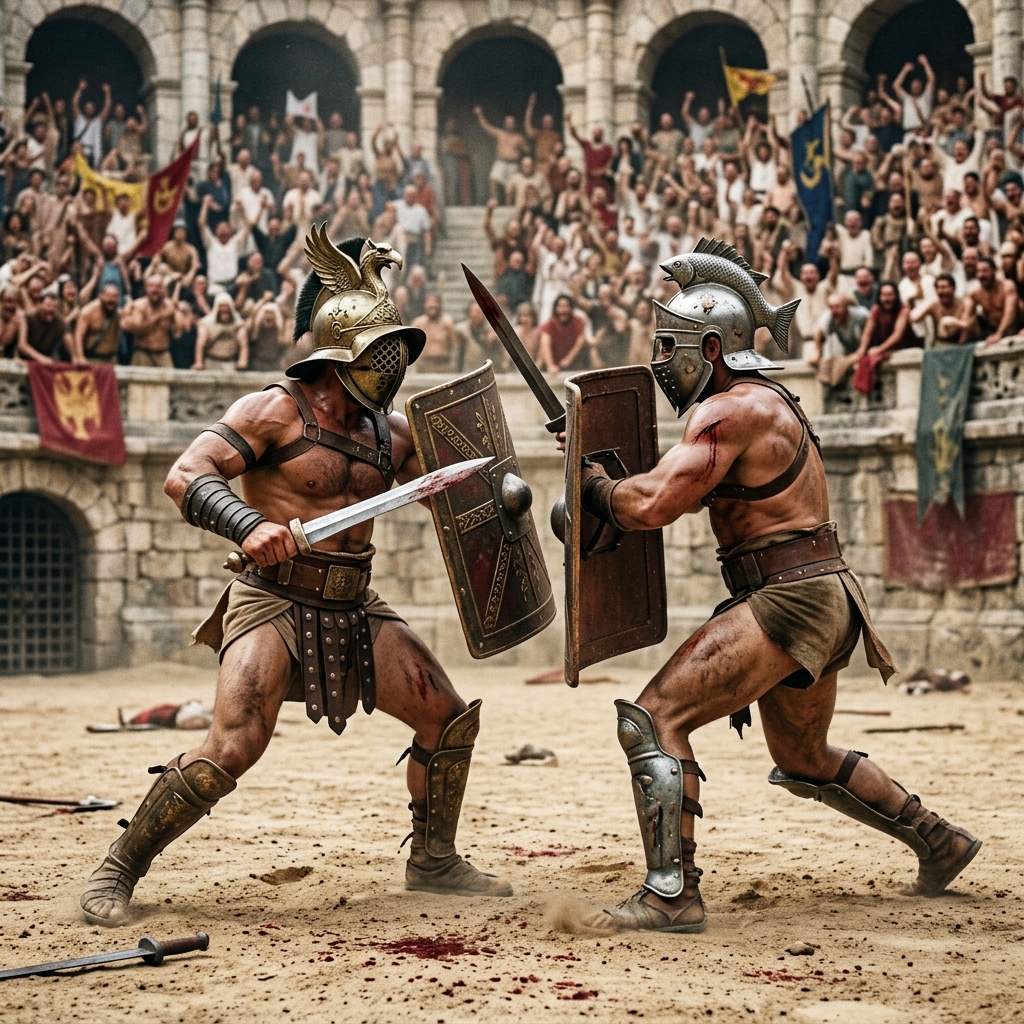
Murmillo: Short sword (gladius), large rectangular shield, helmet with a broad crest and often fish-shaped ornamentation. A classic heavyweight type.
Secutor: Specifically developed to fight alongside the Retiarier. His smooth, rounded helmet with tiny eye slits allowed nets to slide off.
Lightly armed gladiators
Thraker (Thraex): Small shield, curved short sword (sica), tall helmet with a bird of prey motif. Agile and fast.
Retiarier: The most unusual equipment – trident (tridens), net (rete), dagger and arm guards, but neither helmet nor shield.
Typical match-ups such as Murmillo versus Thraex or Secutor versus Retiarius created contrasts – comparable to character classes in modern games.
Rarer and specialised types
- Hoplomachus: Based on Greek hoplites
- Provocator: Equipped with breastplate
- Equites: Mounted gladiators who later continued fighting on foot
Costumes sometimes symbolised defeated peoples such as the Gauls, Germans or Dacians – thus the fights reflected Roman military victories.
Women in the arena: Gladiatrices
Female gladiators were rare, but historically documented. Literary sources such as Cassius Dio mention them, and a 2nd-century relief depicts two female gladiators who were honourably discharged.
Female fighters served primarily as an exotic sensation and were not part of the standard line-up. Around 200 AD, Emperor Septimius Severus banned women from appearing in the arena – due to tensions surrounding traditional gender roles. The existence of female gladiators shows just how flexible Roman forms of entertainment could be when it came to captivating the audience.
The course of a gladiatorial contest

A typical day of games included several events:
| Time of day | Programme |
|---|---|
| Morning | Beast hunts (venationes) |
| Midday | Executions (noxii) |
| Afternoon | Gladiatorial combats |
A munus was a comprehensive social event – comparable to a modern mega-sporting event combined with a town festival.
Organisation and preparation
The organisation involved various parties: the editor as the organiser and financier, and the lanista as the owner and manager of the gladiator troupe. Contracts regulated the number of fighters, match-ups and fees. The pompa (opening procession), accompanied by music and priests, made its way through the city. A few days before the event, gladiators were presented to the public so that spectators could choose their favourites. The lavish pre-event banquet (cena libera) showcased the fighters like stars.
The day of the fight in the amphitheatre
Strict social segregation prevailed in the amphitheatre: senators sat below, while ordinary citizens and women sat further up. The Colosseum held up to 50,000–70,000 people. Sunshades (vela) and water distribution points ensured a certain degree of comfort.
The actual fight
Gladiatorial combats were strictly regulated duels. Referees (summa rudis, secunda rudis) intervened with staffs. The procedure: greeting the audience, brief test blows, waiting for signals, regulated duels – not chaotic slaughter.
Possible outcomes included victory, pardon or, rarely, death on command. The famous ‘thumb question’ is more complicated than films suggest – ancient sources do not provide a clear picture. Victors received palm branches, victory ribbons, money and wreaths.
Social role and perception of gladiators
Gladiators occupied a contradictory position: legally disgraced as infamous, yet at the same time prominent idols. Philosophers such as Cicero and Seneca interpreted their bravery as an example of Roman virtue.
Gladiators as erotic idols
Successful gladiators had large fan bases, particularly among upper-class women. Graffiti from Pompeii describe them as ‘heartbreakers’ (suspirium puellarum). The satirist Juvenal described the affair of a senator’s wife named Eppia with a gladiator – socially scandalous, but apparently not uncommon.
Political threat: Spartacus and other uprisings
The Spartacus uprising (73–71 BC) began with the escape of some 70–80 gladiators from the school in Capua. The group led by Spartacus, Crixus and Oenomaus quickly grew into an army of 70,000–120,000 slaves. Marcus Licinius Crassus and Pompey crushed the uprising. Around 6,000 slaves were crucified along the Via Appia. The uprising led to stricter surveillance of the gladiator schools.
Amphitheatres and other venues

Early fights took place at the Forum Boarium and the Roman Forum in makeshift wooden structures. In Campania, brick-built amphitheatres, such as the one in Capua, served as models for later constructions.
The Colosseum in Rome
The history of the Colosseum’s construction:
- Start: Emperor Vespasian, c. 72 AD
- Inauguration: Titus, 80 AD
- Completion: Domitian
The Amphitheatrum Flavium featured an elliptical arena with a sand floor, underground passages (hypogeum) and tiered seating. Gladiatorial combats, animal hunts and, on rare occasions, naval battles took place here. It remained in use into the 5th century, before being repurposed as a quarry.
Criticism, prohibition and legacy
Criticism existed even in antiquity – Seneca spoke out against the brutalisation of the audience. Emperor Marcus Aurelius attempted to curb costs and excesses. From the 3rd century onwards, Christian authors strongly condemned the games on moral and theological grounds.
The end of the gladiatorial games
It is difficult to pinpoint an exact final act. Key stages:
- 315 AD: Restrictions under Constantine
- 420s/430s: General ban in the Western Roman Empire
- Mid-5th century: Isolated fights in remote provinces
Ritualised combat in other eras
Ritualised violence is found across cultures: medieval tournaments, duels in modern times, bullfighting. Gladiatorial games differed in that the decision on life and death was made publicly by the game organisers and the audience.
Gladiators in art, literature and film
Since the 19th century, novels such as ‘The Last Days of Pompeii’ (Edward Bulwer-Lytton, 1834) have shaped our image. Jean-Léon Gérôme’s painting ‘Pollice verso’ (1872) established the popular thumbs-up gesture – historically questionable, but iconic.
Modern films such as “Spartacus” (1960) and “Gladiator” (2000) take historical liberties. They exaggerate the brutality and oversimplify the complex rules and code of honour of real gladiatorial contests.
Gladiators in LARP and Ancient Reenactment
The Roman arena is one of the most fascinating settings for historical re-enactment and ancient LARP. Anyone portraying a gladiator has a rich selection of character concepts: the heavily armoured Murmillo, the net-wielding Retiarian, the agile Thracian. Each type brings its own combat style and history.
For an authentic appearance, it’s worth choosing the right type – and the right equipment. A tunic, arm guards, sandals and the right accessories complete the character. At vehi-mercatus, you’ll find clothing and accessories for ancient re-enactments – from the simple Roman soldier to the arena character.

Frequently asked questions about gladiatorial combat
Were gladiatorial combats always fatal?
No, many fights ended in injury but not in death. Gladiators were expensive to acquire and train – constant mass killings would have been economically impractical. The death rate fluctuated between 20 and 50 per cent depending on the era.
How often did a gladiator have to fight each year?
The number of fights was limited – often just 2–5 appearances a year. Contracts stipulated minimum intervals between fights to allow for recovery and to preserve the ‘value’ of the fighters.
Were gladiators allowed to lead a normal life outside the arena?
Most gladiators lived in the schools under strict supervision with restricted freedom of movement. Successful fighters occasionally enjoyed special privileges such as trips into town, but remained legally unfree.
Were there children of gladiators, and could they be free?
Children of slave gladiators were generally slaves themselves. Children of free men were born free. Inscriptions suggest family ties and occasional marriages, although sources regarding private life are scarce.
How reliable is our current knowledge of gladiatorial combat?
Our understanding is drawn from literary sources, inscriptions, graffiti, excavations and modern scientific analyses – including bone analyses from gladiator graves in Ephesus. Many details, such as gestures, precise rules and mortality rates, remain disputed. New discoveries can expand our understanding at any time.


Letters from the trading house
New arrivals, market dates and offers, straight from Rinchnach. Unsubscribe any time with one click.
Subscribe to the newsletter

