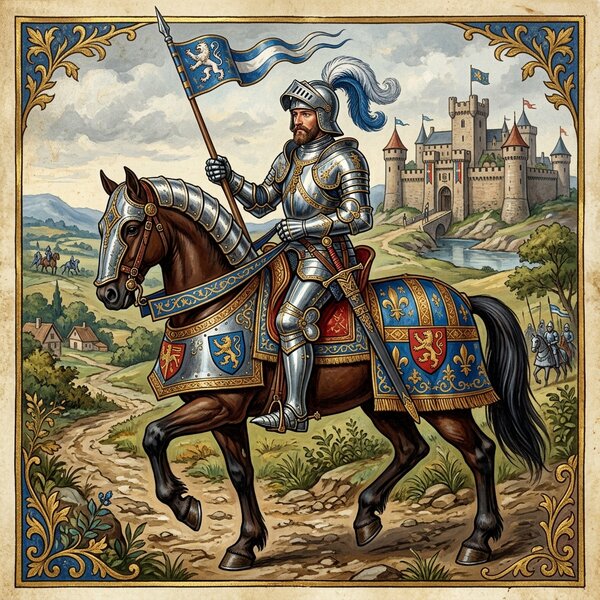

A suit of armour was far more than just a pile of metal plates. It was a sophisticated system comprising several layers, designed to balance protection, mobility and comfort – whilst placing a considerable strain on the wearer’s body. This article examines the structure of the armour layer by layer, explains the function of each component and illustrates what the extra weight meant for the human body.

What to expect in this article
- Key findings at a glance
- Introduction: Knight’s armour in its historical context
- Basics of the structure: the layered principle of knight’s armour
- The textile base: the gambeson and undergarments
- Chainmail: Ring armour as a flexible protective covering
- Plate armour: From breastplate to full armour
- Helmet Types and Head Protection: Development and Field of Vision
- Protection for arms, legs and hands: The precision mechanics of the joints
- Comfort, weight and physical strain: How burdensome was a knight’s armour?
- Putting on and taking off armour: the role of squires and the procedure
- Armour and Combat Tactics: Advantages and Disadvantages in Action
- FAQ – Frequently asked questions about the structure of a knight’s armour
 Reading time approx. 11 mins.
Key findings at a glance
- A classic suit of knight’s armour consisted of a gambeson, chainmail and plate armour – three layers, each with its own protective function.
- A full set of plate armour usually weighed between 20 and 25 kilograms and was nevertheless surprisingly flexible, provided it was precisely tailored to the body; with a helmet and weapons, a fighter carried a total additional load of around 30 to 40 kilograms.
- The additional weight of the armour had a similar effect on the body to a sudden increase in body mass index: the focus shifts to the joints, metabolism and cardiovascular system.
- Sports science experiments show that the energy expenditure when walking in full armour is around 2.1 to 2.3 times higher than without it – a recent study on modern sword fighting in armour also confirms significantly increased heart rate and lactate levels during combat.
- The development of armour spanned centuries: from the chainmail of the High Middle Ages to the Gothic full suit of armour around 1500, the materials, construction and weight distribution underwent fundamental changes.
Introduction: Knightly armour in a historical context
When people think of the history of knightly armour, they often picture a single image: the gleaming knight in full plate armour. In fact, the development of armour spans a period of over 400 years – from the simple chainmail of the 11th century to the highly specialised plate armour of the time of Emperor Maximilian I around 1500. Armour varied greatly across the centuries of the Middle Ages, influenced by new weaponry, changing combat tactics and regional blacksmithing traditions.
The design was always a compromise: maximum protection combined with sufficient freedom of movement. Armour that turned a knight into an immobile statue was worthless on the battlefield. At the same time, it could not have any weak points if it was to provide adequate protection.
Full suits of armour were extremely expensive, individually crafted by specialist armourers in centres such as Milan, Augsburg or Nuremberg – and were thus status symbols of the nobility. This article focuses on the physical construction and the individual parts of the armour, as well as their function – rather than on detailed descriptions of battles.
Basics of the structure: the layered principle of knightly armour
Knight’s armour consisted of several layers that functioned as a coordinated system. Each element fulfilled a specific purpose: shock absorption, protection against cuts or protection against stabs. The typical sequence from the inside out:
- Linen shirt or woollen garments – worn directly against the skin
- Gambeson (padded tunic) – shock absorption and weight distribution
- Chainmail – flexible protection against cuts
- Plate armour – rigid protection against blows, stabs and projectiles
- Tunic or outer garments – identification and protection from the weather
Padded garments were always worn beneath the armour. Even the undergarments and the gambeson could weigh several kilograms and were crucial for comfort and for preventing pressure sores. The protective layers were fastened together with leather straps and buckles.
More important than a low total weight was sensible weight distribution across the shoulders, hips and thighs – a principle that also underpins modern rucksack design and today’s protective clothing. The total weight of all the layers affected the metabolism in much the same way as a sudden increase in body mass index: a knight was, in effect, carrying additional metal weight that placed a constant strain on his circulation and joints.
The textile foundation: the gambeson and undergarments

No knight wore bare steel against his bare skin. There was always a layer of fabric between the body and the metal, which served several purposes at once.
The gambeson (also known as an aketon) was a thickly quilted doublet made of linen and wool, which had been widely used since the 12th century. Its appearance was distinctive: diamond-shaped or parallel quilted seams, natural-coloured or dyed fabrics, often made from several layers of fabric.
The gambeson cushioned impacts and protected against chafing caused by the chainmail or metal plates worn over it. It also absorbed sweat and distributed the weight of the plates over a larger area – a factor often underestimated when it comes to comfort.
| Period | Typical form |
|---|---|
| Around 1250 | Long-sleeved, reaching to the knee |
| Around 1400 | Medium length, close-fitting |
| Around 1500 | Short (arming doublet), with attachment points for plates |
Ordinary fighters often wore only a reinforced gambeson without metal, which already provided considerable protection against slashing blows.
Chainmail: ring armour as a flexible protective covering
From the 11th to the 13th century, chainmail was the most important form of armour for European knights. Chainmail was later often worn beneath plate armour, but remained in use for a long time as a form of armour in its own right.
Chainmail consists of interlocking metal rings – usually in the so-called ‘4-in-1’ pattern, in which each ring connects to four others. Historically, riveted rings were predominantly used; in Europe, up until the 14th century, these were often alternated with solid, unriveted rings made from a single piece. The ring diameters varied considerably throughout history, ranging from around 4 to 14 mm, with medium sizes of around 8 to 10 mm being particularly common.
The main components of chainmail armour:
- Chainmail (haubergeon) – protection for the torso and upper arms
- Chainmail coif – protection for the head and neck
- Chainmail gloves – hand protection
- Chain leggings – leg protection
Advantages: excellent fit to the body, high resistance to cuts from sword blows, good flexibility. Disadvantages: heavy (often 10 to 20 kg, depending on length and design), poorer distribution of weight across the shoulders compared to later plate armour, limited protection against targeted thrusts from lances and crossbow bolts.
From around 1280/1300, plate elements began to supplement chainmail armour in exposed areas – shoulders, knees, shins – as lance tips and bolts were increasingly able to penetrate the chain mail.
Plate armour: From breastplate to full armour
Plate armour evolved from chainmail – the transition took place between around 1350 and 1500. It consists of moulded metal plates that were precisely tailored to the wearer’s body.
High-quality armour was usually made of low- to medium-carbon steel; the exact carbon content varied considerably depending on the artefact and its origin, with modern metallurgical analyses of historical pieces showing values ranging from well below one per cent to, in isolated cases, just above it. The key factor was the combination of hardness and elasticity, which was achieved through the targeted hardening and tempering of the steel. Regional styles characterised the design:
- Italian armour was renowned for its elegant form and ornamentation
- German armour was robust and functional, particularly that from Nuremberg
- English armour often combined continental influences
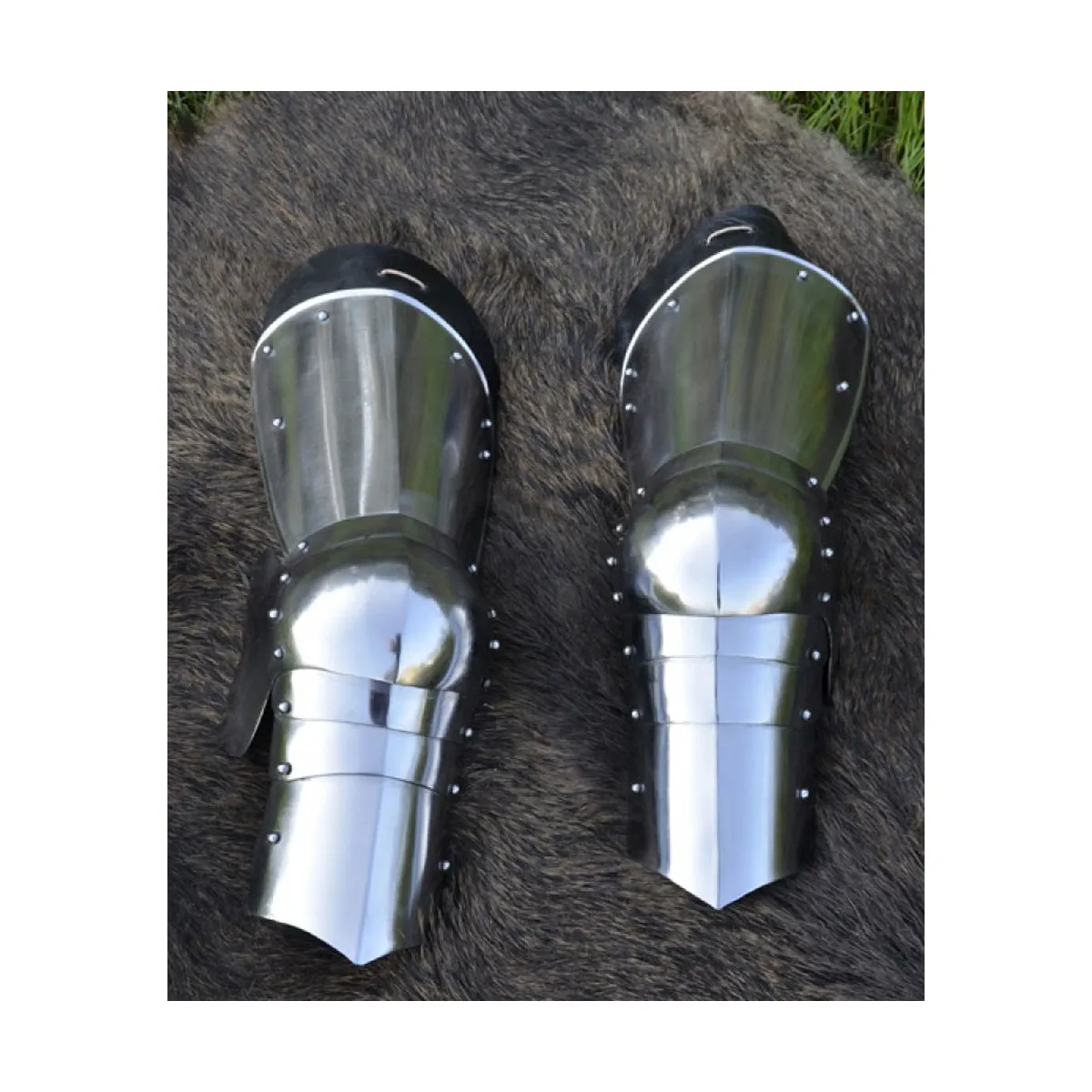
The cuirass protected the chest and back: a two-part construction, often with a central ridge to deflect blows, fastened with straps and buckles. In addition, full armour included shoulder and upper arm protection (pauldrons, rerebraces), hinged elbow guards (coudes/couters), vambraces for the forearm, thigh plates (cuisses), knee guards with side flaps (poleyns) and greaves.
Overlapping plates allowed for flexion and extension. A full set of plate armour weighed between 20 and 25 kilograms and was surprisingly flexible, as the weight was concentrated close to the body’s centre of gravity. Overall, it offered better protection against arrows and bolts than chainmail alone.

Helmet Types and Head Protection: Development and Field of Vision

Helmets vary in shape and function – their development reflects the entire history of knightly armour.
| Helmet type | Period | Features |
|---|---|---|
| Nasal helmet | Around 1100 | Open face, nasal bridge; basic head protection |
| Full-face helmet/pot helmet | 12th–13th centuries | Cylindrical, flat top, narrow eye slits |
| Bascinet | 14th century | Pointed, movable visor |
| Armet | c. 1500 | Fully enclosed, flip-up visor, maximum protection |
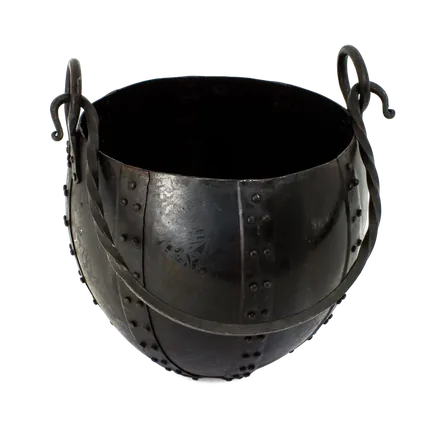
A typical pot helmet (12th/13th century) was cylindrical in shape with narrow eye slits and breathing holes; it usually weighed between 3 and 4 kilograms, whilst reinforced tournament versions could weigh up to 6 kilograms. Vision and breathing were severely restricted – which is why it was often only donned shortly before the fight.
The bascinet with a flip-up visor (14th century) offered decisive advantages: a variable opening, better ventilation and the ability to flip the visor up once out of the thick of battle. Inside, padding made of linen inserts and leather straps helped absorb blows and ensured a snug fit to the head’s circumference and shape. The downside: an increased risk of heat build-up, strain on the neck and impaired orientation – an additional weight of several kilograms on an already strained neck.
Protection for arms, legs and hands: the precision engineering of the joints
The limbs had to be armoured in a particularly complex manner to simultaneously provide protection, freedom of movement and the ability to wield weapons. Armour must fit precisely to prevent injuries – nowhere is this more important than at the joints.
Arm protection: Upper-arm tubes, elbow guards with wings to deflect blows, and forearm guards formed the arm protection. These were fastened to the gambeson using leather straps and buckles.
Gauntlets: These protected the hand whilst also improving dexterity. They consisted of articulated fingers, some with tapered fingertips – crucial for wielding a sword, lance and reins. Hinges and slats allowed for remarkable dexterity.
Leg armour: Thigh plates (cuisses), knee guards with side flaps (poleyns) and shin guards (greaves) were connected by overlapping plates. The backs of the knees were often protected by chainmail gussets (goussets). For horsemen, there were special mouldings on the inside of the leg.
Careful custom-fitting was essential to prevent chafing on the knees, elbows and wrists – a parallel to today’s sports and protective clothing, which must fit snugly without being constricting.
Comfort, weight and physical strain: just how burdensome was a knight’s armour?
The actual sensation of wearing armour depended less on the sheer number of kilograms than on weight distribution, physical fitness and level of training. Nevertheless, the figures speak for themselves.
| Component | Typical weight |
|---|---|
| Plate armour (c. 1500) | 20–25 kg |
| Helmet | 3–6 kg |
| Weapons (sword, lance, shield) | 5–10 kg |
| Total weight | approx. 30–40 kg |
By way of comparison: a modern soldier often carries a similar additional load of 20 to 30 kilograms whilst on field operations. If one were to factor this additional mass into a Body Mass Index calculation, it would result in a sharp rise from a normal weight to significant overweight – mind you, this is merely a figurative comparison, as the BMI itself does not take external equipment into account, but only body weight in relation to height. Nevertheless, the knight effectively carried a constant additional weight that placed a strain on his metabolism, joints and the entire circulatory system, much as excess body weight does today.
Sports science experiments – such as the much-cited study by Askew, Formenti and Minetti (2011) – show that the metabolic cost of walking in armour, with a total weight of around 30 to 50 kilograms, was approximately 2.1 to 2.3 times higher than without it. A case study on modern, full-armour sword fighting, published in 2024 by LUT University in Finland, confirms this finding from a different perspective: During simulated bouts in full armour, the combatants’ heart rates exceeded the age-related maximum towards the end of the duel, and blood lactate levels were significantly above the individual threshold – a sign of extreme physical exertion. Without specific training, a fighter in full armour was therefore subjected to a level of exertion that comes close to the modern-day definition of high-performance sport.
Putting on and taking off armour: the role of squires and the procedure

Putting on the armour usually required a squire – a knight could rarely don a full suit of plate armour on his own. The armour was donned from the inside out:
- Undergarments (linen, wool)
- Gambeson / arming doublet
- Leg armour and shoes (sabatons)
- Chainmail
- Chest and back armour (cuirass)
- Armour for the arms (pauldrons, bracers)
- Armoured gloves
- Helmet and, where applicable, shield
It took around 10 to 20 minutes, or longer, to don a high-quality plate armour – depending on experience and complexity. Tournament armour, with its additional reinforcements, took even longer. Straps, laces and buckles had to be tightened firmly but not so tightly as to cut into the skin, in order to distribute the weight correctly across the shoulders and hips.
Armour and combat tactics: advantages and disadvantages in use
The design of a knight’s armour had a direct influence on medieval tactics – particularly on heavy cavalry.
Advantages: substantial protection against blows and many projectiles, great striking power in mounted lance charges, and an intimidating psychological effect on the opponent.
Disadvantages: reduced stamina during long marches on foot, difficulties on challenging terrain such as mud, ditches or slopes, and an increased risk of injury if falling from a horse.
Historical examples illustrate the limitations of heavy armour: at Crécy (1346) and Agincourt (1415), the French knights were exhausted by soft, muddy ground during their advance and were defeated by lighter, more manoeuvrable English infantry armed with longbows.
As mobile infantry formations and firearms (hakebuses, early cannons) gained in importance from the 15th century onwards, the design of armour underwent a fundamental change. Specialised, heavy tournament armour emerged on the one hand, and lighter field armour on the other. Finally, the transition to lighter cuirass protection took place in the Early Modern period – the classic knight’s armour had largely lost its tactical value on the battlefield.
FAQ – Frequently asked questions about the structure of knight’s armour
How much did a full set of knight’s armour actually weigh?
Well-crafted plate armour from the 15th and 16th centuries usually weighed between 20 and 25 kilograms. Heavy tournament armour – such as the armour worn for jousting – could weigh considerably more, as the priority was on maximum impact resistance. Chainmail armour with a gambeson could reach a similar total weight, but was often more tiring to wear due to the less favourable weight distribution. By way of comparison: modern firefighters or soldiers often carry a similar additional weight in protective clothing and equipment.
Could a knight in full armour walk, ride and get back to his feet?
Trained knights in well-fitted armour could walk, climb stairs, ride a horse and get back up after a fall. Restrictions arose mainly in hot weather, on rough terrain or when exhausted – not due to the material alone. Modern re-enactment experiments show that people wearing historical armour can perform push-ups, pull-ups and short sprints. However, without appropriate training and physical preparation, nobody should wear full armour for any length of time.
Were there different types of armour for tournaments and battles?
Yes. Tournament armour was often heavier, thicker and reinforced on one side. The armour worn for tournaments, for example, had a heavily reinforced left side of the chest and a special helmet, whilst field armour was lighter and more versatile, offering better all-round visibility. The internal structure (gambeson, chainmail, plates) usually remained similar, but the wall thickness, weight and shape varied depending on the intended use.
What role did a knight’s physique play in the design of his armour?
Most suits of armour were made to measure, individually tailored to the wearer’s chest circumference, shoulder width, arm length and leg length. A knight had to be physically fit to carry the additional weight of the metal; being too heavy would have been a disadvantage on top of the weight of the armour. By the standards of the time, knights capable of combat tended to be lean and muscular. A knight’s build directly determined the size and fit of the armour and, consequently, its effectiveness.
How do you care for a historical suit of armour?
Armour should be cleaned regularly with a dry cloth. To prevent rust, it should be oiled with acid-free oil. Leather parts should be treated with special leather cleaners. Armour should be stored in a dry, well-ventilated room with as constant a level of humidity as possible.


Letters from the trading house
New arrivals, market dates and offers, straight from Rinchnach. Unsubscribe any time with one click.
Subscribe to the newsletter