
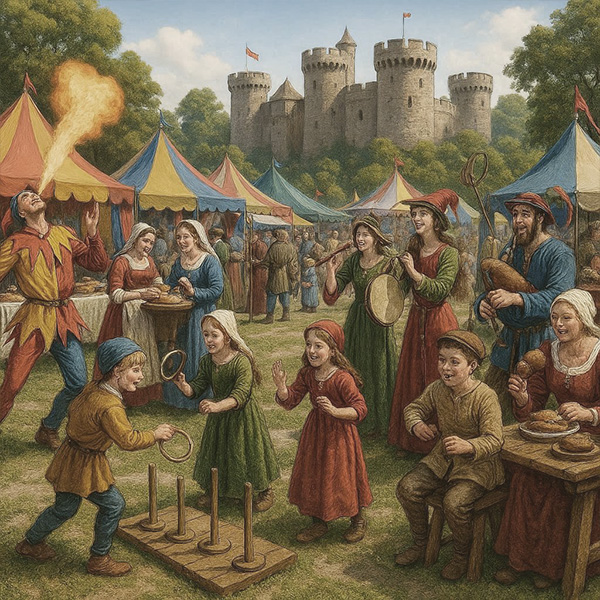
The sun is high in the sky, the streets are bustling with people, and the sound of hammering blacksmiths, singing musicians and cheerful laughter fills the air. You are standing in the middle of a medieval fair – and suddenly the Middle Ages come to life before your very eyes.
In the Middle Ages, fairs and folk festivals were far more than just trading centres. They were meeting places, theatre stages, kitchens, tournament grounds and social networks all at once. Anyone visiting a market back then was immersed in a world full of colours, scents and stories – an experience that still fascinates us today. The exhilaration sparked by a medieval folk festival captivates visitors with its emotional intensity and infectious atmosphere. A medieval folk festival or medieval fair is like a living journey back in time. Amidst half-timbered houses, the sound of bagpipes and the scent of freshly baked bread, an atmosphere emerges that transports visitors straight to the heart of centuries-old tradition. At such festivals, people from villages and towns come together to experience history, craftsmanship, music and culinary delights.
But what exactly defines a medieval folk festival? And why does it still hold such a fascination today? In this article, you’ll learn all about the origins, development, key attractions and the role of these events in Germany’s cultural history.

What to expect in this article
- Everything you need to know at a glance
- Origins and history of medieval folk festivals
- Kirchweih, Kirmes, Kerbe and Rummel – different terms, same joy
- Conclusion: The colourful hustle and bustle at the market
- Folk festivals: More than just entertainment
- Fairground operators, jugglers and their significance
- Attractions that delight – from jousting tournaments to craftsmanship
- A culinary paradise – eating like in the Middle Ages
- Social function – more than just entertainment
- Development up to the present day
- Modern folk festivals with a medieval flair
- Conclusion – keeping tradition and history alive

- Reading time approx. 15 mins.
Everything you need to know at a glance
- Historical roots: Medieval folk festivals originated from harvest times, church consecrations and the inauguration of new churches. They strengthened the sense of community and provided opportunities for trade, entertainment and economic activity.
- Cultural heritage: Showmen and jugglers, with their music, mock battles and crafts, created a cultural legacy in the form of the folk festival, which endures to this day as a traditional cultural asset and intangible cultural heritage.
- Today: Modern festivals combine historical attractions with fairground rides – from the Kiliani Volksfest in Würzburg to the Cannstatter Wasen in Stuttgart.
Origins and history of medieval folk festivals
The history of folk festivals in Germany goes back a long way – some festivals can be traced back to the 9th century. The term ‘Volksfest’ refers to a traditional festival that has evolved over the centuries and is now a central element of German festival culture. They originally developed from church consecration celebrations, i.e. festive occasions marking the consecration of a church, which are considered the origin of many folk festivals. In many cases, these were linked to large markets where traders from across the region offered their wares; in the Middle Ages, various terms such as ‘fair’, ‘market’ or ‘annual fair’ were used for these events. The fair played an important role in this context, as it fulfilled not only religious but also economic and social functions. Today, the term ‘folk festival’ stands for a cross-cultural asset that brings together people from different regions and cultures. A famous example of the connection between church and folk festival is the Lullusfest in Bad Hersfeld, which is celebrated in honour of Archbishop Lull.
Did you know that many fairs originated from church festivals? In the High Middle Ages (11th–14th centuries), traders used religious holidays to offer their wares, as pilgrims and visitors were coming to the towns anyway. These occasions quickly developed into fixed market days. One example of this is the Frankfurt Autumn Market, which was already regarded as one of Europe’s most important fairs as early as the 12th century.
Market peace was crucial: special protection applied during the market. Anyone looking for trouble was in for a rough ride. Disputes were punished, and theft was severely punished. This protection made the markets safe and attractive for traders and visitors from all regions. Cities such as Frankfurt, Nuremberg and Lübeck thus grew into international trading centres – with goods originating from Italy, Flanders or even the Orient. In the Middle Ages, such events were major social occasions. People often travelled for days on end to take part in a folk festival. Farmers, merchants, craftsmen, pilgrims and nobles gathered in these market squares. Permission for such fairs was frequently granted by the Emperor, who authorised their holding through imperial charters, thereby emphasising the significance of the festivities.
Imagine how the town was already buzzing with excitement days beforehand: traders set up their stalls, showmen erected wooden stages for plays, and visitors streamed in from all directions. Soon the square in front of the church was filled with the sounds of market criers, the clatter of horses’ hooves and the crackling of fires where food was being roasted. The long tradition of the folk festival continues to shape social life in Germany to this day and underlines its importance for regional identity and a sense of community.
Kirchweih, Kirmes, Kerbe and Rummel – different terms, same joy
The colourful hustle and bustle at the market
Can you imagine what it smelled like? Freshly baked spiced pastries mingled with the scent of roasted nuts, fresh meat and herbs. There were sounds everywhere: market criers loudly hawked their wares, craftsmen hammered, turned, shaped and created little works of art. Minstrels, jugglers and acrobats captivated the crowds. Children marvelled at parrots or even a bear being led through the streets. Knights in shining armour demonstrated their tournament skills, whilst traders touted exotic goods from distant lands. Anyone who fancied it could try their hand at an archery contest or marvel at the villagers’ dance. Every market was a little universe in its own right – loud, colourful and lively.
Folk festivals: More than just entertainment
Folk festivals were not merely entertainment events – they held deep social and sometimes political significance. Peasants, craftsmen, merchants and nobles came together. Here, friendships were formed, contracts signed and marriages arranged. In summer, the atmosphere was particularly exuberant. Long days and balmy nights invited dancing, music and outdoor games. People celebrated the season, survival and community. Anyone who has ever experienced an old custom such as jumping over the midsummer fire understands how closely celebration, nature and social bonds were intertwined. These festivals were not known by the same name everywhere. In Bavaria they were known as Kirchweih or ‘Dult’, in the Rhineland as Kirmes, in Hesse as Kerbe and elsewhere simply as Rummel. Despite their different names, they shared a common core: the joy of celebrating, trading and coming together. Such fairs were places where the people celebrated themselves. They offered an opportunity to socialise, exchange news and showcase the culture of one’s own region. The aroma of freshly baked spiced pastries mingled with the scent of roasted nuts, fresh meat and herbs. There were sounds everywhere: market criers loudly hawked their wares, craftsmen hammered, turned, shaped and created small works of art. Minstrels, jugglers and acrobats captivated the crowds. Children marvelled at parrots or even a bear being led through the streets. Knights in shining armour demonstrated their tournament skills, whilst traders touted exotic goods from distant lands. Anyone who fancied it could try their hand at an archery contest or marvel at the villagers’ dance. Every market was a little universe in itself – loud, colourful and lively.

Showmen, jugglers and their significance
The showmen were among the most colourful figures at a medieval fair. They travelled from place to place, often as a family, offering attractions that the public eagerly anticipated: jugglers threw burning torches into the evening sky. Jugglers performed acrobatics so daring that visitors held their breath. Musicians played bagpipes, hurdy-gurdies and drums, whilst dancers encouraged the audience to join in. Animal tamers presented exotic animals – a sensation for many people, as they had never seen such creatures before. The daily life of showman families at folk festivals was characterised by mobility, a close-knit family community and the overcoming of daily challenges that life in the showman’s trade entailed. But the showmen were also bearers of knowledge. They brought news from other markets, presented technical innovations or performed plays depicting historical events. The organisation and structure of a fairground business was based on a clear division of tasks within the family, with all members contributing to the success of the enterprise. Traditions and technical knowledge were passed down from generation to generation within the fairground families, thus preserving the cultural heritage.

Attractions that inspire – from jousting tournaments to craftsmanship

A medieval fair would have been almost unthinkable without attractions. Historical rides were particularly popular; their mechanisms and how they worked shaped the visitors’ experience, such as: Jousting tournaments In these spectacular contests, armoured knights rode towards one another with lowered lances. The cracking of wood, the flying shavings and the cheers of the visitors made every tournament an unforgettable event. The competitions were often held under the patronage of an emperor or archbishop. Craft demonstrations Here, visitors could experience blacksmithing, pottery, weaving or leatherwork up close. Some showmen allowed people to try their hand at the crafts themselves – an early form of ‘hands-on attraction’. To ensure the quality and safety of their work or rides, craftsmen and showmen had to precisely measure and test their constructions and technical details. These demonstrations were not only exciting but also preserved knowledge of ancient techniques. Music and dance From sunrise until late into the night, minstrels played, and the square became a dance floor. The joy was infectious, and often the whole town danced together.
A culinary paradise – eating like in the Middle Ages
Every folk festival was also a culinary paradise. The dishes varied by region, but some classics could be found almost everywhere: suckling pig on a spit, roast lamb, sausages, ham, fish and hearty stews. Sweet specialities such as gingerbread, honey cake or pumpernickel were a particular draw for children. Some recipes had hardly changed over the centuries – a slice of tradition you could sink your teeth into.
Social function – more than just entertainment

Trade, economy and innovation
Fairs were the social networks of the Middle Ages. Farmers sold their surplus produce, craftsmen showcased new products, and traders brought exotic goods from faraway regions. Silk fabrics, spices, metals, leather goods – the choice was vast. Markets were also places for the exchange of knowledge. New techniques in craftsmanship, trends in fashion and goods, or news from other regions spread rapidly. Markets brought people together – and made knowledge, goods and entertainment accessible at the same time. Medieval festivals were not just for fun. They served as meeting places where people from different towns and villages came together. Here, alliances were forged, deals were struck and – not infrequently – marriages were arranged. The fair was regarded as an unofficial matchmaking venue. Young people took the opportunity to strike up conversations whilst dancing or strolling through the market. Local communities also played a central role in organising and maintaining folk festival traditions by actively contributing to the preservation of customs and the staging of the festivals.
Market peace and organisation
For all this to work, clear rules were needed. Market peace ensured protection and order. Certain streets were reserved for specific traders; stall fees had to be paid, and customs duties settled. Those who adhered to these rules could run their businesses successfully. For the staging of folk festivals, the law and compliance with legal frameworks were crucial, as permits, official requirements and statutory provisions ensured the smooth running of events and the protection of all involved. During the festival, special protection applied to traders and visitors. Disputes were punished more severely, and the city deployed guards to prevent theft and brawls. Without this order, the market would have descended into chaos. Today, the old market regulations remind us of how important organisation and mutual respect were even back then
Development up to the present day
With industrialisation in the 19th century, the development of folk festivals changed. New fairground rides – from simple carousels to wild rides – added to the attractions. At the same time, many organisers held on to old elements to preserve tradition. Today, folk festivals such as the Munich Oktoberfest, the Hamburg Dom, the Cannstatter Wasen and the Kiliani Volksfest are among the largest of their kind. They attract millions of visitors who appreciate both modern entertainment and historical elements.
Modern folk festivals with a medieval flair
Many modern festivals deliberately draw on the past. Medieval fairs can now be found in numerous towns – often as part of church consecration celebrations or special themed events. Christmas markets incorporate cultural elements to create a nostalgic atmosphere. In doing so, historical attractions blend with modern technology, allowing people today to experience cultural heritage whilst also enjoying contemporary entertainment.
Conclusion – keeping tradition and history alive
A medieval fair is more than just a place of entertainment. It is a living piece of history, a window into centuries-old tradition and a meeting place for the people. Anyone visiting such a folk festival – whether in a small town or at a large fairground like in Bad Hersfeld – feels how memories come to life. Here, fairground attractions, jugglers, music, cuisine and crafts come together to form a festival that transcends generations. The special connection between past and present, and between the generations, is brought to life in a unique way through the folk festival. And perhaps that is precisely why the magic of a medieval folk festival never fades: it unites place, people, culture and joy in a way that no definition can ever fully capture.
Letters from the trading house
New arrivals, market dates and offers, straight from Rinchnach. Unsubscribe any time with one click.
Subscribe to the newsletter

