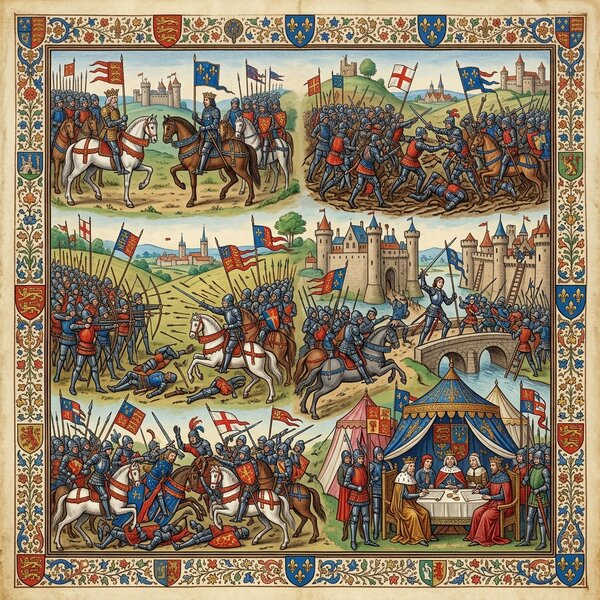
The term ‘Hundred Years’ War’ does not refer to a single, uninterrupted conflict, but rather to a complex series of military campaigns, battles and periods of peace between England and France, which spanned the years 1337 to 1453 – 116 years in fact. 19th-century historians coined this name to summarise the diverse conflicts of this era under a single term.

What to expect in this article
- Key points at a glance
- Causes and background
- The first phase: The Edwardian phase (1337–1360)
- The second phase: The French counter-offensive (1369–1389)
- The third phase: The Lancastrian phase (1415–1453)
- Joan of Arc and the French Revival
- The final years of the war and the end (1435–1453)
- Consequences and significance of the Hundred Years’ War
- A comparison of key battles
- Summary
- Frequently asked questions about the Hundred Years’ War
 Reading time approx. 12 mins.
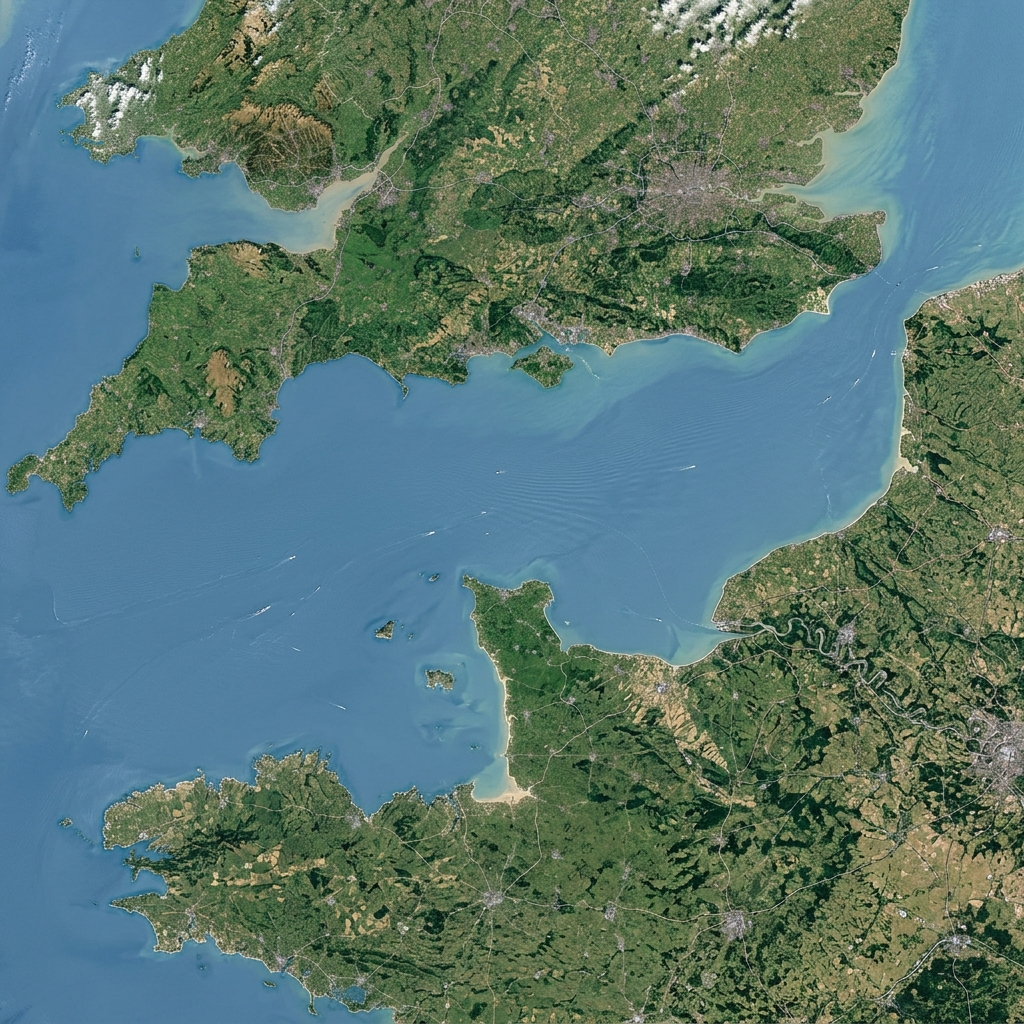
Hostilities were concentrated primarily on French soil: northern France, Normandy, Île-de-France, Aquitaine and Flanders were the main theatres of war. Calais served as a strategic bridgehead on the continent for the English from 1347 to 1558, whilst Bordeaux was the centre of the contested Gascony.
Dynastic disputes, economic interests and military innovations changed the face of the Middle Ages permanently over these eleven decades – whilst at the same time laying the foundation for the emerging nation states of Europe.
Key facts at a glance
- Timeframe and structure: The Hundred Years’ War spanned from 1337 to 1453 – 116 years in total – and was divided into three main phases by prolonged truces: : the Edwardian phase until 1360, the French counter-offensive until 1389 and the Lancastrian phase until 1453.
- Dynastic conflict: At its core was a dispute over the French crown between the English House of Plantagenet and the French House of Valois, triggered by the childless death of Charles IV in 1328 and linked to struggles over territories such as Gascony and Aquitaine.
- Military turning points: The battles of Crécy (1346), Poitiers (1356), Agincourt (1415), the siege of Orléans (1429) and Castillon (1453) formed the decisive milestones in the course of the war.
- Joan of Arc: The young peasant girl from Domrémy became a symbol of the French resistance, lifted the siege of Orléans and made possible the coronation of Charles VII in Reims in 1429.
- Long-term consequences: The war fostered the emergence of national consciousness in both countries, strengthened royal central authority and revolutionised warfare through the longbow, artillery and standing armies.
Causes and background
The roots of the Hundred Years’ War stretch far back into the 12th century. The English kings, as Dukes of Aquitaine, were simultaneously vassals of the French king – a dual status that caused constant tensions and ultimately led to open warfare.
- Feudal ties: Since Henry II (1154), English monarchs had, through their marriage to Eleanor of Aquitaine, at times controlled a third of France. The Capetians and later the Valois dynasty systematically attempted to curtail this power.
- The succession dispute of 1328: Following the death of the childless Charles IV, Edward III of England asserted his claim to the French throne through his mother Isabella of France – a daughter of Philip IV. The French nobility instead elected Philip of Valois as Philip VI.
- Salic law: This law of succession excluded female descendants and their line from the succession to the throne. As a result, Edward’s claim was legally rejected, even though he was closer to the throne by blood than his cousin Philip.
- Economic factors: Gascony exported around 200,000 hectolitres of wine annually. Flanders relied on English wool for its textile production, which favoured alliances between England and Flemish cities.
- The Auld Alliance: The alliance between France and Scotland, which had existed since 1295, forced England to fight on two fronts. David II of Scotland invaded England in 1346, but was defeated.
The immediate trigger came in 1337: Philip VI seized Gascony, whereupon Edward III rejected French suzerainty and officially declared himself King of France in 1340.
The first phase: The Edwardian phase (1337–1360)

The Edwardian phase was marked by spectacular English victories that shook the military balance of the Middle Ages. Edward III proved himself a capable commander who consistently employed tactical innovations.
- Naval battle of Sluys (1340): The English fleet destroyed the French navy, thereby securing control of the English Channel for supplies and troop transports.
- Battle of Crécy (1346): Around 12,000 Englishmen, including 8,000 Welsh longbowmen, faced some 40,000 Frenchmen. The archers fired up to 10 to 12 arrows per minute with a range of 300 metres. The French knightly cavalry suffered devastating losses – 1,500 to 4,000 dead, including 11 princes.
- Fall of Calais (1347): After an eleven-month siege, the city surrendered and remained in English hands until 1558 – the most important English bridgehead on the continent.
- Battle of Poitiers (1356): Edward, the Black Prince and eldest son of Edward III, defeated the French army and took King John II (known as ‘the Good’) prisoner. The ransom amounted to three million écus.
- Treaty of Brétigny (1360): England received an expanded Aquitaine, Poitou, Limousin and Calais under full sovereignty. In return, Edward III temporarily renounced his claim to the throne.
The second phase: The French counter-offensive (1369–1389)
Following the fragile Peace of Brétigny, the war flared up again in 1369 under Charles V of France. The astute king and his Constable Bertrand du Guesclin developed a completely new strategy that turned the tide in France’s favour.
- Change of strategy: France avoided open-field battles in which the English longbowmen could exploit their superiority. Instead, du Guesclin relied on sieges, minor skirmishes and systematic attrition.
- Naval Battle of La Rochelle (1372): A 40-ship Castilian fleet in French service destroyed 27 English ships and severely weakened England’s supply lines.
- Territorial reconquest: By 1378, France had regained two-thirds of Aquitaine. Charles V employed diplomatic skill and military patience in equal measure.
- English weakness: Richard II ascended the throne as a minor. The peasants’ revolt of 1381 under Wat Tyler shook England; domestic political disputes paralysed the war effort.
- Truce of Leulinghem (1389): This truce ushered in a 26-year period of peace, which was diplomatically secured through dynastic marriages.
This counter-offensive impressively demonstrated that victory did not depend solely on spectacular battles, but on strategic perseverance and astute alliance-building.
The third phase: The Lancastrian phase (1415–1453)
In 1415, Henry V of England launched a new offensive with the aim of securing the French throne once and for all. France’s internal divisions played into his hands.
- Battle of Agincourt (1415): 6,000 to 9,000 Englishmen, including around 5,000 archers, faced 12,000 to 36,000 Frenchmen. The muddy ground paralysed the heavy French cavalry. The French suffered devastating losses: 7,000 to 10,000 dead, including a large proportion of the French nobility.
- Treaty of Troyes (1420): Henry V was recognised as the heir of Charles VI. The legitimate Dauphin – the future Charles VII – was effectively disinherited.
- French Civil War: The conflict between the Armagnacs (pro-Charles VII) and the Burgundians further weakened France. Duke Philip the Good of Burgundy allied himself with England.
- Henry V’s death (1422): The early death of the English king left his nine-month-old son Henry VI as heir to both crowns – an extremely fragile position of power.
- English control: In the 1420s, England and Burgundy controlled northern France, including Paris and Île-de-France. The situation for the Dauphin Charles VII. seemed hopeless.

Joan of Arc and the French Revival
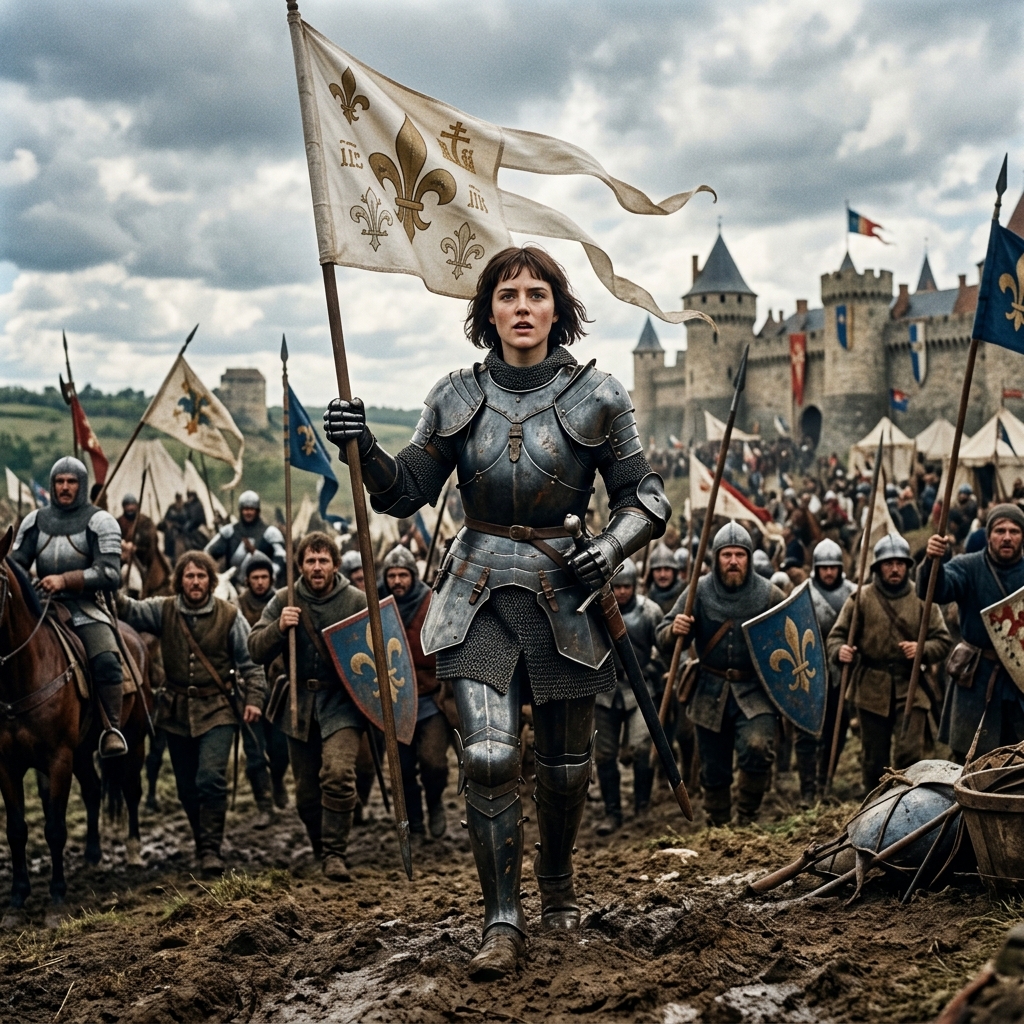
Amidst this bleak situation for France, an unexpected figure stepped onto the stage of history: Joan of Arc. The peasant girl from Domrémy became a symbol of the French resistance and played a decisive role in the turning point of the war.
- Origins and visions: Born in 1412, from 1425 onwards Jeanne claimed to receive divine visions of Saints Michael, Catherine and Margaret, who urged her to support Charles VII.
- Audience at Chinon (1429): In February 1429, the 17-year-old sought out the Dauphin and convinced him of her divine mission. She was given a small army for the relief operation at Orléans.
- Liberation of Orléans (May 1429): With some 4,000 men, Joan lifted the seven-month siege – a decisive moral and military turning point.
- The march to Reims: The successful campaign in Lorraine, with victories at Jargeau and Patay, opened the way to the coronation city.
- The coronation of Charles VII (July 1429): On 17 July 1429, Charles VII was crowned King of France in Reims – a symbolic act that permanently cemented his legitimacy against the English claim.
- Capture and death: In May 1430, Joan was taken prisoner by the Burgundians near Compiègne. Sold to the English for 10,000 écus, she was accused of heresy in an Inquisition trial in Rouen and executed at the stake on 30 May 1431.
- Rehabilitation and canonisation: In 1456, the verdict was overturned; in 1920, the Catholic Church canonised her.
Joan of Arc did not decide the war single-handedly, yet she fostered the emerging French national consciousness and inspired further resistance against the English occupation in a way that no military commander could have achieved.
The final years of the war and the end (1435–1453)
Following Joan of Arc’s symbolic breakthrough, France consolidated under Charles VII. The king proved to be a capable reformer who systematically reconquered and modernised his country.
- Treaty of Arras (1435): Philip the Good of Burgundy dissolved his alliance with England and re-established closer ties with the French king. This diplomatic victory proved decisive in the war.
- Recapture of Paris (1436): The capital returned to French control, followed by large parts of Normandy.
- Charles VII’s military reforms: The Ordonnance of 1445 established the Compagnies d’Ordonnance – France’s first standing army, comprising 1,500 lancers and 1,000 archers. Better funding and the modern use of artillery significantly strengthened French combat power.
- Battle of Formigny (1450): French artillery defeated an English army of around 5,000 men – a clear sign of the military shift.
- Battle of Castillon (1453): On 17 July 1453, 7,000 French soldiers under Jean de Dunois destroyed an English army using around 300 cannons. The 71-year-old English commander John Talbot was killed. Bordeaux surrendered in September of the same year.
- End without a peace treaty: The war ended without a formal peace treaty. England lost all its continental possessions except Calais, which did not fall until 1558. The English kings continued to maintain a formal claim to the French crown until 1801, although it had long since lost any political significance.
Consequences and significance of the Hundred Years’ War
The Hundred Years’ War left a deep mark on European history. Its effects extended far beyond military events and shaped the political, social and economic development of both nations for generations.
Political consequences
- A stronger sense of national identity emerged in France and England. People’s loyalty shifted from local feudal lords to the nation as a whole.
- Charles VII and his successors strengthened royal central authority, reduced the power of the great feudal lords and established a permanent tax system (the so-called taille).
- In England, financial burdens and military defeats led to domestic political crises. The war cost around 5 million pounds and contributed significantly to the outbreak of the Wars of the Roses (1455–1487).
Military innovations
- The decline in the importance of traditional knightly armies in favour of professional foot soldiers became irreversible.
- Longbowmen dominated the battlefields of the early stages with their rate of fire and range.
- Artillery developed into a decisive branch of the armed forces, as the Battle of Castillon impressively demonstrated.
- Mercenary forces and standing armies gradually replaced feudal levies.
Socio-economic consequences
- Vast swathes of France were devastated; economic recovery took decades.
- The Black Death, which began in 1347, caused population losses of 30 to 50 per cent in Europe and made recruitment considerably more difficult.
- Uprisings such as the Jacquerie (1358), in which around 20,000 peasants were killed, and the English peasant revolt (1381) testified to deep social upheaval.
- Trade routes shifted; the Channel border between England and France became established as a permanent dividing line.
Overall, the war marked the transition from medieval feudal structures to modern territorial states – a turning point whose consequences continued to be felt into the modern era.
Key battles compared
| Battle | Year | Winner | Significance |
|---|---|---|---|
| Crécy | 1346 | England | First major test of the longbow; heavy losses among the French nobility |
| Poitiers | 1356 | England | King John II of France taken prisoner |
| La Rochelle | 1372 | France / Castile | English naval supremacy in the Atlantic broken |
| Agincourt | 1415 | England | Crushing defeat of the French nobility; Henry V at the height of his power |
| Orléans (relief) | 1429 | France | Turning point brought about by Joan of Arc; enables the coronation of Charles VII |
| Castillon | 1453 | France | Last major battle; artillery proves decisive; end of the war |
Summary
The Hundred Years’ War from 1337 to 1453 was a series of conflicts between England and France, unfolding in three phases. The Edwardian phase (1337–1360) saw English victories at Crécy and Poitiers, as well as the Peace of Brétigny. The French counter-offensive under Charles V (1369–1389) turned the tide through relentless attrition tactics. The Lancastrian phase (1415–1453) saw Agincourt, the rise of Joan of Arc and the final French triumph at Castillon.
France won the war and regained almost all English territories on the continent. Only Calais remained English until 1558. The Hundred Years’ War is regarded as a key event between the Middle Ages and the Early Modern Period: it accelerated the emergence of nation states, revolutionised warfare and shaped the European balance of power for centuries.
Frequently asked questions about the Hundred Years’ War
Why is the conflict called the ‘Hundred Years’ War’ even though it lasted longer?
The war actually spanned 116 years, from 1337 to 1453. Historians of the 19th century coined the term to summarise the many individual wars and periods of peace between England and France under a single umbrella term. The name emphasises the overall duration of the hostilities, even though there were lengthy interruptions and truces in between.
What role did the Black Death play in the Hundred Years’ War?
The plague epidemic of 1347–48 hit both sides hard and caused population losses of up to a third. This made it considerably more difficult to recruit soldiers, led to labour shortages and wage increases. The social tensions fuelled uprisings such as the Jacquerie in France (1358) and the Peasants’ Revolt in England (1381), which had a significant indirect influence on the course of the war.
How did warfare in the 14th and 15th centuries differ from earlier campaigns?
Warfare underwent a fundamental transformation: from a focus on chivalric close combat to the growing importance of ranged weapons, logistics and artillery. The English longbow had a range of 300 metres, compared to 200 metres for the crossbow. Sieges accounted for around 80 per cent of military operations. Mercenary armies and professionally organised units increasingly gained the upper hand over individual acts of chivalry.
Which figures, apart from kings and Joan of Arc, were particularly important?
As Constable, Bertrand du Guesclin shaped the French strategy of attrition under Charles V; Philip the Good of Burgundy decisively influenced the outcome of the war through his change of allegiance in 1435; John II was taken prisoner at Poitiers; his ransom placed a heavy burden on France; The military commanders La Hire and Xaintrailles supported Joan of Arc in her military successes.
How can the Hundred Years’ War be usefully divided into phases?
The standard three-part division provides a clear framework: the Edwardian phase (1337–1360) with English triumphs, the French counter-offensive under Charles V (1369–1389) with the strategic turnaround, and the Lancastrian phase (1415–1453) with Joan of Arc and the French final victory. This division provides a clear structure for the wealth of events, even if it necessarily simplifies historical transitions.


Letters from the trading house
New arrivals, market dates and offers, straight from Rinchnach. Unsubscribe any time with one click.
Subscribe to the newsletter