

No sooner do you think of Vikings than they appear in your mind’s eye: Thor with his hammer raised, Ragnar on the longship, Freya in her gold-embroidered robe. Norse mythology provided the Scandinavians with a rich supply of first names that promised strength, courage and a touch of magic. Yet right alongside this awe-inspiring world of names existed a second, decidedly cruder realm – the nicknames.
Here’s what you can expect in this article
- Key insights at a glance
- Introduction: From Thor to Nose-Björn – why Viking names are so special
- How Viking names came about: a serious first name, a wild nickname
- The role of Norse mythology in Viking names
- What makes a Viking name ‘quirky’?
- Legendary Vikings – classic names, quirky nicknames
- Bizarre Viking nicknames relating to the nose, head and more
- Animal-inspired Viking names: Björn, Ulf, Ylva and their meanings
- Viking names for boys: powerful rather than embarrassing
- Viking names for girls: from Freya to Skadi
- A blend of tradition and humour: ‘Nose-Björn’ and co. for role-play, games and stories
- Between saga and comic: how Hägar the Horrible shapes the image of the Vikings
- Viking names in children’s culture: Wickie, Ylva & other heroines
- Naming practices in the early Middle Ages: how Vikings really named their children
- The Old Norse language and the spelling of Viking names
- From brutal to enchanting: the meanings behind Viking names
- The modern popularity of Nordic Viking names
- Tips for parents: choosing Viking names without embarrassing your child
- Creatively reimagining quirky Viking nicknames
- Viking names beyond Scandinavia: Iceland, Greenland & more
- Pop culture, TV series & games: why Viking names are back in fashion
- FAQ – Frequently asked questions about Viking names and their quirky meanings
 Reading time approx. 14 mins.
Key takeaways at a glance
- As well as their first names, Vikings often had striking nicknames such as ‘Flatnose’, ‘Boneless’ or ‘Furtrousers’ – many of these nicknames were humorous or derisive and alluded to appearance, deeds or embarrassing traits.
- Typical Viking nicknames described physical characteristics, personality traits or notable deeds, and served primarily to help people identify one another in a society without fixed surnames.
- This article provides specific historical and legendary examples, verified meanings of Old Norse names and practical naming ideas for boys and girls – ranging from powerful to whimsical.
- Modern pop culture, such as Hägar the Horrible (since 1973), the TV series Vikings (since 2013) and Wickie (since 1974), often shapes our image of Viking names more strongly than historical sources themselves.
- From choosing a name for a baby to pen-and-paper role-playing games: here, parents, fans and storytellers can find inspiration from over a thousand years of Norse culture.
Introduction: From Thor to Nasen-Björn – why Viking names are so special
No sooner do you think of Vikings than they appear in your mind’s eye: Thor with his hammer raised, Ragnar on the longship, Freya in her gold-embroidered robe. Norse mythology provided the Scandinavians with a rich store of first names that promised strength, courage and a touch of magic. Yet right alongside this awe-inspiring world of names existed a second, decidedly cruder realm – the nicknames.
Erik, Björn or Astrid are now regarded as powerful Viking names for boys and girls. The truly bizarre nicknames, on the other hand, appear mainly in sagas and chronicles. Imagine if your neighbour were called ‘Björn Big Nose’ or ‘Ulf Red Nose’ – in the Viking Age, this was simply everyday life, not mockery whispered behind closed doors. This article explores the fascination of Old Norse naming: from mythological heroes and warriors passed down through history and legend to practical name ideas for children with a passion for all things Nordic.
How Viking names came about: a serious first name, a wild nickname
The Vikings did not have fixed surnames – instead, they used patronymics. A first name was given at birth and usually had a positive meaning, derived from Old Norse-Germanic word roots. Over the course of a person’s life, a nickname (Old Norse ‘viðrnefni’) was often added, based on stories, physical characteristics or simply mockery.
The key features of name formation:
- Two-part first names: Combinations such as Sig-urd (victory + guardian) or Thor-stein (thunder + stone) were typical.
- Patronymic surnames: Vikings often used the suffix ‘-sson’ for sons and ‘-dóttir’ for daughters. Eriksson means ‘son of Erik’, Haraldsdóttir ‘daughter of Harald’.
- Nicknames: an unofficial additional name used in everyday life to distinguish individuals – distinctive nicknames were widespread amongst the Vikings.
- Chronological context: The Viking Age spanned approximately 800 to 1050 AD and covered Norway, Sweden and Denmark, and later also Iceland and Greenland.
The Vikings believed that a name could influence luck and success. Anyone named after a successful ancestor was thought to inherit that ancestor’s good fortune – a custom that shaped the Old Norse naming tradition for centuries.
The role of Norse mythology in Viking names
Norse mythology provided the inspiration for solemn, awe-inspiring first names. Parents deliberately chose names that promised divine protection and strength – a direct link to Thor, Freyja and the other powers.
Theophoric boys’ names:
- Thorstein – ‘Thor’s stone’, a symbol of steadfastness.
- Thorvald – ‘Thor’s power’.
- Freyr – god of prosperity and fertility.
- Magni – ‘the Strong’, son of Thor in mythology.
Female names from mythology:
- Freya/Freyja – Goddess of love in Norse mythology.
- Sif – Goddess of the Earth and fertility.
- Skadi – Goddess of the hunt and winter.
- Idun – Keeper of the apples of eternal youth.
These names were meant quite seriously – a stark contrast to the later, often derisive nicknames. Many modern Viking names found in baby name lists stem directly from this mythological tradition.
What makes a Viking name ‘bizarre’?
A Viking name becomes ‘bizarre’ when a respectable first name is paired with a drastic epithet. The Old Norse language was direct, vivid and often brutally honest – and this is precisely what is reflected in the epithets.
Three types of quirky epithets can be distinguished:
| Type | Example | Explanation |
|---|---|---|
| Physical characteristics | Flatnose, Skallagrímr (Baldie) | Distinctive nose, bald head, scars |
| Deeds/Fate | Loðbrók (Fur Trousers), Blood-Axe | Unusual clothing, brutal weapons |
| Mockery/Character | Beinlausi (Boneless), ‘the Fat One’ | Weaknesses, quirks, exaggerations |
In the sagas, such names were often exaggerated and dramatised for narrative effect – recognisability was more important than politeness. One might almost think of today’s gaming nicknames, only with considerably more bite and without a trace of irony.
Legendary Vikings – classic names, quirky nicknames
A look at the most famous examples of historical and legendary figures shows how this combination worked:
- Ragnar Lodbrok – the name Ragnar is derived from the Old Norse regin (‘council’, ‘divine powers’) and herr (‘army’, ‘warrior’) and is usually translated as ‘Warrior of the Gods’. His epithet ‘Loðbrók’ means ‘fur trousers’ – according to legend, he wore fur trousers soaked in pitch for protection whilst fighting a giant serpent.
- Ivar the Boneless (Ívarr hinn Beinlausi) – Ívarr is thought to be derived from the Old Norse ýr (‘yew’, the wood used for bows) and a root meaning ‘warrior’, thus roughly translating as ‘bow warrior’. His epithet ‘Beinlausi’ can mean ‘boneless’ or ‘legless’ – exactly which of these it referred to remains a matter of debate amongst historians to this day.
- Harald Fairhair (Haraldr Hárfagri) – Harald literally means ‘commander of the army’ or ‘ruler of the army’, derived from Old Norse/Germanic harja (army) and waldaz (ruler). His epithet ‘Schönhaar’ stems from a saga account: according to legend, he vowed not to cut his hair until the whole of Norway was united under his rule – though modern historians regard this episode as a later literary embellishment.
- Harald Bluetooth (Haraldr Blátǫnn) – named after a conspicuously dark, presumably dead tooth. This 10th-century Danish king united Denmark and parts of Norway and is the namesake of Bluetooth technology: The developers chose his epithet as a code name in 1997 because the wireless technology was intended to connect various devices, just as he had once united hostile tribes. Even the Bluetooth logo is a bind rune formed from his initials in runic script.
- Erik the Red – Erik (Eiríkr) means ‘the sole ruler’ or ‘the eternal ruler’. According to tradition, his epithet referred to his red hair or his quick-tempered nature.
- Björn Iron-Side (Bjǫrn Járnsíða) – a legendary Viking chieftain whose epithet symbolises strength and invulnerability. Björn simply means ‘bear’ and remains one of the most popular Viking names to this day.
Quirky Viking nicknames relating to the nose, head and so on
- Ketill Flatnose (Ketill Flatnefr) – ‘Flatnose’, a 9th-century ruler of the Hebrides recorded in sagas such as the *Landnámabók* and the *Laxdæla saga*, presumably so named because of a strikingly broad nose.
- Egill Skallagrímsson – his father’s epithet, ‘Skallagrímr’, means ‘Bald-headed Grímr’. Egill carried on the name as a patronymic, even though it actually referred to his father’s bald forehead.
- Váganef – literally meaning something like ‘scale-nose’, recorded as a nickname for a particularly straight, well-proportioned nose. Attested in Old Norse lists of nicknames.
- Blátǫnn – ‘Blue Tooth’, the facial feature that, over a thousand years later, became a world-famous technology brand name.
And ‘Nose-Björn’? Historically, this exact name is not attested – but in Old Norse, it would have been entirely plausible. A ‘Nef-Bjǫrn’ (Björn with the distinctive nose) would have fitted the pattern perfectly: a serious first name, coupled with a blunt reference to the most striking facial feature. It was precisely this structure – first name plus body part – that was a classic principle underlying Old Norse epithets.
Animal-inspired Viking names: Björn, Ulf, Ylva and their meanings
Many Viking names drew on animals as symbols of strength – which today no longer seems bizarre, but simply cool:
- Björn – ‘bear’, a symbol of strength and ferocity.
- Ulf (Úlfr) – ‘wolf’, representing loyalty to the pack and a fighting spirit.
- Arne (Ǫrn) – ‘eagle’, a symbol of foresight and freedom.
- Ylva – means ‘the she-wolf’ in Old Norse, a powerful feminine variant.
- Orm – ‘snake’, a symbol of cunning and a connection to nature.
These essentially ‘ordinary’ animal names were often combined with whimsical nicknames: Björn Ironfist, Ulf Rednose or Orm Dragontooth. Björn, Ulf, Ylva and Arne in particular are now among the most popular Nordic names for boys and girls.
Viking names for boys: powerful rather than embarrassing
Many parents are looking for a strong name with a Viking flair – but one that won’t cause laughter in the school playground. These boys’ names have stood the test of time:
- Erik – ‘the sole ruler’, borne by kings and the famous Greenland explorer Erik the Red.
- Leif – ‘heir’, ‘descendant’; Leif Eriksson was one of the first Europeans to reach North America around the year 1000.
- Gunnar – ‘warrior’, ‘fighter’.
- Hakon – ‘the Tall’, ‘the Noble’.
- Sten – ‘stone’, firm and unshakeable.
- Ragnar – ‘Warrior of the Gods’, made legendary by Ragnar Lodbrok.
- Thor – ‘Thunder’, a direct reference to the gods.
- Vidar – ‘the far-fighting one’, son of Odin.
- Arne – ‘Eagle’.
- Finn – ‘the Fair One’, ‘the Wanderer’.
Viking names often have warlike or combative meanings. In German-speaking countries, Finn, Leif and Erik have become noticeably more common since the 2000s – fuelled by TV series such as Vikings and the general trend towards Nordic names.
Viking names for girls: from Freya to Skadi
For girls, too, Nordic names offer a blend of strength and elegance that rarely goes out of fashion. Many girls’ names are directly inspired by goddesses and heroines:
- Freya/Freyja – goddess of love, beauty and fertility.
- Astrid – from Old Norse áss (god) and fríðr (beautiful), meaning ‘divinely beautiful’.
- Ingrid – ‘the beautiful one of the god Ing’, a fertility deity who later merged with Freyr.
- Sigrid – from sigr (victory) and fríðr (beautiful), usually translated as ‘beautiful victor’.
- Helga – ‘the Holy One’, a classic name from the North.
- Liv – ‘life’, short and simple.
- Ylva – ‘she-wolf’, pure connection to nature.
- Runa – ‘mystery’, from rún (rune).
- Skadi – goddess of the hunt, energy and winter.
In contrast to the more drastic nicknames, these first names almost invariably convey positive, enchanting meanings. TV series, comics and children’s books – including characters such as Ylva from “Wickie” – continue to contribute to their popularity to this day.
A blend of tradition and humour: Nasen-Björn & Co. for role-playing, games and stories
Quirky Viking names are ideal for pen-and-paper role-playing games, computer games, LARP, fantasy novels or comics. Here’s how to create a fitting character name:
Blueprint:
- A serious first name (Björn, Hakon, Astrid).
- A memorable nickname (Red Nose, Iron Fist, Dragon Tooth).
- Optional: patronymic surname (Eriksson, Gudrunsdóttir).
Male characters:
- “Björn Red Nose” – got his name after a brawl at the market in Birka.
- “Leif One-Eye” – lost an eye during the stormy crossing to Vinland.
- “Gunnar Blood-Axe” – his axe was stained red after every battle.
Female characters:
- “Astrid Dragonheart” – according to legend, she vanquished a sea serpent.
- “Freya Wolf’s Tooth” – wore a wolf’s tooth as an amulet.
- “Ylva Long-Plaits” – her plait was said to reach down to her knees.
When it comes to real baby names, however, it’s best to stick to first names – nicknames belong more in the world of fiction than on a birth certificate.
Between saga and comic: How Hagar the Horrible shapes the image of the Vikings
On 4 February 1973, Dik Browne’s US comic strip *Hagar the Horrible* appeared for the first time – and became a firm favourite with the public practically overnight. To this day, the character continues to shape the popular image of Vikings for entire generations.
- Hagar – a fictional, pseudo-Scandinavian name for the grumpy warrior with a heart of gold.
- Helga – a classic Viking woman’s name, meaning ‘the Holy One’, portrayed here as a resolute wife.
- Hamlet – based on the Old Danish name Amleth.
- Lucky Eddie – the clumsy friend.
The comic deliberately plays on clichés: horned helmets (not historically documented!), hard-drinking seafarers and punning names. Comics like these often shape our modern image of Viking names more lastingly than the historical sources themselves.
Viking names in children’s culture: Wickie, Ylva & other heroines
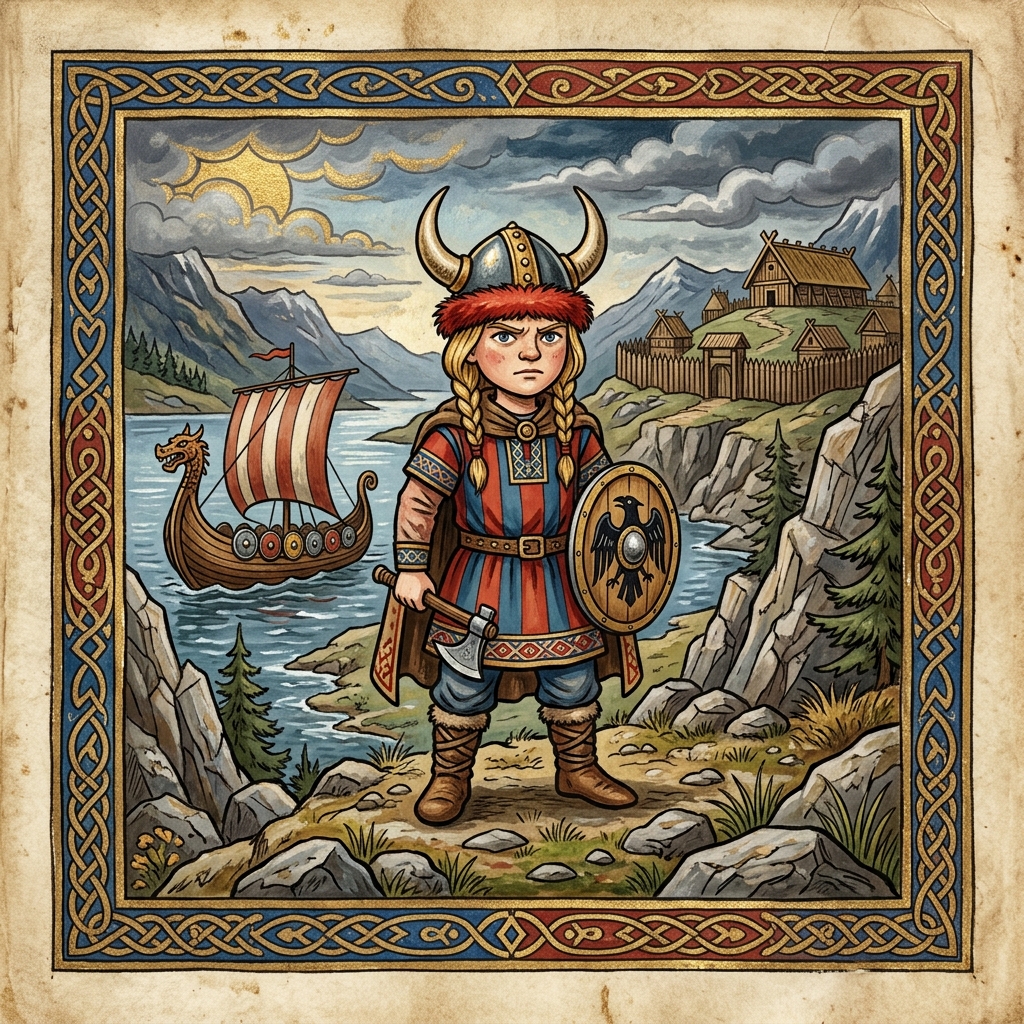
On 31 January 1974, the first episode of ‘Wickie and the Strong Men’ aired on ZDF – for entire generations of children, this was their first encounter with the Viking world, long before ‘Vikings’ or ‘Assassin’s Creed Valhalla’ were released.
- Wickie – a fictional name, but firmly entrenched in children’s minds as a Viking name.
- Halvar – from the Old Norse Hallvarðr, meaning ‘rock protector’.
- Ylva – ‘she-wolf’, also featured as a character’s name.
- Gorm, Sven – based on real Nordic names.
These character names have been deliberately chosen to appeal to children, whilst remaining close to real Norse first names. For parents looking for a name with a Norse ring to it, without it sounding too extreme, such stories offer a good guide.
Naming practices in the early Middle Ages: what Vikings really called their children
Not every Viking was named after a TV hero. In the everyday lives of farmers, traders and fishermen, naming conventions were far more down-to-earth than in the sagas.
- Recycling family names: Parents often named their children after successful ancestors, particularly grandparents and uncles.
- Germanic word roots: sigr (victory), hildr (battle), björn (bear), ulf (wolf) as building blocks.
- Two-part names: Sigurd, Gudrun, Brynhild – combinations with clear meanings.
- Patronymic formation: -son and -dóttir as the standard system.
- Regional differences: Traditions varied in Norway and Denmark; Christian influences later introduced names such as Olaf and Knut.
The Vikings believed that names influenced luck and success – one reason why they were chosen so carefully.
The Old Norse language and spelling of Viking names
The Vikings spoke Old Norse and used runes (the Elder and Younger Futhark) for inscriptions. The following adaptations apply to modern spellings:
| Old Norse | Modern | Example |
|---|---|---|
| Þ | Th | Þór → Thor |
| ð | d | Guðrún → Gudrun |
| ö/ø | o/oe | Bjǫrn → Bjorn |
| á | a | Hákon → Hakon |
‘Ragnarr loðbrók’ thus became our ‘Ragnar Lodbrok’. For birth certificates in Germany, parents must use the simplified forms – a registry office will not accept a Þ or ð.
From brutal to enchanting: the meanings behind Viking names
Some meanings sound surprisingly poetic, whilst others remain thoroughly martial:
- Warlike: Gunnar (warrior), Hilda (battle), Brand (sword/fire).
- Peaceful: Frida (peace), Liv (life).
- Nature-related: Björn (bear), Ulf (wolf), Solveig (power of the sun).
- Mythological: Erik (eternal ruler), Freyr (god of prosperity).
Particularly quirky in German: Knut literally means ‘knot’, and Harald Schönhaar sounds more like a shampoo advert than a king. It is precisely this contrast between gentle meanings and the rugged image of the Vikings that gives them their special appeal.
The modern popularity of Nordic Viking names
Old Norse names are now more popular than they have been for a long time. Since the 1990s and 2000s, demand has been rising steadily in German-speaking countries:
- Trending: Finn, Leif, Mika – names with Nordic associations.
- Rediscovered: Erik, Björn, Ragnar, Sören.
- For girls: Freya, Liv, Ida, Ylva, Astrid.
Many parents are deliberately looking for strong, internationally recognisable names that are not too common. The influence of TV series such as ‘Vikings’ (since 2013) and ‘The Last Kingdom’, as well as comics such as ‘Hägar the Horrible’, on this perception is enormous. Nordic aesthetics are also increasingly evident in design and pop culture – a sign of a broad cultural trend that extends far beyond the choice of names.
Tips for parents: choosing Viking names without embarrassing your child
The real decision lies between historical authenticity and practicality for everyday life:
- First name first: use nicknames only within the family circle.
- Pronunciation test: Grandparents, teachers and friends should be able to pronounce the name without any difficulty.
- Check the meaning: make sure the translation isn’t unintentionally funny or negative.
- Think long-term: How does the name sound on a business card or in an email address?
- Use reliable sources: historical name encyclopaedias and university resources from Scandinavia rather than just TV series.

Creatively reinvent quirky Viking nicknames
Old Norse templates are ideal for developing your own credible nicknames – perfect for stories and role-play.
Basic principles:
- Physical trait + everyday word: Redbeard, Big Nose, Iron Hand.
- Animal + weapon imagery: Wolf’s Axe, Bear’s Shield.
- Nature + character: Stormheart, Oakfist.
Examples with mini-stories:
- “Björn Big Nose” – his nose was so distinctive that he could be recognised even in the thickest fog.
- “Erik Stormhelm” – survived a hurricane on the open sea.
- “Runa Mist-Eye” – found paths where others saw only mist.
- “Liv River Song” – sang so loudly whilst rowing that she could be heard three fjords away.
Names like these are ideal for online profiles and fiction – but it’s best not to have them on your ID card.
Viking names beyond Scandinavia: Iceland, Greenland & Co.
Viking culture extended far beyond their homeland in Scandinavia. Around the year 1000, Leif Eriksson became one of the first Europeans to reach Vinland (North America) – and brought Nordic naming traditions all the way to the New World.
- Iceland still retains the patronymic system to this day (Jónsson, Jónsdóttir).
- Many Old Norse names are still traditionally given there.
- Sagas such as the Edda and the Icelandic Sagas are key sources for names and epithets.
- Examples: Snorri (the Swift), Guðrún (God’s Secret) – both names are common from Scandinavia to Iceland.
Pop culture, TV series & games: why Viking names are back in fashion
Since the 2010s at the latest, Vikings have once again featured heavily in films, TV series and games. Their influence on naming conventions cannot be overstated:
- TV series ‘Vikings’ (since 2013): characters such as Ragnar, Lagertha, Floki and Bjorn Ironside have made Old Norse names famous worldwide.
- Video games: “Assassin’s Creed Valhalla” (2020) featuring Eivor, Sigurd and a rich Norse atmosphere.
- Fantasy literature: Nordic linguistic and mythological elements permeate many works, from Tolkien to modern fantasy.
Many fans adopt names from these media for their children, pets and online avatars. In doing so, traditional meanings blend with modern pop culture associations to create names that appeal to both women and men and lend a touch of Norse energy to everyday life.
FAQ – Frequently asked questions about Viking names and their quirky meanings
Were there really Vikings with such strange names as ‘Nose-Björn’?
Strictly speaking, ‘Nose-Björn’ has no historical basis. However, the sagas and the *Landnámabók* contain numerous nicknames that emphasise physical characteristics – such as *Flatnefr* (Flat Nose) for Ketill Flatnose or *Skallagrímr* (Baldhead). The structure ‘first name + physical characteristic’ was absolutely typical, so a ‘Nose-Björn’ would be historically plausible, even if he is a fictional character created for literary purposes. In any case, such nicknames show that the Vikings certainly had a sense of humour when it came to naming people.
Can I officially register a Viking nickname as a middle name in Germany?
Under German naming law, a first name must be recognisable as such and must not constitute an obvious mockery of the child. Names such as Erik, Björn, Liv or Freya are perfectly acceptable. No registry office will register drastic nicknames such as “Boneless” or “Blood Axe”. With the reform of naming law on 1 May 2025, certain requirements were relaxed, for example regarding the mandatory gender-specific nature of first names – subject to the basic assessment


Letters from the trading house
New arrivals, market dates and offers, straight from Rinchnach. Unsubscribe any time with one click.
Subscribe to the newsletter

