
Charlemagne is one of those rulers whose name has been repeated so often that it has almost become an abstraction. The Father of Europe. The first emperor of the Western world. The man who shaped the Middle Ages. All of this is true – and yet all of it obscures who he really was: an 8th-century Frank who, through military might, political skill and an extraordinary drive for reform, built an empire that encompassed large parts of what is now Europe.

What you can expect in this article
- The man behind the myth
- 1. Origins and youth – the son of Pippin
- His relationship with his brother Carloman
- 2. Campaigns and conquests – the empire takes shape
- The Saxon Wars: Decades of violence
- Roncesvalles – the defeat that became a legend
- 3. The Coronation in 800 – a moment that changed history
- 4. Reforms – the ruler as a shaper
- The Missi dominici: the king’s eyes in the empire
- Carolingian minuscule: A script for an empire
- Education as an instrument of power
- 5. Aachen – the capital of a continent
- The Palatine Chapel – a building with a message
- Aachen after Charlemagne
- 6. Death, division and legacy – what remains of an empire
- The Treaty of Verdun 843 – the end of unity
- 7. The Carolingian Renaissance – culture as a programme
- 8. Frequently asked questions about Charlemagne
- Was Charlemagne really that great?
- Could Charlemagne read and write?
- Was Charlemagne a forerunner of Europe in the modern sense?
- What is the Charlemagne Prize?
- How did Charlemagne die?
- Conclusion: Why Charlemagne is still important
 Reading time approx. 12 mins.
The man behind the myth
| Birth | 747 or 748 (exact date uncertain) |
|---|---|
| Death | 28 January 814 in Aachen, pneumonia |
| Father | Pippin the Younger, King of the Franks |
| Mother | Bertrada of Laon |
| Coronation | 25 December 800 by Pope Leo III in Rome |
| Main residence | Aachen (Palace and Palace Chapel) |
| Successor | Louis the Pious (son) |
He was not a noble knight in the late medieval sense. He was an early medieval ruler – which means: pragmatic, tough, religious and possessed of an energy that apparently captivated his contemporaries. Einhard, his biographer and contemporary, describes him as tall, strong, with alert eyes and a voice that was surprisingly thin for his physique. He spoke several languages, attempted to learn to write in his later years (and, by his own account, failed) and took a genuine interest in education and theology.
This article explains who Charlemagne was – without the myth, but with the respect deserved by one of the most influential figures in European history.
At a glance: Charlemagne lived from around 747/748 to 814. He ruled the Frankish Empire from 768 and was crowned Emperor of the West in Rome on 25 December 800. His reforms in administration, education and writing had a lasting impact on Europe. He died on 28 January 814 in Aachen.
1. Origins and youth – the son of Pippin
Charlemagne was probably born in 747 or 748 – the exact date is not recorded in the sources. His father was Pippin the Younger, King of the Franks, who had already significantly expanded the kingdom. His mother, Bertrada of Laon, played a formative role in his upbringing and later also accompanied him in his early political endeavours.
Charlemagne grew up in a world where rule meant riding alongside, fighting alongside and deciding alongside. Even as a young man, he accompanied his father on military campaigns. Administration, law, warfare, religion – this was not a theoretical education, but learning through participation. This practical experience shaped him more profoundly than any school ever could have.
The relationship with his brother Carloman
After Pippin’s death in 768, Charlemagne and his brother Carloman ruled the Frankish Kingdom jointly. The division was in accordance with Frankish inheritance customs – but it immediately gave rise to tensions. The brothers had different ideas, different advisers, different interests. An open conflict was brewing.
Then, in December 771, Karlmann died suddenly – young, from an unknown illness. Charlemagne became sole ruler. Karlmann’s widow fled with her children to the Lombards. What this says about the brothers’ relationship is left to speculation. The fact that Charlemagne did not contest the succession speaks for itself.
2. Campaigns and conquests – the empire takes shape

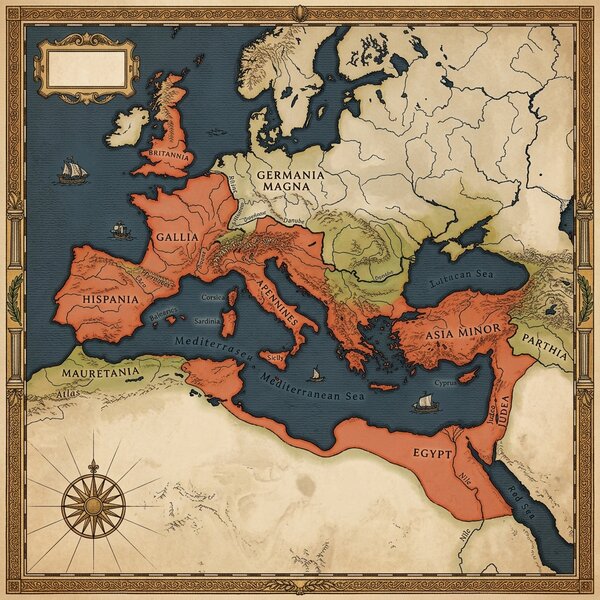
During his reign of almost fifty years, Charlemagne led more military campaigns than can easily be listed. The empire he left behind was not inherited – it was hard-won. With brutal determination, great logistical prowess and a flair for alliances.
| Campaign / Opponent | Period | Outcome |
|---|---|---|
| Lombard Kingdom (Italy) | 773–774 | Charlemagne becomes King of the Lombards, expansion of power in Italy and close ties to the Church of Rome |
| Saxon Wars | 772–804 | Subjugation and Christianisation of the Saxons after decades of struggle – the most brutal conflict of his reign |
| Avars (Eastern Europe) | 791–796 | Devastating defeats of the Avars, establishment of the Avar March, Frankish control over Central Europe secured |
| Spanish March | 778 onwards | Initial defeat at Roncesvalles (778), control over parts of northern Spain later secured |
The Saxon Wars: Decades of violence
No campaign is as closely associated with Charlemagne as the Saxon Wars – and none is so difficult to categorise. For more than thirty years, Charlemagne fought against the Saxons, who settled in the north-east of the Frankish Empire and stubbornly resisted subjugation and Christianisation.
The wars were characterised by extraordinary brutality. In 782, according to sources, Charlemagne had 4,500 Saxon hostages executed at the so-called ‘Blood Court of Verden’ – a figure that is debated in academic circles but is regarded as a historically documented event. At the same time, following their final subjugation, he enacted just regulations for Saxon society. Charlemagne was not a monster by nature – he was a ruler who governed using the means of his time. Those means were cruel.
In the end, the Saxons were subjugated, Christianised and integrated into the Frankish Empire. Former enemies became subjects, and later supporters of the Carolingian Empire.
Roncesvalles – the defeat that became a legend
In 778, Charlemagne marched into Spain to drive back the Muslim rulers. The expedition failed. During the retreat through the Pyrenees, his rearguard was ambushed and annihilated by Basque guerrillas in the Pass of Roncesvalles. One of the fallen was a certain Roland, Margrave of the Breton March.
This setback might well have been forgotten. Instead, it became the basis for the Song of Roland, one of the most significant epic poems of the Middle Ages – in which the Basques became Saracens and Roland rose to become an invincible hero. History rarely becomes legend quite so directly as it does here.
3. The coronation of 800 – a moment that changed history
On 25 December 800, Charlemagne entered St Peter’s Basilica in Rome for Christmas Mass. What happened next continues to occupy historians to this day: Pope Leo III placed the imperial crown upon his head.
Was Charlemagne prepared? His biographer Einhard claims that Charlemagne stated he would not have gone to church that day had he known of the Pope’s intentions. That sounds like an understatement – or like politics. It is more likely that the coronation had been discussed beforehand, but Charlemagne wanted to leave the initiative to the Pope in order to emphasise the independence of his power.
What the coronation meant: Charlemagne was now Emperor of the West – the successor to the Western Roman emperors in the mindset of the time. This immediately created tensions with Constantinople, where the Byzantine Emperor regarded himself as the sole legitimate Roman Emperor. But it also laid the ideological foundations for what would later become the Holy Roman Empire.
Note: The imperial coronation of 800 was not an isolated event – it was the result of a long-standing close relationship between the Frankish Empire and the Papacy. Charlemagne had provided political support to Leo III when the latter found himself in difficulty in Rome. The crown was, in a sense, a token of gratitude.

4. Reforms – the ruler as a shaper

Charlemagne would be a mere footnote in history had he merely waged wars. What makes him a key figure are his reforms. He did not merely build an empire – he sought to organise it for the long term.
| Reform | Impact and significance |
|---|---|
| County constitution | Counts as royal representatives with administrative and judicial powers – the foundation of modern regional administration |
| Missi dominici | Royal envoys who monitored compliance with orders and combated corruption in the counties |
| Monastic schools | Educational institutions throughout the empire – monks and external pupils learnt to read, write and Latin |
| Carolingian minuscule | Standardised script for the entire empire – facilitated administration, communication and the transmission of knowledge |
| Church reform | Standardisation of liturgy and canon law, promotion of the clergy as educators |
| Reform of weights and measures | Uniform systems of weights and measures facilitated trade and administration throughout the Frankish Empire |
The Missi dominici: the king’s eyes in the realm
One of Charlemagne’s most effective instruments was the system of the Missi dominici – royal envoys who travelled in pairs (one secular, one ecclesiastical) through the counties, inspected the work of the counts, received complaints and administered justice. This was early medieval administrative oversight: not a modern bureaucracy, but a functioning control mechanism.
Carolingian minuscule: a script for an empire
Under Charlemagne, a new, standardised script was developed and implemented: the Carolingian minuscule. Clear, legible, reproducible. That sounds like a technical detail – but it was an administrative and cultural revolution. If all clerics, officials and scribes used the same script, instructions, laws and letters could be understood throughout the entire empire. The humanist typefaces of the Renaissance later developed from the Carolingian minuscule.
Education as an instrument of power
At his court in Aachen, Charlemagne gathered the most learned men of his time: Alcuin of York, Einhard, Paulus Diaconus. This court school was more than an educational project – it was a political instrument. An educated clergy governed more reliably. A standardised liturgy strengthened cohesion. Knowledge was power, and Charlemagne knew it.
5. Aachen – the capital of a continent
Charlemagne could have established his main residence anywhere in the empire. He chose Aachen. The reasons were pragmatic: thermal springs, a favourable location, good hunting grounds. But what Aachen became was more than a residence – it became the cultural and political centre of the Western world.
The Palatine Chapel – a building with a message
The most significant example of Carolingian architecture is the Palatine Chapel in Aachen, built between 793 and 813. Today it forms the heart of Aachen Cathedral. Charlemagne had columns and marble slabs transported from Italy to furnish it – a deliberate link to antiquity and to Rome.
The chapel is an octagonal central structure, inspired by San Vitale in Ravenna. It was intended to demonstrate that this ruler stood in the tradition of the great kings and emperors. Architecture as a political statement. The Throne of Charlemagne on the upper floor later served as the coronation site for German kings – right up until 1531.
Aachen after Charlemagne
Charlemagne was buried in the Palatine Chapel following his death in 814. Around 400 years later, his remains were transferred to the Charlemagne Shrine, which is now located in the choir hall of Aachen Cathedral. The cathedral remains one of Europe’s most significant historical sites to this day – and has been a UNESCO World Heritage Site since 1978.
6. Death, division and legacy – what remains of an empire
Charlemagne died on 28 January 814 at his palace in Aachen. He was in his late sixties – a ripe old age for the time. Einhard cites pneumonia as the cause of death. His body was buried immediately, in accordance with early medieval custom.
His successor was Louis the Pious, his only surviving son from his marriage to Hildegard. Charlemagne had carefully arranged for his succession – and yet the empire fell apart. Not immediately, but inexorably.
The Treaty of Verdun in 843 – the end of unity
In 843, Charlemagne’s grandsons settled the division of the Frankish Empire into three parts in the Treaty of Verdun: West Francia (which later became France), East Francia (from which the German Empire emerged) and the Middle Kingdom. This division laid down the basic contours of European political geography for centuries.
The empire that Charlemagne had united survived in its original form for only about thirty years after his death. But his legacy was not the empire – it was the model. Administration by counts, education through monastic schools, law through written statutes, writing through minuscule script. These structures survived the division.
Charlemagne continues to shape Europe to this day – not through his borders (which disappeared), but through his structures. Administrative traditions, legal concepts, educational institutions and the idea that a Christian West can form a political unity: all of this can be traced back to the Carolingian legacy.

7. The Carolingian Renaissance – Culture as a Programme

The term ‘Carolingian Renaissance’ sounds magnificent – and indeed it is, once you understand what is meant. It was not a cultural awakening born of inner enthusiasm, but a deliberate programme: Charlemagne sought to raise the standard of education throughout the empire, establish uniform standards and preserve the heritage of antiquity.
The most eminent scholars of the time worked at his court in Aachen. Alcuin of York reformed the education system. Einhard wrote the Vita Karoli Magni, the first major biography of a Western ruler since antiquity. In monastic schools throughout the empire, people taught, copied and discussed.
Many ancient texts that still exist today survived because Carolingian monks copied them. Without Charlemagne’s educational programme, the cultural heritage of antiquity in Europe would be far more patchy.
8. Frequently asked questions about Charlemagne
Was Charlemagne really that tall?
Einhard, his biographer, describes him as exceptionally tall and powerfully built. Bone analyses in the 19th and 20th centuries attributed to Charlemagne suggested a height of around 1.84 to 1.92 metres. For the 8th century, that would indeed be exceptional. The exact figure remains uncertain – but it is historically documented that he stood out physically to his contemporaries.
Could Charlemagne read and write?
He could read – Einhard reports that he kept books by his bedside. He only learnt to write as an adult and found it difficult: he practised on wax tablets which he kept under his pillow, and, according to Einhard, complained that he had started too late. In a way, this makes him more human than his legend.
Was Charlemagne a forerunner of Europe in the modern sense?
That would be an anachronistic interpretation. Charlemagne did not think in terms of a modern European project. He thought in terms of rule, religion and power. It is historically correct that his empire foreshadowed the basic structures of later European states – but that was not a plan, but a result.
What is the Charlemagne Prize?
The International Charlemagne Prize of Aachen has been awarded annually since 1950 to individuals who have made a significant contribution to European unification. Named after Charlemagne, it is the oldest award for services to European integration. Previous recipients include heads of state, institutions and visionaries of the European idea.
How did Charlemagne die?
Charlemagne died on 28 January 814 in his palace in Aachen. Einhard describes a condition known as pleurisy, which is often equated with pneumonia today. He was around 66 or 67 years old – a remarkably advanced age for an active ruler in his time.
Conclusion: Why Charlemagne is still important
Charlemagne is not a myth to be blindly trusted – nor a monster to be wholesale condemned for his brutality. He was a ruler of the 8th and 9th centuries who, using the means and methods of his time, accomplished an extraordinary feat.
What remains: an administrative model that shaped generations. An educational reform that preserved ancient knowledge. An imperial title that gave birth to the idea of a Christian West. A Carolingian minuscule script from which our modern printed typefaces emerged. A city of Aachen that still bears witness to its history today.
Anyone wishing to understand the Early and High Middle Ages – whether as a reader, a re-enactor or a LARP player – cannot ignore Charlemagne. He is the starting point for much of what followed.





Letters from the trading house
New arrivals, market dates and offers, straight from Rinchnach. Unsubscribe any time with one click.
Subscribe to the newsletter