
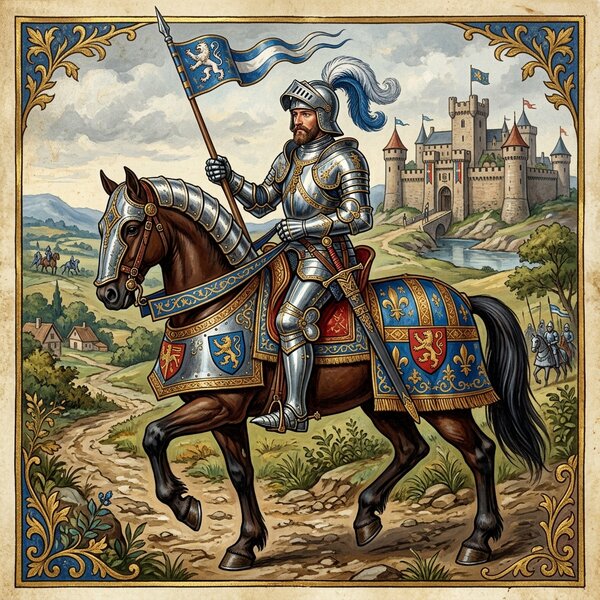
Shiny plate armour, a sword at his side, a warhorse beneath the saddle – this is how films and fantasy novels portray the medieval knight. Yet hardly any depiction asks what this man actually wore next to his skin before even putting on the first metal plate. The answer is surprisingly multi-layered – in the literal sense.

What you can expect from this article
- Key findings at a glance
- Myth and reality of knightly armour
- The innermost layer: linen shirt, breeches and stockings
- The padding layer: gambeson and textile protection
- Arming doublet: the foundation of plate armour
- Leg protection: chausses and chainmail leggings
- Under the helmet: padded hoods, chainmail hoods and types of helmet
- Period, region and purpose: how undergarments evolved
- Daily life and care of undergarments
- FAQ – Frequently asked questions about a knight’s undergarments
 Reading time approx. 8 mins.
Key findings at a glance
- A knight almost never wore ‘bare metal’. Between the skin and the metal lay at least two, often three or more, layers of fabric.
- The innermost layer consisted of a linen shirt and bruche (linen underpants), supplemented by woollen stockings or leggings.
- On top of this came a padded gambeson or tunic; later, a close-fitting arming doublet with attachment points for the metal armour.
- Beneath the helmet, a padded coif protected the head, often combined with a chainmail coif.
- The exact undergarments varied depending on the period (11th–15th centuries), region and intended use – battle and tournament presented different requirements.
Myth and reality of knightly armour
Films often depict knights as men wearing metal directly against their bare skin. The historical reality was quite different: every suit of armour – whether chainmail, scale armour or, later, full plate armour – was part of a multi-layered system in which the textile undergarments were just as important as the metal itself.
The time frame ranges from the 11th/12th centuries, when chainmail dominated, to the fully developed plate armour of around 1450–1500. A chainmail tunic made up of thousands of individual iron rings usually weighed between 10 and 20 kilograms, depending on its length and design; a complete suit of plate armour, including undergarments, typically weighed between 25 and 40 kilograms. Anyone who had to carry such a weight and fight whilst wearing it needed considerably more than just nothing underneath.
This article focuses exclusively on what knights wore directly beneath their armour – not on weapons such as swords or lances, not on shields or maces, and not on horses or tabards worn over the armour.
Bottom layer: linen shirt, breeches and stockings

The basis was formed by two items of clothing that were standard throughout the High and Late Middle Ages:
- Linen shirt (kittel): A loosely cut, usually knee-length shirt that absorbed sweat, was easy to wash and protected the more expensive layers worn over it. Linen was considered a cool, absorbent fibre and was virtually irreplaceable for managing moisture beneath the steel.
- Bruche (braies): Loose-fitting linen underpants, usually reaching to the knee, fastened at the waist with a cord – just as common in everyday wear as they were under armour.
- Stockings and leggings: Made of wool, close-fitting and tied to the bruche or doublet. They kept the legs warm and prevented chainmail or plate armour from pressing directly against the skin.
- Footwear: Simple leather shoes or cloth leggings with sewn-on leather soles, before iron sabatons became commonplace as part of plate armour.
Even wealthy knights attached great importance to clean, well-fitting undergarments. It can be clearly ruled out that any member of the nobility would have worn anything threadbare beneath their steel.
The padding layer: gambeson and textile protection
Beneath the actual armour, knights wore a gambeson – a quilted, thickly padded jacket made of several layers of linen or wool, sometimes additionally lined with horsehair or scraps of fabric. Without this padding, blows would have caused severe bruising and broken bones even if the metal held firm, for whilst plates deflect blows, they transfer the force to the body beneath.
Archaeological finds confirm that such textile protective layers did indeed exist: in German-speaking regions, 15th-century armour vests have been preserved or are documented from towns such as Stendal and Lübeck. Ordinary foot soldiers and poorer combatants sometimes wore only this textile armour on its own, whilst wealthy knights used it as a base layer beneath chainmail or plate armour.
In the 12th and 13th centuries, gambesons were still voluminous and cut in a cloak-like style. By the 14th and 15th centuries, they had become shorter and more form-fitting – a development directly linked to the emergence of plate armour.

Arming Doublet: the foundation of plate armour
With the advent of plate armour, the voluminous gambeson was increasingly replaced by a more form-fitting doublet – the arming doublet, the technical foundation of late medieval full armour (c. 1380–1500).
- Construction: The doublet featured sewn-in reinforcements and attached arming points to which the individual armour components were fastened, so that the chest, shoulders and hips shared the load.
- Cut: Similar to a civilian doublet, but with reinforced seams and additional padding under the arms and shoulders to ensure maximum mobility in combat.
- Source: The English manual ‘How a man shall be armyd’ from the early 15th century (preserved in a manuscript at the Pierpont Morgan Library) describes step by step how a man would don his shirt, bruche, arming doublet and, finally, the metal armour pieces.
- Fashion: In the 15th century, arming doublets with a narrow waist and accentuated chest also influenced civilian court fashion – the cut of the breastplate worn over it, which from the 14th century onwards was increasingly made of iron, was closely tailored to the doublet beneath.
Leg protection: chausses and chainmail breeches

The legs were also particularly vulnerable in combat and were therefore protected with multiple layers:
- Chausses (leggings): In the 12th/13th centuries, separate woollen tubes for each leg, tied at the ankle. Later, these evolved into closed trousers.
- Padded trousers: Quilted padding for the thighs and knees, which absorbed blows beneath chainmail or plate leg armour and kept the metal away from the body.
- Chainmail chausses: Chainmail protected particularly vulnerable areas such as the groin and the back of the knee beneath the plate armour – as documented on tombstones and in surviving pieces of armour.
- Practical reality: Not every knight possessed a full set of plate leg armour whilst on campaign. Sturdy, well-padded woollen trousers were sufficient in many cases.
Status also played a role in the choice of colour: red textiles were labour-intensive and expensive to dye and were therefore regarded as a sign of wealth – whether red also offered practical advantages in concealing bloodstains, as is occasionally suggested, cannot be conclusively proven historically.
Under the helmet: padded hoods, chainmail hoods and types of helmet
The head was the most vulnerable area and was therefore protected with particular care.
- Padded cap (arming cap): Thickly quilted linen or woollen fabric, worn directly on the head, often secured under the chin with straps. It cushioned blows, stabilised the helmet and prevented pressure marks.
- Evolution of helmet types: In the 12th century, the helmet evolved from the simple nasal helmet, which protected only the nose and eye area, into the heavy pot helmet with narrow vision slits. Pot helmets usually weighed between 3 and 4 kilograms; reinforced versions could weigh up to 6 kilograms. From the early 14th century onwards, the later bascinet was fitted with a movable visor, thereby offering significantly greater flexibility between visibility and protection.
- Coif: A close-fitting chainmail cap covering the head, neck and shoulders, worn either under or over the padded cap, which protected the areas left exposed by the helmet.
- Material: Wool or horsehair were used as padding; cotton was scarcely available in Europe during the High Middle Ages.

Period, region and purpose: how undergarments evolved
A knight’s equipment was not a rigid system, but evolved over the centuries – from the voluminous textile armour of the early High Middle Ages to the slim, specialised arming doublet of the Late Middle Ages.
| Period | Dominant armour | Typical undergarments |
|---|---|---|
| 11th–12th centuries | Chainmail (approx. 10–20 kg) | A voluminous, cloak-like gambeson worn over a linen shirt and bruche |
| 13th–14th centuries | Transition to the first plate armour components | Shorter, more form-fitting gambeson; first reinforcements |
| 15th century | Full plate armour (approx. 25–40 kg) | Tight-fitting arming doublet with lacing for armour components |
Studies using faithful replicas show that a complete suit of armour, including the doublet and padding, could weigh between 30 and 50 kilograms – according to these studies, the weight made walking approximately 2.1 to 2.3 times more strenuous and running around 1.9 times more strenuous than without armour. Underclothing was not an additional problem, but rather part of the solution, as it ensured a more even distribution of weight.
- Regional differences: Italian armour (Milanese style) tended to feature finer inner linings, whilst German armour often had more robust padding.
- War vs. tournament: Tournament armour was generally more heavily padded and heavier than war armour. The frequently cited date of 938 for the ‘first tournament rules’ can be traced back to Georg Rüxner’s *Thurnierbuch*, written in the 16th century, and is regarded in modern scholarship as a later legend rather than a historical fact – the earliest actually documented tournaments date only from the late 11th century. It was not until the 15th century that tournament padding reached its peak.
- Social status: A king or member of the high nobility would own tailor-made undergarments; poorer combatants wore improvised items. The hands were also protected with padded gloves.
Daily life and care of the undergarments

Putting on the various layers – shirt, bruche, gambeson, arming doublet, chausses – took time and skill. In practice, knights usually required the help of a squire, particularly when fastening the metal plates to the doublet and securing the buckles at the back.
Maintenance was no trivial matter either: linen undergarments were changed and washed regularly, whilst gambesons and arming doublets had to be aired and dried to prevent mould and odours. A well-fitting arming doublet distributed the weight of the plate armour evenly across the shoulders, chest and hips – a poorly fitting one, on the other hand, turned its wearer into a beast of burden for his own equipment.
The myth of the knight in threadbare clothing beneath expensive armour can clearly be dispelled when it comes to the wealthy nobility: they wore functional, often bespoke garments that combined mobility with the prestige befitting their status. The breathable layers of linen also offered a noticeable advantage in summer against overheating beneath the steel.
FAQ – Frequently asked questions about knights’ undergarments
Did knights in the Middle Ages wear underwear?
Yes. A knight usually wore a linen shirt and a bruche as the innermost layer, often supplemented by woollen stockings or leggings. Linen was preferred for hygienic reasons, and even nobles attached importance to clean underwear – contrary to the popular image of the ‘dirty Middle Ages’.
Was undergarment standardised, or did every knight wear something different?
There was no ‘uniform’ in the modern sense, but the typical layers were similar everywhere: shirt, bruche, gambeson or armour-wams, arming doublet, chausses. Cut, quality of material and decoration varied depending on the era, region, wealth and personal preference.
Did knights wear their normal everyday clothes under their armour?
To some extent. Basic items such as shirts, doublets and simple woollen trousers were similar to everyday clothing. For combat, however, specially padded and reinforced doublets and trousers were added, which were not worn in civilian life.
Were there differences between tournament and battle undergarments?
Yes. In the 15th century, tournament undergarments were often more heavily padded to absorb heavy but blunt blows – for example, in jousting, with particularly thick helmet crests and reinforced armour doublets on the chest and shoulders. In warfare, by contrast, the padding was a compromise between protection and mobility, as a fighter had to be able to march for hours whilst wearing it.
Could knights even put on their armour without help?
A man could usually put on his undergarments – shirt, bruche, gambeson, arming doublet – by himself. In practice, however, putting on a full suit of plate armour, including leg and arm guards, almost always required a squire to help with fastening and adjusting it.


Letters from the trading house
New arrivals, market dates and offers, straight from Rinchnach. Unsubscribe any time with one click.
Subscribe to the newsletter

