









What was love really like in the Middle Ages? In this article, we look at the different forms of love in the Middle Ages – from idealised courtly love to matter-of-fact, practical marriages and social expectations.

What you can expect in this article
- The most important facts at a glance
- Marriage and social expectations
- The family in the Middle Ages
- Minnesang: expression of forbidden love
- The emergence of courtly love
- 769 to 1007: From Old High German Minna to Middle High German Minne
- 1007 to 1226: Chivalry and the Crusades of the Romanesque period, urbanisation and three-field crop rotation
- 1186 to 1425: The heyday of courtly love
- Minnesingers and their art
- The role of courtly love
- Tristan and Isolde: A tragic love story
- Passion and affection outside of marriage
- The medical view of love
- The influence of the Church on love
- Women and their role in love
- Romanticism and its rediscovery
- Love letters and poems
- Fidelity and infidelity
- Love as a literary theme
- Sexuality and love life
- Concluding remarks

- Reading time approx. 15 min.
The most important points at a glance
- Duke William IX of Aquitaine played a central role in the development of courtly love and minnesang. He created a new form of love poetry in which the ideal of an unattainable lady is celebrated.
- Marriages were often arranged and focused on power and money; personal feelings and romantic love played no part.
- The minnesang and literary works of the Middle Ages sang of complicated forbidden love and social expectations. Tensions between desire and reality were expressed through the songs.
Marriage and social expectations
In the Middle Ages, marriages were usually arranged by parents. These marriages were intended to secure money, power and social status. The feelings of those involved played a subordinate role; marriages were made for economic and practical reasons, not for love. The dowry that the bride brought into the marriage was an important financial prerequisite and contributed to the financial security of the family.
There were clear social expectations of marriage: men had to bear legal and financial responsibility, and women were responsible for the household and children. This rigid division of roles clearly reflects the patriarchal structures of medieval life and left little room for individual needs and feelings.
The reality of marriage in the Middle Ages often contradicts the romantic notions of courtly love.
The family in the Middle Ages
In the Middle Ages, the family played an important role in society. Property rights and family name were major factors that determined a family's social status. One's origin and family tree determined the social class to which one belonged. Middle High German literature and music dealt with this extensively. The family often appears as a theme in the works of poets and musicians. Knowledge of family connections and property rights was essential to understanding the social structures and norms of the Middle Ages.

Minnesang: expression of forbidden love
An important art form of the Middle Ages was Minnesang, which was strongly inspired by courtly love. Minnesingers such as Walther von der Vogelweide and Wolfram von Eschenbach created songs that sang of the unattainability of the beloved and the passion and despair associated with it. The famous tale of Tristan and Isolde sings of the challenge of forbidden love.
Love was often portrayed here as a game in which minstrels expressed their feelings and desires in poetic form. These songs served as entertainment, of course, but they also allowed singers to question social norms.
The emergence of courtly love
769 to 1007: From Old High German Minna to Middle High German Minne
Minne developed in the Middle Ages and was deeply rooted in the culture and literature of the time. Originally derived from the Old High German term "Minna", its meaning changed over the centuries. Minne was the expression of romantic feelings cultivated by poets such as Walther von der Vogelweide and Reinmar von Hagenau. These early works sang of forbidden love and the complicated social ideas of the Middle Ages.
1007 to 1226: Chivalry and the Crusades of the Romanesque period, urbanisation and three-field crop rotation
In the 11th and 12th centuries, courtly love underwent significant development, strongly influenced by chivalry and the Crusades. During this Romanesque period, the idea of courtly love and the worship of the lady emerged. Society changed, large cities arose, and the three-field system was introduced. People were given the opportunity to express their own desires and feelings more strongly. Courtly love became an important cultural phenomenon that fuelled the romantic ideals of the knights and nobles of the Middle Ages.
1186 to 1425: The heyday of courtly love
Courtly love flourished in the 12th and 13th centuries. Poets such as Gottfried von Straßburg and Wolfram von Eschenbach spread courtly love by cementing courtly love and the worship of women in their works. The pursuit and desire for idealised love made courtly love the subject of Middle High German literature and music.


Minnesingers and their art
Famous minstrels shaped German literature with their emotional and vivid lyrics. Minnesang was not only a form of poetry, but also influenced the entire value system of aristocratic society in the Middle Ages.
The minstrels created a connection between desire and reality by playfully exploring the boundaries of courtly society through their art. Typical characteristics of Minnesang were the idealisation of love and the use of nature metaphors.
The role of courtly love
Courtly love originated in the 12th century in aristocratic circles and was one of the most influential cultural movements of the Middle Ages. Influenced by the ideology of gallantry, knights placed the unattainable lady at the centre of their adoration. They idealised the lady as sacred and unattainable. This love was seen as a kind of game involving courtesy and desire. Duke William IX of Aquitaine was a creator of this ideal of the unattainable woman and the approach to courtly love.
Social norms required knights to worship their ladies with respect and devotion, without the possibility of a sexual relationship or a relationship in general.
Courtly love was more an expression of duty, decency and loyalty than a genuine romantic connection.
Tristan and Isolde: A tragic love story

The legend of Tristan and Isolde is one of the most famous stories of forbidden love in the Middle Ages. It is a tragic love story between the knight Tristan and the Irish princess Isolde. Tristan is sent to Ireland to win the beautiful Isolde for his uncle, King Marke of Cornwall. However, on the journey, Tristan and Isolde accidentally drink a love potion that makes them fall madly in love with each other.
This story provides valuable insights into the concepts of love, longing and social constraints in the Middle Ages. It shows how strict social norms influenced people's romantic relationships and the challenges this entailed.
Passion and affection outside of marriage
In addition to idealised courtly love, there was also 'lowly love', which referred to romantic stories involving non-noble women and also involved physical relationships. This form of love told of passion outside of marriage.
Abstinence outside of marriage was vehemently demanded by the Church. Sexual relationships were only legitimate within marriage. Despite these strict regulations, there were many passionate relationships that were lived out outside of the bonds of marriage.
Medical view of love
Love was also viewed from a medical perspective in the Middle Ages. Hildegard von Bingen was an important scholar of her time and recommended, for example, the use of betony to free women from the 'madness of love', which was considered problematic. Her medical teachings emphasised the importance of balancing bodily fluids.
Medical advice dealt with sex and attempted to find a balance between lust and religiosity. In the Middle Ages, love madness was considered unsuitable for marriage, and a medical solution was even deemed necessary.
The influence of the Church on love
The Church exerted a considerable influence on ideas about love. Minstrels questioned the norms expected by the Church in their songs.
The mystical wedding was a spiritual union between man and God and was intended to create a deep spiritual bond. These religious ideas influenced the way love, sex and marriage were perceived in the Middle Ages.
Women and their role in love

In the Middle Ages, it was imperative that a girl enter marriage as a virgin. This virginity determined her (social) value. Women often had no influence on the choice of their partner; marriages were arranged between parents. Christian teachings portrayed women as seductive and men as easily seduced.
Women were required to behave passively during sexual intercourse in romantic relationships. Women often had to find a balance between social expectations and personal needs.
Romanticism and its rediscovery
Romanticism, which emerged at the end of the 18th century, sought new forms of expression for love and rediscovered the minnesang. The early Romantics of Jena played an important role in reviving the minnesang traditions.
In Romanticism, the image of love was strongly influenced by the minstrels, who wrote about unfulfilled passion and the beauty of women. A love that lasted until the end of time. In Goethe's work 'The Sorrows of Young Werther', he used love letters to reveal inner conflicts and deep emotional suffering.
Love letters and poems
Love letters in the Middle Ages served as an important means of communication to express feelings and strengthen relationships. A love letter from Germany, dated around 1180, reads: 'Dû bist mîn, ich bin dîn' (You are mine, I am yours).
Literary love letters differ from real letters in that they were often very dramatic. Real love letters usually served the purpose of strengthening or restoring interpersonal relationships, which was often considered boring and unspectacular in literature.
Fidelity and infidelity
Society's reaction to extramarital relationships was often negative, as they were seen as a threat to the social order. Passionate feelings were often acted upon outside of marriage, and these affairs often led to illegitimate children and accusations of adultery.
Love as a literary theme
In medieval literature, love was often exaggerated, clinging to unfulfilled desires and unattainable objects of desire. Minstrels often addressed unfulfilled love and adored court ladies in their songs, which made love something painful and distant. This view underscored the fact that marriage arrangements and pragmatic considerations took precedence over romantic notions.
Geoffrey Chaucer combined romantic ideas with certain festivals in his novels and influenced people's perceptions and ideas.

Sexuality and love life
Sexuality in the Middle Ages was diverse and complex, despite the influence of the Church, which attempted to regulate sexuality. A large number of brothels offered men who could not marry opportunities for sexual activity. Marital sexuality was practised only under strict rules that limited sexual intercourse to the marriage bed and certain positions. A married woman was often pregnant for large parts of her life and was expected to bear numerous children.
Prostitution was strongly condemned by the Church on the one hand, but on the other hand it was also accepted as a necessary evil that was supposed to maintain social order.
Homosexuality, especially between men, was viewed with great contempt. Female homosexuality was less criticised as it did not pose a threat to male dominance. The existence of penitential books and erotic literature shows that the Church's rigid sexual rules did not always correspond to everyday life.
Concluding remarks
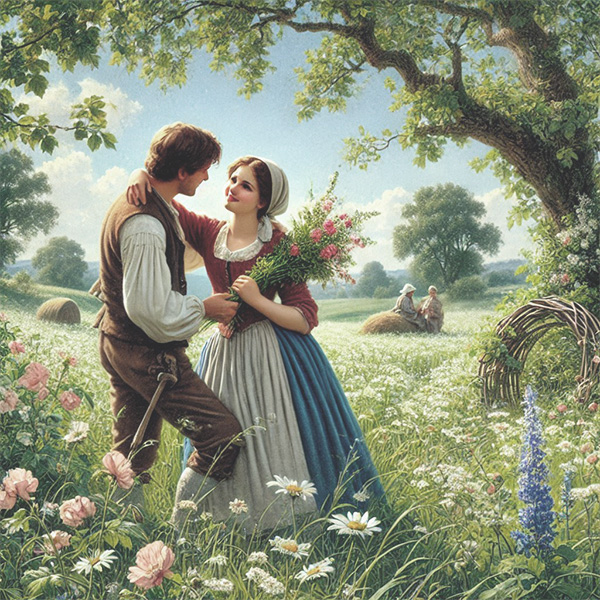
Love in the Middle Ages was a complex web of social norms, religious influences and personal desires. Courtly love idealised the worship of unattainable ladies, while marriage was often arranged for pragmatic reasons. Minnesang and stories such as Tristan and Isolde offered insights into the diverse forms of medieval love. Medical and ecclesiastical guidelines and rules shaped the understanding of love and sexuality. Women often had to submit to strict social expectations and guidelines.
Romanticism in the 18th century rediscovered medieval ideals of love and influenced the literary representation of love and passion. The diversity of medieval love literature and the significance of courtly love show how deeply rooted the longing for love is in human beings. Despite strict social and religious norms, people found ways to express their feelings and desires.


