





Medieval music encompasses a fascinating world of sound spanning from the 9th to the early 15th century. From the monophonic choral melodies of monasteries to the intricate polyphony of the Notre-Dame school – this era laid the foundations for everything we know today as Western music.

What you can expect in this article
- What is medieval music?
- Overview of the period: Chronological context
- Church music: Gregorian chant and early polyphony
- Secular music: minstrels, troubadours and courtly culture
- Composers of medieval music
- Musical notation, keys and soundscapes
- Life with music: function and significance in everyday life
- Medieval music today: From research to the medieval music scene
- FAQ – Frequently asked questions about medieval music
 Reading time approx. 8 mins.
What is medieval music?

The term ‘medieval music’ refers to the European musical tradition that musicologists date from the 9th century to around 1430. Some accounts extend this period even further, up to around 1500. It was during this time that the foundations of musical notation, the church modes and the first forms of polyphony were established.
Today, medieval music is often associated with the medieval scene, fantasy films and historical series. Historically, however, the term primarily refers to sacred liturgy and courtly song. In everyday life back then, music was performed live and tied to specific places and occasions – there were no sound recordings or streaming.
A clear distinction defines the genre: on the one hand, there is sacred music comprising liturgical chants, masses and hymns. On the other hand, there is secular music featuring love songs, dance music and satirical songs. Much of this has been reconstructed from manuscripts and visual representations such as miniatures in codices.
Key facts at a glance:
- Medieval music encompasses the European musical tradition from the 9th century to around 1430 and is closely linked to the Church, court culture and everyday life.
- Gregorian chant, as monophonic church music, forms the starting point of musical notation, particularly in monasteries such as St. Gallen from the 9th century onwards.
- In the 12th and 13th centuries, composers such as Léonin and Pérotin developed an artful polyphony known as Ars antiqua at the Notre-Dame School in Paris.
- The Ars nova of the 14th century, through Philippe de Vitry and Guillaume de Machaut, gave rise to new notation systems and complex rhythms.
- Alongside church music, secular groups such as minstrels, minnesingers and troubadours played an important role, even though their music has often survived only in fragments.
Overview of periods: Chronological classification
Medieval music can be divided into three major periods:
Early Middle Ages (c. 9th–11th centuries)
- The emergence of liturgical chants in the context of the Carolingian Reform
- First neume notation without precise pitches
- Centres such as the monasteries of St. Gallen and Reichenau as guardians of the tradition
High Middle Ages (c. 12th–13th centuries)
- Development of polyphony through organum techniques
- The heyday of the Notre-Dame School in Paris with Léonin and Pérotin
- Simultaneous rise of courtly song among troubadours and minnesingers
Late Middle Ages (c. 14th century to 1430)
- Ars nova and Ars subtilior with sophisticated mensural notation
- Distinctive time signatures and complex rhythms
- Transition to early Renaissance music
Some historians date the Middle Ages from as early as the 5th century. However, it is only with the advent of systematic musical notation that a more accurate reconstruction of the sounds becomes possible.
Church music: Gregorian chant and early polyphony
The Roman Catholic Church was one of the most important patrons of music in the Middle Ages. It was here that the earliest written melodies were composed, the influence of which is still felt today.
Gregorian chant
Gregorian chant forms the core of early medieval church music:
| Characteristic | Description |
|---|---|
| Form | Unison, unaccompanied vocal music |
| Language | Latin liturgical texts |
| Origin | Carolingian Empire, 8th/9th century |
| Performers | Monks and clerics in monasteries and cathedral chapters |
Typical texts included psalms, hymns and liturgical prayers such as the Introit, Kyrie and Alleluia. Pope Gregory I was traditionally credited with the name, although the codification took place primarily under Pippin the Younger and Charlemagne.
Early notation
The Cantatorium of St. Gallen (c. 922) is one of the oldest sources of neumes. This early musical notation merely indicated the melodic progression, without specifying exact pitches. It was not until around 1025 that Guido of Arezzo introduced staff notation with four lines.
The Notre-Dame School
The Notre-Dame School in Paris (c. 1160–1250) marked the breakthrough of polyphony. Léonin created the Magnus Liber Organi, a collection of polyphonic organa. Pérotin composed the four-part organum ‘Viderunt omnes’ – a milestone of the Ars antiqua featuring, for the first time, clearly structured polyphony and rhythmic modes.
The motet developed in the 13th century as a multi-layered piece based on a liturgical cantus firmus, often even multilingual.

Secular music: minstrels, troubadours and courtly culture

Secular music formed a major part of everyday musical life. However, our knowledge of it is significantly more patchy than that of church music.
Minstrels
Fiddlers were itinerant people of low social standing. They performed at markets, in taverns and at festivals, lived in legal uncertainty and were dependent on their audience. Typical instruments: hurdy-gurdies, fiddles, flutes, drums, bagpipes and simple harps. Their practice was primarily improvisation – many melodies have been lost.
Minnesang in the German-speaking world
Minnesang was courtly love poetry of the 12th and 13th centuries. Noble or semi-noble poet-composers performed their songs at courts. Important figures:
- Walther von der Vogelweide (c. 1170–after 1228) – his ‘Palestine Song’ combined courtly themes with religious and social commentary
- Heinrich von Morungen (c. 1200)
- Neidhart von Reuental (early 13th century)
Central themes included chivalric love, nature, but also satire on social conditions.
Troubadours and Trouvères
In southern France, troubadours such as Bernart de Ventadorn were active, whilst in the north, trouvères such as Thibaut de Champagne were active. This courtly song culture was interconnected across Europe and exchanged ideas across languages and regions.
The surviving tradition remains problematic: the Codex Manesse (c. 1300–1340) contains images of minstrels, but often lacks complete musical notation of the melodies.
Composers of medieval music
Many works from this period have been handed down anonymously. However, we do know the names of some significant figures.
Hildegard von Bingen (1098–1179)
The Benedictine abbess and mystic composed over 70 chants, collected in ‘Symphonia armoniae celestium revelationum’. Her music is monophonic, but characterised by unusually broad melodic lines and a distinctive modal language – often in honour of Mary and the saints.
Guillaume de Machaut (c. 1300–1377)
One of the most important writers and composers of the Ars nova in France. His “Messe de Nostre Dame” (c. 1360) is regarded as the first complete mass cycle by a single composer. In addition, he composed over 140 chansons in various forms.
Philippe de Vitry (1291–1361)
He is credited with the treatise ‘Ars nova’. He revolutionised mensural notation with precise note values and flexible time signatures.
Other important musicians
- Pérotin – master of early polyphony at Notre-Dame
- Francesco Landini (c. 1325–1397) – a significant Italian composer with over 140 ballads
Musical notation, keys and sound world
Development of notation
| Period | Period | Characteristics |
|---|---|---|
| Neumes | 9th–10th centuries | Imprecise pitches, indication of progression |
| Line notation | from 1025 | Guido of Arezzo, four staves |
| Mensural notation | 13th/14th century | Precise note values (Longa, Brevis, Semibrevis) |
Church modes
The modal scales (Dorian, Phrygian, Lydian, Mixolydian) differ significantly from later major and minor keys. This modal sound, with its open fifths and fourths, often strikes modern listeners as ‘archaic’ or ‘mystical’ – and is thus a distinctive feature of authentic medieval music.
Instrumentation
| Category | Instruments |
|---|---|
| String instruments | Fiddle, rebec |
| Plucked instruments | Harp, psaltery, lute |
| Wind instruments | Shawm, cornett, crumhorn |
| Percussion | Bells, drums |
Instruments were constructed differently depending on the region. Today, exact timbres can only be reconstructed approximately – a challenge for any playlist of historical recordings.
Performance practice
Medieval sources reveal little about tempo, dynamics or exact instrumentation. Early music ensembles draw on manuscripts, theorists such as Johannes de Grocheio and pictorial sources. Modern performances are historically informed, but always interpreted.
Life with music: function and significance in everyday life
Religious functions
Music accompanied Mass, the Liturgy of the Hours and processions. Special festivals such as Christmas, Easter and Corpus Christi were given rich musical accompaniment. Singing served as a means of devotion and community.
Court and urban life
Minnesingers and court musicians performed at tournaments, weddings and banquets. By the late Middle Ages, there were already municipal council musicians who took on official duties in places such as Cologne.
Folk music
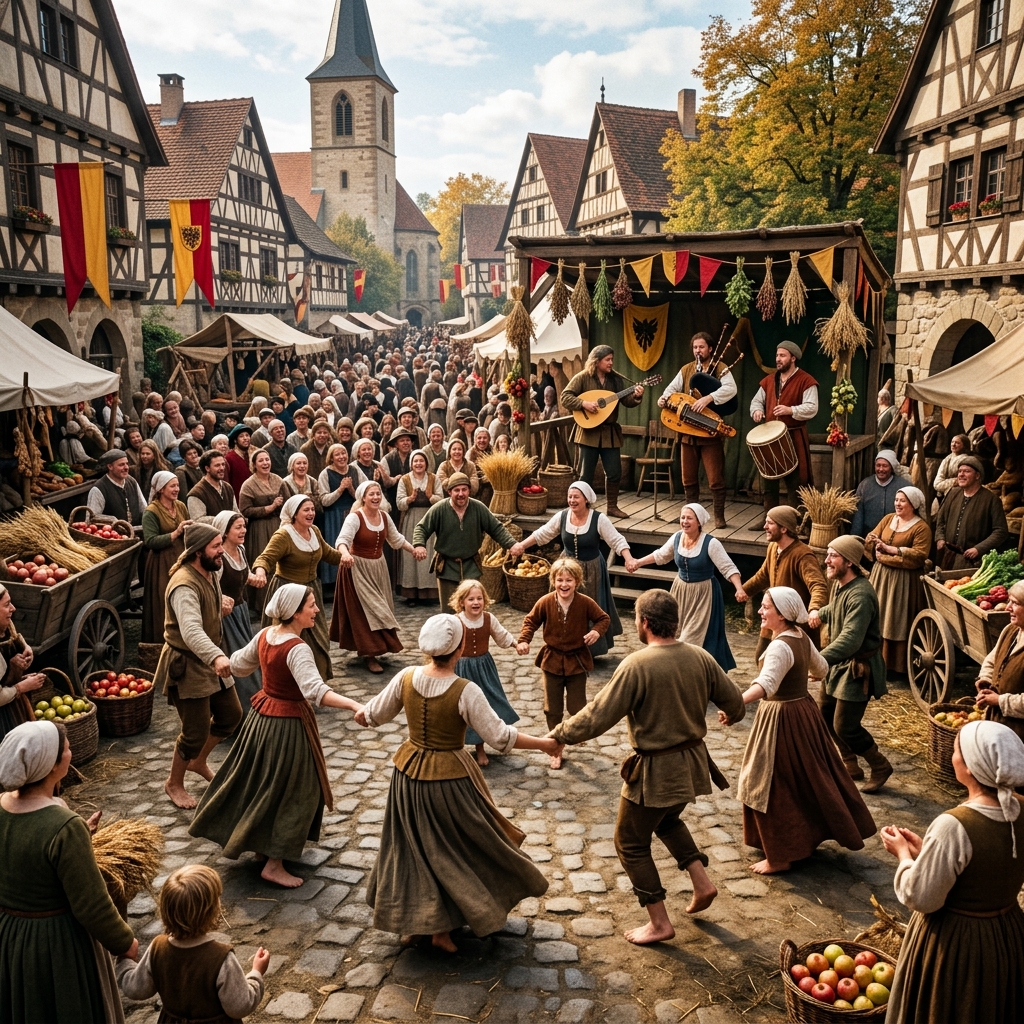
People danced and made music in village squares, at harvest festivals and in markets. This lively everyday music was mostly improvised and is known only indirectly from reports – traditions of the estampie are one of the few surviving examples.
Themes and content
Typical songs dealt with love and longing, nature and the seasons, war and peace, mockery of the authorities, and moral teachings. This diversity of themes resembles today’s pop lyrics – love and social criticism are timeless.
Medieval music today: from research to the medieval scene
Medieval music is alive and well – and extends far beyond the walls of musicology departments. At medieval markets and LARP events, the sound of hurdy-gurdies, bagpipes and shawms is part of the authentic atmosphere. Minstrels and troubadours are just as much a part of the scene as knights, merchants and herbalists.
Anyone portraying a minstrel, a female minstrel or a troubadour needs the right look: from period-appropriate clothing to historically accurate accessories on the belt.

FAQ – Frequently asked questions about medieval music
Was Gregorian chant really the only music sung in the early Middle Ages?
No, alongside Gregorian chant, other regional liturgical traditions existed. Ambrosian chant in Milan had its own modal characteristics. In Spain, the Mozarabic rite persisted until the 11th century. Some of these forms were later supplanted or adapted to the Roman tradition.
How faithful to the original do today’s performances of medieval music sound?
The exact sounds cannot be fully reconstructed. Tempo, articulation and precise tunings are usually not recorded. Early music ensembles draw on sources, replica instruments and current research. They offer a historically informed, yet always interpreted version – with advantages such as authentic modal sounds, but also limitations in details such as vibrato or instrumentation.
What role did women play in medieval music apart from Hildegard von Bingen?
In monasteries, numerous nuns sang and composed, though their names have rarely been handed down. At courts, noblewomen were presumably also musically active. In southern France, there were the Trobairitz – noble troubadours such as the Comtessa de Dia or Azalais de Porcairagues, who wrote their own texts.
Were there already musical scores for instrumental music in the Middle Ages?
The majority of surviving musical notation is vocal. Instruments were often used to double the voices or for accompaniment. A few collections of purely instrumental pieces exist from the late Middle Ages, such as estampie traditions in manuscripts like the London Manuscript.
How does medieval music differ from Renaissance music?
Renaissance music (from around 1450) relies more heavily on major/minor harmony, imitation between the voices and balanced polyphony. Medieval music is more modally characterised, frequently employs open fifths and fourths, and appears less regular rhythmically in its earlier phases. The transition is evident in increasing harmonic progression rather than modal linearity.


