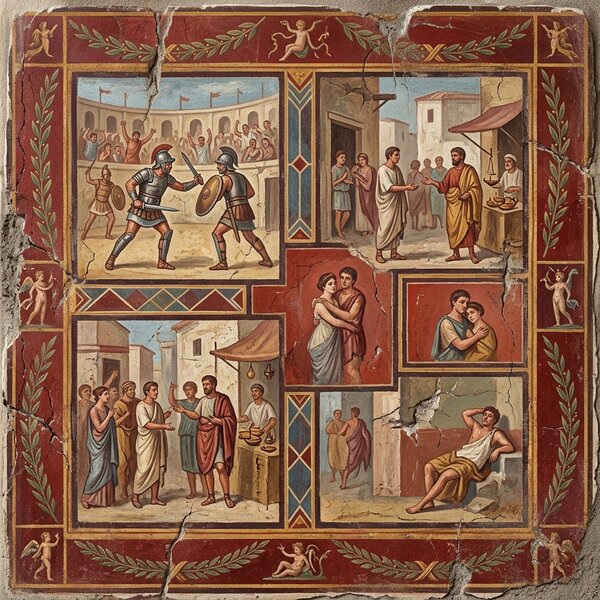
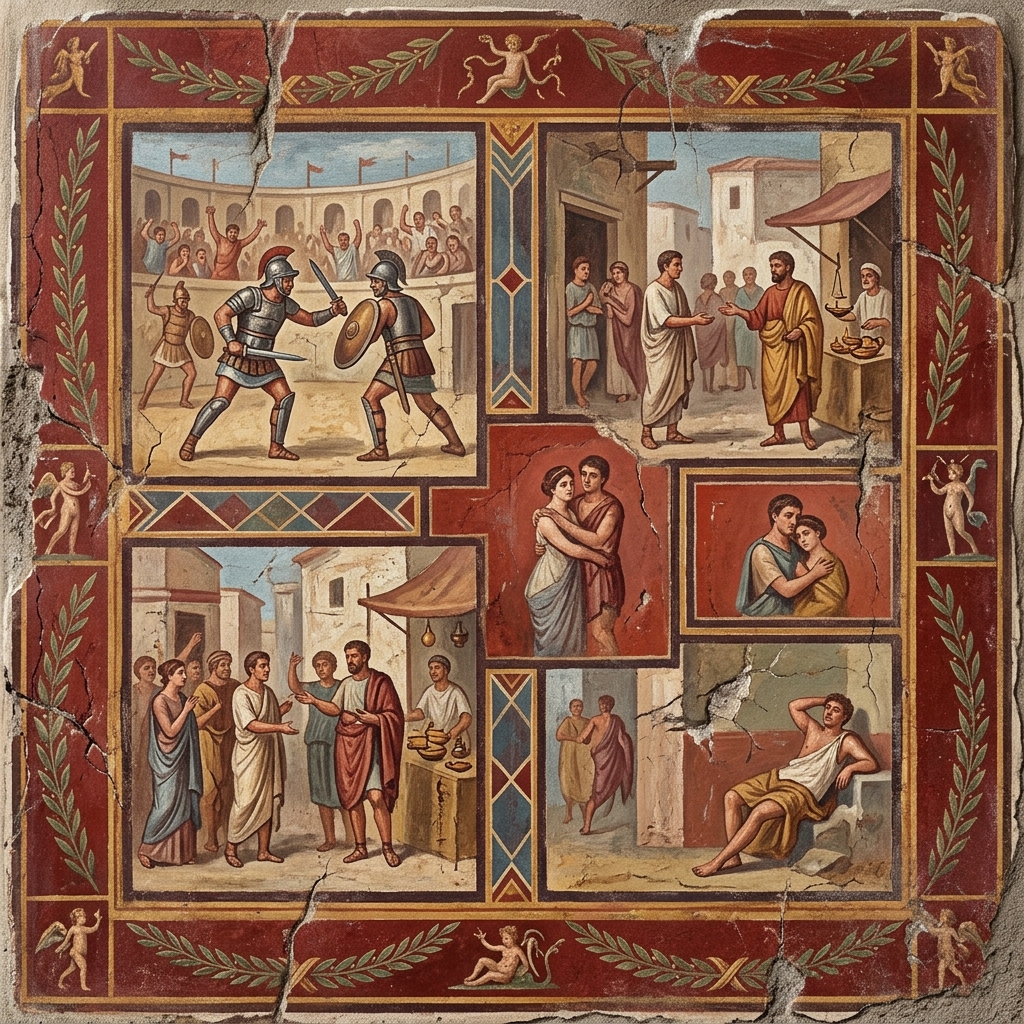
It is said that over 10,000 inscriptions have been preserved in Pompeii – carved into plaster, painted on walls, or hidden beneath ash. They tell of love, mockery, gladiatorial combats and boredom. This article reveals what the craziest walls of antiquity tell us about people’s real lives – and how cutting-edge research is still unearthing new messages from the plaster today.
What you can expect from this article
- Key findings at a glance
- Pompeii and its ‘talking’ walls – an introduction to a different kind of antiquity
- Love, mockery and ‘rumours’ – what the graffiti really reveal
- From a marginal note to a field of research – the history of graffiti research
- High-tech in the ruins – the ‘Bruits de couloir’ project
- What the graffiti reveal about society, education and sex in ancient Pompeii
- FAQ on graffiti from Pompeii
 Reading time approx. 8 mins.
Key findings at a glance
- The graffiti from Pompeii offer intimate insights into everyday life: love stories, crude jokes, complaints about food and advertisements for sexual services appear right next to one another.
- Graffiti are one of the most important sources of information about everyday life in the Roman Empire – they were not written by wealthy individuals, but by slaves, soldiers, traders and travellers.
- Modern technologies such as RTI (Reflectance Transformation Imaging) and photogrammetry now reveal hidden carvings that are invisible to the naked eye.
- In 2025, the international project ‘Bruits de couloir’ (Sorbonne Université and Université du Québec à Montréal) discovered and digitally preserved 79 previously unknown inscriptions in the theatre corridor at Pompeii.
- The walls function like ancient social media: personal messages, public mockery and scenes from everyday life reveal voices that would otherwise never appear in history books.
Pompeii and its ‘talking’ walls – a gateway to a different ancient world
On 24 August 79 AD – according to traditional dating, although several researchers now argue for a later date in October of the same year – Vesuvius buried the city of Pompeii under ash and pumice. The eruption froze everyday life in its tracks: bread in ovens, coins on tables and, indeed, thousands of messages on the walls.
These inscriptions have been preserved in the streets around the Forum, Via Stabiana, the theatre district and the amphitheatre. Ancient graffiti refers to texts and images scratched into fresh plaster – not colourful spray paint, but fine scratch marks in lime. The total number of known inscriptions from Pompeii is estimated at over 10,000; a significant proportion of these have now been scientifically documented and recorded in anthologies such as the *Corpus Inscriptionum Latinarum*, Volume IV. They range from short names and literary quotations to crude jokes. Graffiti in Pompeii offers insights into the everyday lives of people from all social classes: slaves, traders, soldiers, travellers, children – they all left their mark on the walls of buildings and the city’s ramparts.
Love, mockery and ‘gossip’ – what the graffiti really reveals

The graffiti features love messages and everyday comments crammed into a small space. A particularly vivid example was only rediscovered in 2025 in the theatre corridor at Pompeii: ‘Methe, slave of Cominia, from Atella, loves Chrestus. May the Pompeian Venus favour both their hearts, and may they always live in harmony.” These lines reveal something about personal relationships, slavery and belief in the goddess Venus – and, at the same time, that even an enslaved woman could speak out publicly and by name.
Alongside these are cheeky insults such as the famous wall graffito: “I am surprised, wall, that you have not collapsed under the weight of all these words.” Other inscriptions celebrate gladiators – such as ‘Celadus, the sigh of the maidens’ (Suspirium puellarum Celadus thraex), found in the gladiatorial barracks at Pompeii – or contain complaints about the food in taverns. Some of the scribbles are simply malicious gossip: the name ‘Miccio’ appears no fewer than four times in the theatre corridor alone, accompanied by a crude and vulgar mockery of his origins – an example of how personal feuds were literally carved in stone. Comments can even be found in the toilets.
Political content is comparatively rare – although Pompeii did have painted election slogans (programmata), the majority of the carvings revolve around emotions, humour, love and crude jokes. The wall served as a social space for communication: a place for love messages, publicly played-out arguments and rumours – genuine ‘corridor gossip’, from which the ‘Bruits de couloir’ project takes its name. The graffiti in Pompeii is thus comparable to modern chat messages or noticeboards, only carved in stone rather than posted digitally.
From a footnote to a field of research – the history of graffiti research
The excavations at Pompeii, which have been ongoing since the 18th century, initially focused primarily on villas, frescoes and statues. In the late 19th century, the German archaeologist August Mau systematically classified the wall paintings into his four Pompeian styles – a classification still in use today – and, in his seminal work *Pompeii: Its Life and Art* (1899) – yet everyday scribbles remained a side issue in research for a long time, overshadowed by official commemorative inscriptions, gravestones and high art.
The real shift only came with the growing interest in social and everyday history, as well as in digital methods. From 2013 onwards, the US classical scholar Rebecca Benefiel from Washington and Lee University, together with an international team, established the Ancient Graffiti Project – an open digital database of ancient graffiti from Pompeii, Herculaneum and other sites, which links text, translation and context. Social media is further fuelling this interest: photo posts from the ruins of Pompeii featuring ancient inscriptions now reach an audience of millions, making the subject accessible to a wider public.
High-tech in the ruins – the ‘Bruits de couloir’ project

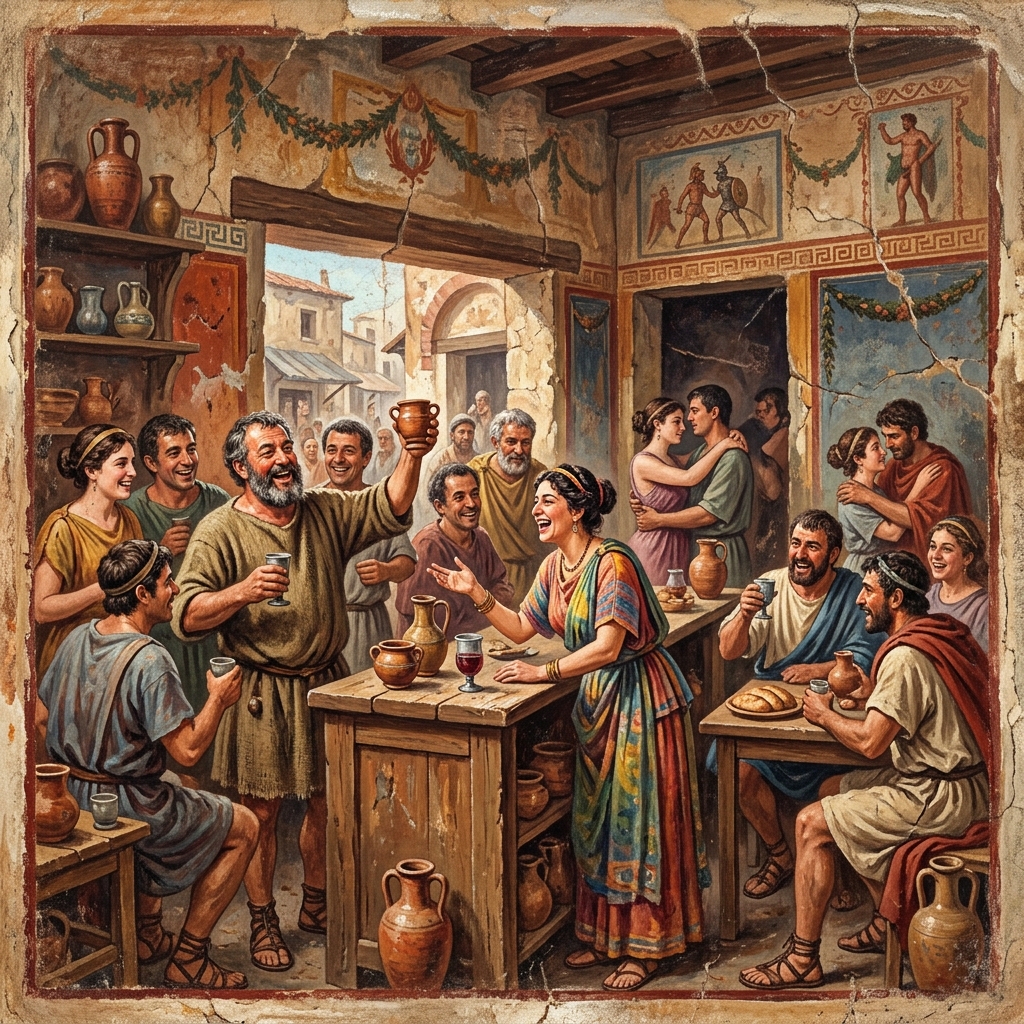
An unassuming passageway in Pompeii’s theatre district, which once led to the city’s two ancient theatres, has been at the centre of international graffiti research since 2025. The ‘Bruits de couloir’ project is coordinated by Louis Autin and Éloïse Letellier-Taillefer (both from Sorbonne Université) together with Marie-Adeline Le Guennec (Université du Québec à Montréal), in cooperation with the Archaeological Park of Pompeii. Two field campaigns, in 2022 and 2025, enabled a complete re-examination of around 300 inscriptions in the corridor, including 79 previously unknown engravings – declarations of love, sketches of gladiators, drawings of animals and lists of names.
The technology behind it: using Reflectance Transformation Imaging (RTI), light incident from various angles reveals the finest scratch marks that are invisible to the naked eye. This was made possible by a partnership with Éloi Gattet, the founder of Mercurio Imaging, who developed the RTI imaging dome required for the project. Photogrammetry complements the method by creating three-dimensional models of the corridor, in which each engraving is spatially located – including the love message from Methe mentioned at the beginning.
The research team led by Le Guennec, Autin and Letellier-Taillefer is now working on its own digital platform (bdc-pompei.com), where the results will in future be made available to both the academic community and the general public. At the same time, the Archaeological Park of Pompeii is planning a protective canopy over the delicate corridor: the digital documentation takes the strain off the fragile wall and reduces the impact of the weather and visitor traffic. The initial findings have been published in the e-Journal degli Scavi di Pompei.
What the graffiti reveal about society, education and sex in ancient Pompeii
Ancient graffiti in Pompeii was predominantly not created by wealthy individuals. The authors were freedmen, slaves, craftsmen and travellers passing through – as evidenced by their names, level of language and style. Pompeii’s graffiti is often written in colloquial Latin; in the same theatre corridor, several groups of Safaitic characters were even found – a South Semitic script for a Proto-Arabic dialect, which is not documented anywhere else in the western Roman Empire. Researchers suspect that these were left by auxiliary troops of Legio III Gallica, who were stationed in Campania during the winter of 69/70 AD amidst the turmoil surrounding Vespasian’s accession to the imperial throne, and who had previously been stationed in Syria for decades.
Numerous inscriptions contain names and short texts, as well as alphabet exercises, arithmetic problems and quotations from Virgil’s *Aeneid* – evidence of a surprisingly high level of literacy even beyond the upper classes. Gladiators were a popular subject for graffiti in Pompeii: fighters’ names, victory announcements and fan slogans appear throughout the city.
According to research estimates, erotic or blatantly obscene content accounts for only a small proportion of all inscriptions, but is strikingly candid in its wording – including price listings for sexual services, the cost of which sometimes differed little from that of everyday purchases such as bread or wine. The contrast with official inscriptions is striking: painted campaign slogans in large, carefully crafted letters stand alongside spontaneous carvings that reveal intimate desires, jealousy or mockery. These walls reveal a Pompeii full of laughter, desire and pride – a far cry from the often overly sterile image of classical antiquity.

FAQ on graffiti from Pompeii
Can you see the famous graffiti when visiting Pompeii?
Much of the graffiti is visible on site, particularly along the Via dell’Abbondanza and in the theatre district. However, sensitive sites such as the theatre corridor are only accessible at certain times or are presented via digital stations. Before visiting the Archaeological Park, you should check for up-to-date information, as which areas are accessible often changes due to restoration work.
How do researchers know that an inscription is genuinely ancient?
Archaeologists analyse the style of writing, layers of plaster and patina. Modern scratches are usually found on fresh fracture edges or restored plaster and differ significantly from ancient surfaces. Photographic archives dating back to the 19th century also help to distinguish more recent damage from genuine ancient finds.
How are individual graffiti inscriptions in Pompeii dated?
Exact dates are rare. Relative dating based on construction phases, layers of plaster and references to known events – such as specific games or office-holders – provide clues for chronological classification. All authentic graffiti must have been created before 79 AD, as the eruption of Vesuvius sealed off the city. Overlapping carvings sometimes reveal a chronological sequence.
How are the texts translated from Latin – is anything lost in the process?
Epigraphists transcribe the text as accurately as possible, decipher abbreviations and mark gaps. Wordplay, metre and obscenities can often only be rendered approximately in German. Modern annotated collections and online databases such as the Ancient Graffiti Project present the original and the translation side by side – a good starting point for capturing more nuances.
Are there finds similar to those in Pompeii in other cities too?
There is also a wealth of graffiti in Herculaneum, Ostia and Rome. However, Pompeii’s sudden burial has yielded an extraordinary concentration of well-preserved inscriptions that reveal social interactions among people from all walks of life. Methods such as RTI and 3D documentation are increasingly being applied to other ancient sites – yet Pompeii remains the benchmark against which new projects are measured.



Letters from the trading house
New arrivals, market dates and offers, straight from Rinchnach. Unsubscribe any time with one click.
Subscribe to the newsletter