









Saint Nicholas of Myra († 6 December 343) is one of the most popular figures among Christian saints.
Read more about Nicholas' life here...

What you can expect in this article
- Origin and childhood
- Ordination and rise to bishop
- Bishop of Myra – A life dedicated to the poor and needy
- Nicholas and his miracles
- The Death and Veneration of Saint Nicholas
- Values and significance
- Customs and traditions
- St. Nicholas: Images and representations
- Companions and helpers
- Nicholas of Myra and Nicholas of Sion
- Saint Nicholas and "Santa Claus"
- Contemporary significance
- Reflection for 6 December
- Nicholas' influence and legacy
 Reading time approx. 10 min.
Origin and childhood
Nicholas was probably born around 270 in the city of Patara, a historic city in the region of Lycia in what is now south-western Turkey. At that time, Lycia was part of the Roman Empire. Little is known about Nicholas' family or his origins. It is assumed that his family was very religious and wealthy. His mother Anna, who died young, and his father Euphemius, who was a wealthy landowner, shaped Nicholas' Christian faith from an early age.
Legends tell that Nicholas showed extraordinary piety and charity even as a child. Even as a child, he helped other children and brought them small gifts. At a young age, he is said to have turned away from the worldly temptations and riches of his parents' home and devoted himself to serving God. Nicholas learned Christian teachings from a local bishop and showed great commitment and spiritual maturity.

Ordination and rise to bishop
Nicholas entered the clergy at an early age and was ordained a priest while still in his youth. After the death of his parents, he inherited his family's fortune. Instead of using it for himself, the young priest Nicholas donated it and distributed it among the poor. These selfless acts of charity form the basis for the later legends about Saint Nicholas.
The life story of Nicholas His career as Bishop of Myra is associated with numerous legends and miracles. One of the most famous stories tells of Nicholas standing up to a tyrannical Roman governor during a council of priests and bishops. This public stance earned Nicholas of Myra great respect among the council of clergy. Ultimately, he was appointed bishop of an important city in the region of Lycia. At that time, Myra was a centre of early Christianity.

Bishop of Myra – A life dedicated to the poor and needy
Nicholas of Myra was a bishop who was deeply passionate about the Christian faith. Nicholas cared deeply for the poor, the oppressed and the sick. Many of his miracles and deeds revolved around his generosity and helping those in need. He was known for giving to the needy and bringing them joy.
The legend of the father of three girls who lived in such poverty that he feared he would not be able to marry his daughters off because he could not offer them a dowry. Nicholas learned of the family's plight and decided to help them secretly. Nicholas is said to have thrown gold coins through the window, which served as a dowry for the girls. In another version of the story, Nicholas is said to have placed the gold in their shoes, which they had left by the fireplace to dry. This act of generosity is said to have marked the beginning of his legendary veneration as the patron saint of children and families.
Nicholas and his miracles
The rescue of the sailors
During a sea voyage, St. Nicholas saved a group of shipwrecked sailors from drowning. Nicholas trusted and prayed to God, whereupon the storm that threatened the ship subsided and spared the vessel. From that day on, Nicholas was considered the patron saint of sailors.

The rescue of the innocent
A Roman governor sentenced three soldiers to death, even though they were innocent. Bishop Nicholas appeared to the governor in a dream and saved the men from execution by overturning the sentence. This miracle also made him the patron saint of prisoners.
The resurrection of the dead
Nicholas is said to have brought three children who had been murdered by an innkeeper back to life. His role and appearance as a miracle worker and healer grew considerably after this story. Nicholas helped the children and protected them, which further strengthened his importance in tradition and Christmas customs.

The death and veneration of Saint Nicholas
Nicholas died on 6 December 343 in Myra. Soon after his death, his grave became a popular destination for pilgrims, and the veneration of his relics grew steadily. During the First Crusade around 1087, his human remains were taken from Myra to Bari in Italy and buried in a basilica built especially for Nicholas. The transfer of his remains contributed significantly to the spread of his cult in Europe.
Nicholas quickly became one of the most popular saints of the Middle Ages, especially in the Western Church. The anniversary of his death, 6 December, became a day of charity and love for one's neighbour, accompanied in many countries by gifts and donations. Articles about Nicholas often highlight the historical aspects and traditions associated with this festival. The veneration of Nicholas spread from Turkey to Italy, Germany and other parts of Europe.
Values and significance
Saint Nicholas embodies core Christian values such as charity, selflessness and compassion. These values are not only historically significant, but have lost none of their relevance in the present day. Nicholas is a shining example for all those who are committed to charity and helping others. He shows us how important it is to bring joy to others and to appreciate the generosity of Saint Nicholas. His stories and legends remind us that true greatness lies not in wealth or power, but in the ability to help others and do good. Saint Nicholas is a symbol of selflessness and charity, which are often lacking in our modern world.
Customs and traditions
St. Nicholas Day on 6 December is an integral part of Christian tradition and is celebrated in many countries with various customs and traditions. These customs date back to the legends and stories surrounding St. Nicholas, which emphasise his generosity and charity.
Boots and shoes: On the evening of 5 December, children place their cleaned boots or shoes outside the door or window. Overnight, St. Nicholas fills them with sweets, nuts, mandarins and small gifts. Sometimes the children also find a rod, which symbolises naughty behaviour.
St. Nicholas parades: In many towns and villages, there are St. Nicholas parades in which St. Nicholas, often accompanied by Knecht Ruprecht or other helpers, walks through the streets and distributes sweets to the children. These parades are often festive and attract many spectators.
St. Nicholas visits: In some regions, St. Nicholas visits children at home or in schools and kindergartens. He wears a bishop's robe and carries a staff, and asks the children if they have been good. He often carries a large book with him in which the good and bad deeds of the children are recorded.
St. Nicholas markets: Similar to Christmas markets, some regions have special St. Nicholas markets where you can buy handmade gifts, sweets and other treats. These markets are often festively decorated and offer a variety of activities for children and adults.
Traditional foods: On St. Nicholas Day, special foods and pastries are often prepared. These include gingerbread, speculoos and Nikolauswecken, a sweet yeast pastry in the shape of a bishop. These celebrations are not only an expression of veneration for St. Nicholas, but also an opportunity to live and pass on the values of charity and generosity.
St. Nicholas: Images and representations
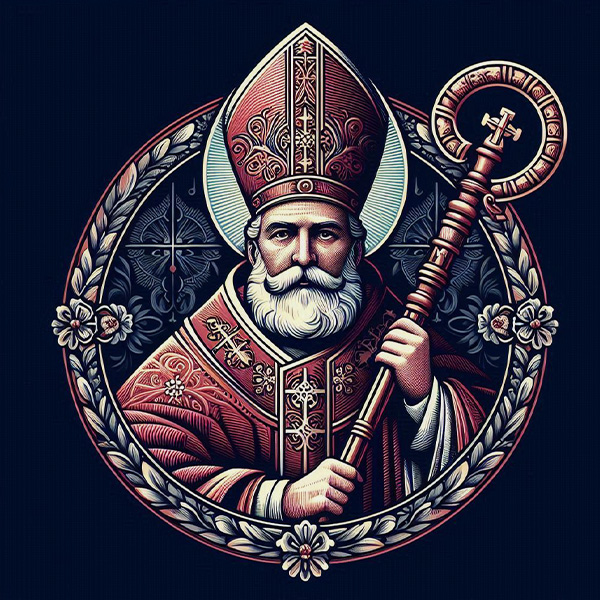
Saint Nicholas is often depicted in images and representations as a wise old man with a white beard and a red cloak. This representation is deeply rooted in Christian iconography and emphasises his role as Bishop of Myra. The bishop's crook and mitre that he often wears are symbols of his spiritual authority and position as bishop. These iconic features make him easily recognisable and underline his importance in Christian tradition.
Another common motif in depictions of Saint Nicholas is the three golden apples or balls, which refer to the legend of the poor man's three daughters. These symbols represent his generosity and willingness to help others in need. The detailed depictions of Saint Nicholas show not only his outward appearance, but also his inner kindness and helpfulness, which make him a revered saint.
Companions and helpers
Saint Nicholas is often supported by various companions and helpers who assist him in his work. One of the best-known companions is Knecht Ruprecht, a fearsome figure who admonishes children to behave well. Knecht Ruprecht is firmly anchored in many German traditions and serves as a kind of counterpoint to the benevolent Nicholas by reminding children of the consequences of bad behaviour.
Nicholas of Myra and Nicholas of Sion
This merging of the two historical figures has led to Saint Nicholas being regarded today as a single, revered figure, even though he is based on two different people.
Nicholas of Myra
Nicholas of Myra lived in the 4th century and was bishop of Myra in Lycia, which is now in Turkey. He is one of the most famous saints of the Eastern and Western Churches and is known for numerous legends.
Nicholas of Sion
Nicholas of Sion lived in the 6th century and was abbot of the monastery of Sion and later bishop of Pinara, also in Lycia. He is known for his pilgrimage to Jerusalem and his charity. Nicholas of Sion died on 10 December 564 and was venerated as a saint from an early age.
Saint Nicholas and "Santa Claus"
In the course of world events, Saint Nicholas changed, especially in the Western world, and increasingly took on folk characteristics. Particularly in the 19th century, with the large immigration of European Christians to the United States, the figure of "Santa Claus" was born and became very popular. This name probably originates from the English deformation of the Dutch "Sinterklaas", which goes back to "Sint Nikolaas", whereby the saint has different names in different regions, such as Nikolo, Samichlaus or Sinterklaas.
The religious legends of Saint Nicholas merged with the various customs and traditions of individual countries and peoples and, over time, became increasingly commercialised. Today's "Santa Claus" is a mixture of St. Nicholas' charitable and caring spirit, the idea of Father Christmas and modern consumer habits. This figure, who is now known in many parts of the world, is usually depicted as a cheerful, burly man with a white beard who distributes gifts to children on Christmas Eve.

Contemporary significance
Saint Nicholas is still very important today and inspires people all over the world to do good and help others. His legends and stories are timeless and convey important values such as charity, generosity and selflessness. These values are particularly emphasised through gift-giving, which brings joy and honours the generosity of Saint Nicholas. Saint Nicholas is a role model for all those who are committed to charity and helping others.
His message of charity and selflessness is particularly relevant today, when many people are looking for role models who can show them how to lead a good and fulfilling life. Saint Nicholas reminds us that true greatness lies not in wealth or power, but in the ability to help others and do good. His veneration and the traditions associated with it are a living legacy that reminds us that each of us has the ability to make the world a better place.
Reflection for 6 December
6 December, the feast day of Saint Nicholas, offers a wonderful opportunity to remember the values and message of this important saint. On this day, we can make a special effort to engage in charity and help others. Whether through donations, volunteer work or small gestures of kindness, each of us can make a contribution. Saint Nicholas is a role model for us all, and his example shows that true greatness lies in the ability to help others and do good. Let us use this day to make the world a little brighter and friendlier, in the spirit of Saint Nicholas.
Nicholas' influence and legacy
Saint Nicholas is now the patron saint of many cities, regions and professions. Nicholas is considered the patron saint of children, sailors, merchants, students, prisoners, the poor and many others.
But Nicholas' influence extends far beyond these celebrations: the way Nicholas lived his life is an example of Christian charity, benevolence and selflessness. The legends about Nicholas have inspired believers for generations. His veneration has shaped not only profound religious traditions, but also cultural traditions that continue to have an impact in the modern day.


