









No disease has transformed Europe as profoundly as the Black Death of the 14th century. In just a few years, it killed an estimated third of Europe’s population – millions of people, entire villages, craft guilds and monasteries. Those who survived found themselves living in a different world: one with more land, higher wages, a shaken faith in God and a different outlook on life.

What to expect in this article
- The origins: older than previously thought
- Its arrival in Europe: 1347
- The three forms of the plague
- How the plague spread
- Reactions to the plague
- Persecution of Jews: Scapegoats in a crisis
- Social and economic consequences
- The end of the great wave of the plague – and what came after
- The Plague in the context of LARP and re-enactment
- Chronology: The Plague from the Bronze Age to the 18th century
 Reading time approx. 8 mins.
Where did the plague come from, how did it spread, what forms did it take – and what remains of it? This article provides a historical overview.
Key facts at a glance:
- The origins of the Black Death lie in the Tian Shan mountains in Kyrgyzstan – as proven by a 2022 study.
- The bacterium Yersinia pestis is at least 1,000 years older than long assumed – Bronze Age genomes from Russia prove this.
- In 1347, the plague reached Europe via Sicilian ports – brought in on ships from the Black Sea region.
- The three main forms: bubonic plague, pneumonic plague, plague sepsis – each with a different mode of transmission and mortality rate.
- Reactions ranged from quarantine to persecution of Jews – often simultaneously.
- The beaked mask of the plague doctor is not a medieval symbol, but an early modern one – it only came into use in the 17th century.
The origin: older than thought
The plague was long regarded as a medieval phenomenon. This is true only of its most devastating outbreak. The bacterium Yersinia pestis itself is far older.
In 2018, researchers at the Max Planck Institute for Evolutionary Anthropology reconstructed Yersinia pestis genomes from skeletons buried around 3,800 years ago in the Samara region of Russia. This means that bubonic plague is at least 1,000 years older than previously thought – and that at least two different strains of the bacterium already existed in the Bronze Age.
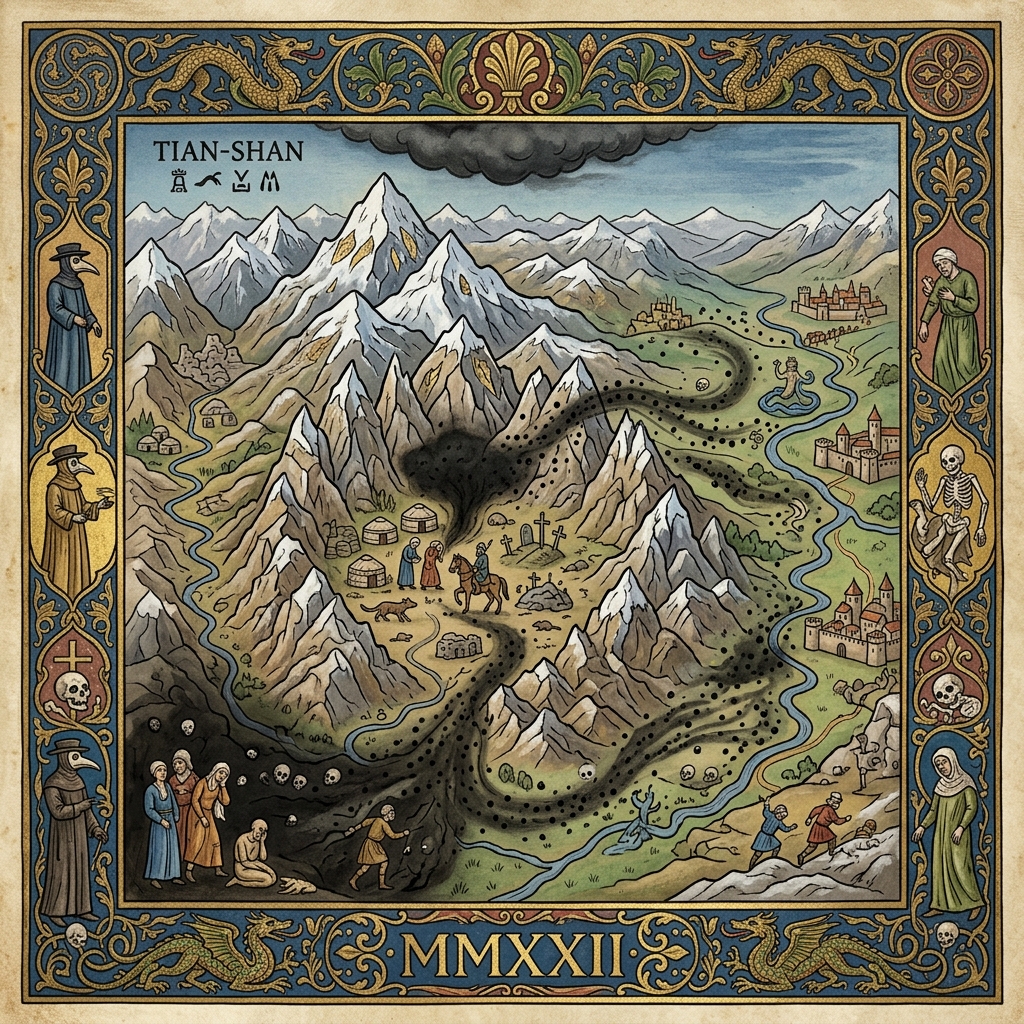
The geographical origin of the medieval outbreak was clarified by a study published in the journal Nature in 2022: the Tian Shan mountains in Kyrgyzstan were the epicentre. There, in historical cemeteries dating from the early 14th century, skeletons containing Yersinia pestis DNA were found – dated to the years immediately preceding the European outbreak.
Arrival in Europe: 1347
Long before the Black Death arrived in Western Europe in 1347, the disease had already ravaged the continent once before: the Justinian Plague (541–549 AD) killed millions of people in the Eastern Roman Empire and parts of Europe.
The medieval outbreak began differently. Ships from the Black Sea region brought the plague to the Sicilian coast – the port of Messina is considered the point of entry. The port city of Caffa (now Feodosia in Crimea), an important trading centre for the Genoese, played a key role. It is said that Tatar troops, who were besieging the city and were themselves decimated by the plague, hurled infected corpses over the city walls using catapults. The fleeing crews of Genoese ships carried the disease westwards.
From Italy, the plague spread rapidly along Europe’s trade routes. In densely populated cities with poor water supplies and cramped living conditions, the bacterium found ideal conditions.
The three forms of the plague
Yersinia pestis manifested itself in three clinical forms, which differed in terms of transmission, progression and mortality:
| Form | Transmission | Main symptoms | Incubation / Course |
|---|---|---|---|
| Bubonic plague | Flea bite (infected rat → flea → human) | Painful swollen lymph nodes (buboes), high fever | 1–7 days; mortality rate without treatment approx. 30–60% |
| Pneumonic plague | Droplet transmission from person to person | Fever, cough, bloody sputum, chest pain | 1–3 days; mortality rate if left untreated almost 100% |
| Peste sepsis | Direct entry of the bacterium into the bloodstream | High fever, chills, toxic shock, organ failure | Often death within 24 hours; extremely high mortality rate |
Bubonic plague was the most common form. Pneumonic plague was the most dangerous because it could be transmitted directly from person to person – without passing through a flea or rat. Plague sepsis was the fastest and deadliest variant.

How the plague spread
The classic chain of transmission: infected rats, infested with Xenopsylla cheopis (the rat flea), die. The fleas move onto human hosts and transmit the bacterium when they bite. In medieval towns, where rats were ubiquitous, this chain spread rapidly.
Recent research (including from the University of Oslo, 2018) discusses whether human fleas and body lice may also have played a significant role in some outbreaks – which would better explain the sometimes explosive spread in sparsely populated areas. However, the rat-flea theory remains the established explanatory model.
An early institutional development: around 1423, the first European plague islands (lazaretti) were established in Venice – isolation stations for the sick and those suspected of having the disease. The Lazaretto Vecchio is considered Europe’s first epidemic hospital.
Reactions to the plague
Quarantine
The most significant preventive measure was quarantine. The term is derived from the Italian quaranta (forty). Ragusa (now Dubrovnik) was the first European city to introduce formalised isolation in 1377: ships from affected areas initially had to wait 30 days (trentino); later, the period was increased to 40 days. Venice institutionalised the 40-day quarantine around 1403 with the Lazaretto Vecchio.
Religious and medical responses

The medical knowledge of the time was insufficient to identify the cause of the plague. The prevailing theory was the miasma theory: poisoned air, caused by decay or cosmic constellations, was considered the cause. The consequences:
- Burning herbs and fragrances to ‘purify the air’
- Bloodletting to detoxify the body
- Religious processions – which, paradoxically, encouraged the spread
- Amulets and herbal mixtures against the ‘bad air’
The plague doctor and his mask
The most famous symbol of the plague is the plague doctor’s beaked mask – and it is younger than most people think. The iconic protective garment with the long beak only became popular in the 17th century, described by the French physician Charles de Lorme around 1619. It did not exist in this form at the time of the Black Death in the 14th century.
The concept behind it was nevertheless rational: aromatic substances – lavender, thyme, cloves, juniper, vinegar – were placed in the beak-like protrusion to filter the air, which was considered dangerous. The long waxed coat was intended to keep out fleas and infectious bodily fluids. Judged by the knowledge of the time, this was not superstition, but a serious attempt at protection.
Plague doctors were often not renowned physicians – better-qualified doctors shunned the work. Towns and communities hired whoever they could get. Their tasks: treating the sick, documenting deaths, enforcing quarantine, performing post-mortems on corpses.
Persecution of Jews: Scapegoats in a crisis
The plague affected everyone – but blame was deliberately assigned. In many parts of Europe, rumours spread that Jews had poisoned the wells to kill Christians. These accusations were false, but they were believed and led to a wave of massacres.
Between 1348 and 1351, Jewish communities in cities from Strasbourg to Brussels, from Mainz to Barcelona, were attacked, expelled or murdered. In Strasbourg in 1349, over 2,000 Jews were burned at the stake before the plague had even reached the city. In some regions, Jewish communities were completely wiped out.
These pogroms are one of the darkest chapters in medieval history – an example of how collective fear and existing prejudices can lead to organised violence against minorities in times of crisis.
Social and economic consequences

A third of the European population died. Some regions lost half their inhabitants; some villages were completely wiped out. The social consequences were profound and long-lasting:
- Labour shortage: Those who survived were suddenly in demand. Peasants and craftsmen were able to negotiate better terms. Wages rose.
- Erosion of ecclesiastical authority: The Church had no answer to the plague – neither theological nor medical. Public trust suffered.
- New forms of piety: flagellation movements, depictions of the dance of death, an intensification of remembrance of the dead.
- Population trends: The European population recovered very slowly. By 1450 – around a hundred years after the major outbreak – pre-crisis levels had not yet been reached in many regions.
- The end of feudalism as a mass phenomenon: The social shifts caused by the labour shortage contributed, in the medium to long term, to the decline of feudal serfdom.
The end of the great wave of the plague – and what came after
The first major wave of the Black Death subsided around 1353. But the plague did not disappear. Further outbreaks followed – in 1360–1363, 1374, 1382 and repeatedly right up to the 18th century. The last major European outbreak occurred in 1720–1722 in Marseille, where around half the city’s population died.
The plague was a key factor in the social upheavals of the late Middle Ages – it accelerated processes that led to new ways of thinking, new art and a changed self-image of humanity. In the long term, these developments contributed to the culture of the Renaissance. However, the plague was not the sole cause of this: the Renaissance had already begun in Italy with Petrarch and Dante, even before the great outbreak – and the end of the Middle Ages is historically usually associated with the fall of Constantinople in 1453 or the discovery of America in 1492, not with the end of the plague wave.
The Plague in the context of LARP and re-enactment
For anyone who wishes to understand the Middle Ages not merely as a backdrop but as a historical reality: the Plague is the most decisive single event of the 14th century. A character set in the 1340s to 1360s lives in a world where one in three people is dead or will soon die. This shapes society, piety, the economy and personal relationships in a way that no other event of the Middle Ages has shaped to such an extent.
Plague doctor costumes are now widespread at medieval markets and LARPs – knowing that the beaked mask is early modern, you can create a deliberate portrayal that is historically informed. At vehi-mercatus, you’ll find garments and accessories for authentic portrayals of medieval daily life.

Chronology: The Plague from the Bronze Age to the 18th century
| Period | Event |
|---|---|
| approx. 3800 years ago | Yersinia pestis genomes in Bronze Age skeletons from Russia (Max Planck Institute, 2018) |
| 541–549 AD | Justinian Plague – first major European outbreak |
| Early 14th century | Outbreak in the Tian Shan Mountains (Kyrgyzstan) – documented by a 2022 study |
| 1347 | Arrival in Europe via Messina (Sicily) and Caffa (Crimea) |
| 1347–1353 | First major wave of the plague in Europe – around a third of the population dies |
| 1348–1351 | Anti-Semitic pogroms across much of Europe |
| 1377 | Ragusa (Dubrovnik): Europe’s first formal quarantine regulations |
| c. 1403 | Venice: Lazaretto Vecchio – Europe’s first hospital for infectious diseases |
| c. 1619 | Beak mask of the plague doctor described (Charles de Lorme) – early modern, not medieval |
| 1720–1722 | Last major European outbreak of the plague in Marseille |


