

Roles, Rights and Influence – From Peasant Woman to Empress
At a glance: Women in the Middle Ages were generally disadvantaged in legal terms, but they were not powerless. There were significant differences depending on social status, location and time. Empresses ruled empires, abbesses controlled manors, and women in towns ran businesses. Oppression existed – but it was not uniform.
What you can expect in this article
- The image that doesn’t add up – and the reality behind it
- 1. Life in the countryside – work that was rendered invisible
- Widows: The surprisingly strong legal position
- 2. Noblewomen, queens, regents – power was possible
- What regency really meant
- 3. Women in the city – work, guilds, control
- Women’s guilds and women’s professions
- Dress codes: clothing as an instrument of control
- 4. Convents, abbeys, Beguines – spaces of freedom for women
- Why daughters entered convents
- The Beguine movement: freedom between the systems
- Hildegard von Bingen – and our in-depth series
- 5. Writing, thinking, arguing – learned women
- Christine de Pizan: Europe’s first professional female writer
- Anonymous female writers: the invisible majority
- 6. Law, Marriage, Control – What the Law Said
- The principle of gender guardianship
- Marriage: A strategic instrument, not a romantic promise
- Deterioration in the Late Middle Ages
- 7. Forgotten, Suppressed, Rediscovered – Historiography as a Question of Power
- What modern research is changing
- 8. Frequently asked questions about women in the Middle Ages
- Were women generally without rights in the Middle Ages?
- Could women really rule in the Middle Ages?
- How did women in the Middle Ages gain an education?
- What was everyday life like for a woman living in a town?
- Was there early feminism in the Middle Ages?
- Conclusion: A millennium – many women’s lives
 Reading time approx. 12 mins.
The image that doesn’t add up – and the reality behind it

The helpless maiden in the tower. The silent wife at the hearth. The chaste nun behind convent walls. These are the images many associate with women in the Middle Ages – and almost all of them are either oversimplified, exaggerated or simply wrong.
The truth is more complicated and far more interesting. The Middle Ages span around a thousand years of history – from about 500 to 1500. During this millennium, there was no single, uniform role for women. What a woman could do, was allowed to do and experienced depended on her social status, the region she lived in and the century. An empress of the 10th century and a peasant maid of the 14th century lived in such different worlds that it is almost impossible to group them under the same heading.
To make matters more complicated: our knowledge of this period is shaped by male chroniclers. In their texts, women usually appeared as mothers, wives or saints – rarely as individuals acting independently. Since the 1970s, historical scholarship has been systematically reconstructing what actually happened. The result fundamentally changes the picture.
1. Life in the countryside – work that was rendered invisible
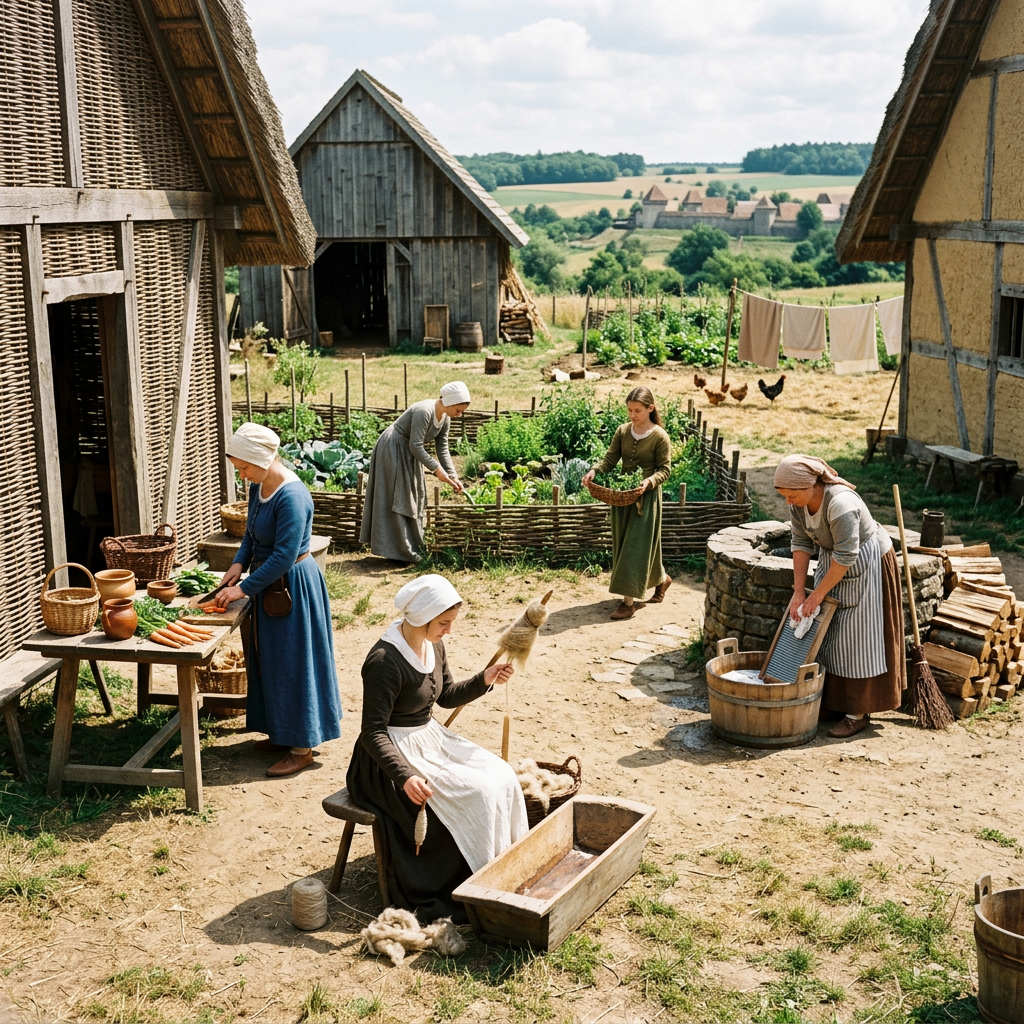
The vast majority of the medieval population lived in the countryside. This applied to women just as much as to men. As peasant women, farmwives or maids, they performed physically demanding work that was simply indispensable for the family’s survival.
When you imagine a medieval housewife, don’t picture someone simply standing at the stove. The range of tasks was enormous:
- Stocking up on supplies: smoking, salting, drying – preservation was what got a family through the winter
- Textile production: spinning, weaving, sewing – clothes didn’t come from the shop, they were made at home
- Livestock rearing: chickens, pigs and goats were part of the household and had to be looked after daily
- Gardening: vegetables and herbs for cooking and medicine
- Child-rearing: Not just care, but early education in everything life required
The division of labour dictated that men took on the heavier field work – ploughing, harvesting, felling timber. Women were responsible for housekeeping and light farm work. In practice, these boundaries were constantly blurred. When the husband was away on military campaigns, on long-distance trading trips or simply ill, the wife ran the entire household – staff, supplies, decisions.
Widows: The surprisingly strong legal position
Widows held a special position. In many regions and under municipal laws, they were considered to have full legal and commercial capacity. They could run farms and workshops in their own name, conclude contracts and appear in court. The Sachsenspiegel – the authoritative German-language legal code of the 13th century – guaranteed widows the right to maintenance (livelihood) and the morning gift.
This is no minor point. It shows that the notion of the completely oppressed, incapacitated woman is a distortion. Under medieval law, a widow often had more freedom than a married woman.
2. Noblewomen, queens, regents – power was possible

Noblewomen had considerably different opportunities than non-nobles. Their world was shaped by political alliances, estate management and dynastic obligations. A marriage was almost never a love story – it was a contract between families, often with significant political implications.
But that does not mean women were passive figures in this context. Queens and princesses signed documents, settled disputes, received envoys, managed estates and built their own networks. Their role was not merely ceremonial.
| Name | Period | Role and achievements |
|---|---|---|
| Theophanu | c. 955–991 | Empress of the Holy Roman Empire, regent for her son Otto III. Held the title of co-emperor and actively exercised power. |
| Adelheid of Burgundy | 931–999 | Empress; after the death of Otto the Great, an influential regent and advisor to her successors. |
| Matilda of Canossa | c. 1045–1115 | Margravine of Tuscany, acted as mediator between Pope Gregory VII and King Henry IV during the Walk to Canossa in 1077. Commanded her own armies and territories. |
| Eleanor of Aquitaine | c. 1122–1204 | Duchess of Aquitaine in her own right, Queen of France and later of England. She took part in the Crusades and shaped courtly culture. |
What regency really meant
Legally, these women often ruled only in a representative capacity – on behalf of underage sons or absent husbands. In practice, however, they built up their own power bases that extended far beyond their role as regents. Theophanu appears in documents as prominent as a reigning emperor. Matilda of Canossa was able to grant fiefs and possessed military clout.
The decline came in the late Middle Ages. With the expansion of chancelleries, universities and state bureaucracy, women were systematically pushed out of positions of power. What was still possible in the 10th and 11th centuries became increasingly difficult in the 15th century.
Note on character portrayals: A female ruler in the High Middle Ages is not a special case – she is the historical norm. Women in these roles were not exceptions that need explaining. They were active participants in a system that allocated power according to social status, not gender.
3. Women in the city – work, guilds, control
The medieval city was a space full of contradictions for women. There were opportunities that did not exist in the countryside. And there were new forms of control that likewise did not exist in the countryside.
Many women worked as employees in family businesses: as bakers, innkeepers, cloth merchants, brewers. Often without their own guild membership – formally, everything ran under the husband’s name. But they were the ones doing the work.
Women’s guilds and women’s professions
In some cities there were genuine women’s guilds, particularly in the textile trade. Spinners, weavers, yarn-makers, gold-spinners, silk-makers – these were not marginal professions, but pillars of the urban economy.
A concrete example: Fygen Lutzenkirchen (1450–1515) in Cologne. She was a master of the silk weavers’ guild, ran a large trading house and trained at least 25 apprentices. The Cologne silk trade was a major industry – and women played a leading role in it, not a supporting one.
Dress codes: clothing as an instrument of control
From the 14th century onwards, urban dress codes became widespread. Certain fabrics and colours were reserved for specific social classes. Prostitutes were required to wear distinctive markings. Bans on luxury goods were intended to prevent excessive expenditure.
That sounds like fashion history. But it was a history of power. These regulations served as a means of visible control – what one wore signalled one’s social status, one’s morality, and one’s affiliation. Women were a particular focus of this.
4. Monasteries, convents, Beguines – spaces of freedom for women

In the Middle Ages, convents and abbeys offered women something that was rare in secular society: a protected space for education, writing, thinking – and power.
Why daughters entered convents
Noble daughters were often sent to convents. The reasons were rarely purely religious:
- Saving on a dowry: Entering a convent cost less than a marriage befitting one’s station
- Political alliances: Membership of a convent could strengthen alliances
- Protection: From unwanted or dangerous marriages
- Provision: Surplus daughters found a secure place in the convent
In wealthy convents such as Essen or Quedlinburg, abbesses wielded considerable power. They controlled manors, finances, libraries and educational institutions.
The Beguine movement: freedom between the systems
From the 13th century onwards, a remarkable new way of life emerged: the Beguines. Pious communities of women in towns who were neither nuns nor married women. They lived together, worked, cared for the sick and devoted themselves to spiritual practices – without monastic rules and without male control.
The Beguines in Cologne project documented around 2,100 Beguines over 200 years – a group that had long been virtually unknown to academia.
For LARP and re-enactment: The Beguine is one of the most fascinating and least-played female roles of the Middle Ages: devout yet independent, economically active, neither a nun nor a housewife. Perfect for characters caught between two worlds.
Hildegard von Bingen – and our in-depth series
The best-known example of monastic female power is Hildegard of Bingen (1098–1179): abbess, naturalist, composer, and correspondent with emperors and popes. She wrote theological and natural history works, travelled throughout the empire preaching, and publicly criticised abuses within the Church and the nobility.
Equally remarkable is Mathilde of Quedlinburg (10th/11th century), who became an abbess at the age of eleven and, as an imperial princess, administered manorial estates. Both represent a reality that the romanticised image of the Middle Ages completely overlooks.
5. Writing, Thinking, Arguing – Learned Women
Women in the Middle Ages wrote more frequently than was long assumed. Works that still exist today – if one looks for them specifically – were produced above all in monastic contexts and at courts.
Christine de Pizan: Europe’s first professional writer
Christine de Pizan (1364 – c. 1430) is the most striking example. Born in Venice and raised in Paris, she received an exceptionally good education at the French royal court. Following the early death of her husband, she supported herself and her children through writing – the first woman in Europe to do so systematically.
Her best-known work is *The Book of the City of Ladies* (1404/05). In it, she openly criticises the misogynistic literature of her time and envisions an allegorical city in which women are portrayed as dignified, capable individuals.
This is not feminism in the modern sense. But it is a political argument for the dignity of women – in the year 1405.
Anonymous women writers: the invisible majority
Many female scribes and illuminators remained anonymous. Modern palaeographic studies – analyses of handwriting styles, penmanship and ink formulations – show that in certain scriptoria, it was predominantly women who wrote, even if their names have not been handed down.
The fact that their texts have survived in poorer condition than those of their male contemporaries is due to specific causes: the Reformation and secularisation destroyed many women’s convents and their archives. Libraries were transferred into male hands. What was not catalogued disappeared.
6. Law, Marriage, Control – What the Law Said
Medieval law was a patchwork quilt: municipal law, provincial law, feudal law and ecclesiastical law overlapped. And depending on the legal system, the conditions for women varied greatly.
The principle of male guardianship
In much of medieval Europe, women were under male guardianship, known as ‘munt’. The guardian changed depending on the stage of life:
| Stage of life | Guardian |
|---|---|
| Unmarried | Father or brother |
| Married | Husband |
| Widowed | Often again father, brother or son – sometimes none (widow recognised as independent) |
Recent research, however, significantly qualifies this picture. Studies on the legal situation in the Frankish Empire (6th–8th centuries) show that women possessed considerably more autonomy in certain areas of law than had long been assumed.
Marriage: a strategic instrument, not a romantic promise
Marriage in the Middle Ages was an alliance designed to secure property, inheritance rights and political alliances. Personal affection played a role – but a secondary one. This was particularly true among the nobility, where marriages were often arranged during childhood.
Three terms describe the financial situation at the time of marriage: dowry (the bride’s assets), morning gift (a gift from the husband after the wedding night) and widow’s property (a guaranteed share in the event of death). These arrangements protected women, at least to some extent – but were also instruments of control.
Deterioration in the Late Middle Ages
The transition to the modern era was by no means a step forward for women. From the 14th and 15th centuries onwards, guilds systematically excluded women. Universities – newly emerging institutions – were exclusively for men. Canon law tightened control over female religiosity.
This is an important point for LARP and reenactment: games set in the High Middle Ages offer women greater historical scope than those set in the Late Middle Ages. A female character with influence in the 12th century is more plausible than the same character in the 15th century.
7. Forgotten, suppressed, rediscovered – historiography as a question of power
There are many examples of powerful women in the Middle Ages: empresses, abbesses, merchants’ wives, writers, legal practitioners. Why are they so little known? Because they were not recorded – or because what was recorded was later lost.
Male-dominated chronicles wrote about kings and bishops, battles and councils. Women appeared as mothers, wives or saints – rarely as independent actors. What was not documented was considered non-existent.
Specifically: the Reformation and secularisation destroyed many women’s convents and their archives. Libraries were transferred into male hands. What was not catalogued disappeared.

What modern research is changing
Since the 1970s, feminist historians have been specifically searching for traces of women. They comb through city archives, convent accounts, wills and court records. The result: a much more nuanced picture.
The Beguines in Cologne project documented over 2,100 Beguines – a group that had previously been largely overlooked by academia. Palaeographic analyses identify female scribes in scriptoria. Archaeological excavations uncover tools and objects that point to women’s work.
8. Frequently asked questions about women in the Middle Ages
Were women in the Middle Ages generally without rights?
No. Legally disadvantaged – yes, and in many regions to a considerable extent. But not without rights. Women could inherit, appear in court, enter into contracts and own property – to a very varying extent depending on the legal system, social class and region. Widows often had considerable legal capacity.
Could women really rule in the Middle Ages?
Yes – and that’s without quotation marks. Theophanu ruled the Holy Roman Empire as Empress and Regent. Matilda of Canossa had her own territories and armies. Abbesses of large monasteries administered manorial estates. These women ruled in reality, not symbolically.
How did women in the Middle Ages gain an education?
Higher education was primarily accessible through convent schools, cathedral schools and private tutors – almost exclusively for the daughters of the nobility or wealthy townspeople. Convent schools served as genuine centres of learning. The vast majority of women were functionally illiterate – as were the vast majority of men.
What was everyday life like for a woman in the town?
Getting up early, lighting the fire, fetching water, preparing breakfast. Looking after the children. Helping out in her husband’s shop or workshop. Shopping at the market. Textile work. Dinner. Praying. Sleeping. On holidays: church, community, rest. That was no romantic life – it was a hard life, but one embedded in society.
Was there early feminism in the Middle Ages?
The term did not exist. But there were certainly female authors who criticised existing images of women. Christine de Pizan is the most prominent example. Hildegard von Bingen argued for the intellectual equality of women. This was not a political programme – but it was a reasoned counter-argument against misogynistic literature.
Conclusion: A millennium – many women’s lives
The Middle Ages were not a good time for women – in the sense that structural discrimination was omnipresent. But neither was it a time in which women merely suffered and remained silent. It was a millennium full of diverse women’s lives – with power and powerlessness, with scope for creativity and narrow boundaries, with forgotten voices and those that are still heard today.
Anyone who knows the Middle Ages – really knows them, not the fantasy version – experiences a much richer world through re-enactment and LARP. The peasant woman who runs the farm. The widow who takes over the business. The Beguine who lives between the systems. The regent who administers an empire. The writer who challenges stereotypes of women. All of this is historically documented – and all of this can be played out.
You’ll find suitable costumes for all these roles – from the farmer’s wife to the abbess, from the townswoman to the noblewoman – at vehi-mercatus.de.




Letters from the trading house
New arrivals, market dates and offers, straight from Rinchnach. Unsubscribe any time with one click.
Subscribe to the newsletter

