




Learn how Ostara welcomes spring and discover its pagan roots. Read the article and immerse yourself in this fascinating tradition.

What you can expect in this article
- Everything you need to know at a glance
- Ostara: Spring and its ancient traditions
- The origins of Ostara
- The symbolism of the goddess Ostara
- Rituals in honour of Ostara
- Ostara in modern practice
- The blending of Ostara and Easter
- Summary

- Reading time approx. 15 min.
Everything you need to know at a glance
- Ostara is closely associated with the spring goddess Eostre. Eostre represents renewal in spring and has deep historical and mythological roots.
- Customs that are still very popular today and originally belong to Ostara include dyeing eggs and lighting fires.
- The name 'Easter' originates from the cardinal direction east. The light rises in the east, a new day begins: renewal.
Ostara: Spring and its ancient traditions
Ostara is an ancient spring festival connected to nature and represents new beginnings and the rebirth of nature. The festival is probably named after the Germanic goddess Ostara and was traditionally celebrated on the spring equinox. Although Ostara has pagan roots, many of its customs and symbols, such as dyeing eggs, are still practised in many different cultures today. The Christian faith adopted various customs and symbols, which are still very well known and familiar today. In this article, you will learn more about the origins, mythological connections, customs and modern practices of Ostara.

The origins of Ostara

In the 19th century, the goddess name "Ostara" was first mentioned by Jacob Grimm. Mr Grimm cites the writings of the Anglo-Saxon monk Beda Venerabilis as his source. In his work "De temporum ratione", Beda wrote that Eosturmonath – as he called the month of April – was named after a goddess named Eostrae. However, many scholars question this. They are critical of whether Eostrae actually existed as an independent goddess or whether it could be an Easter name for another goddess such as Freya. Her name was probably derived from the Old Germanic word for "dawn" or "east". The sunrise, the beginning of a new day. The goddess herself – whatever you may call her – represents new beginnings and the awakening of nature after a long, dark winter.
The goddess is often depicted as young, radiant and full of joie de vivre. She also visually represents blossoming life and vitality, growth and new life after the lifeless winter. In some depictions, the goddess is accompanied by hares, which are intended to reinforce the symbolism of fertility and rapid growth. Eggs – as a sign of new life – also accompany the goddess.
There are also other spring goddesses, such as the Roman Aurora, the Indian Ushas and the Greek Eos, who all represent the dawn.
The symbolism of the goddess Ostara
Ostara is not only a goddess of spring, but also governs the natural balance. The spring equinox, with which her festival is closely associated, marks the point at which day and night are once again of equal length. The long, dark nights have lost their dominance and light and darkness are once again in balance.
Important symbols associated with the goddess:
- The hare: The hare is the symbolic animal of the goddess Ostara and represents fertility and new beginnings. These animals are known for their high reproduction rate and therefore symbolise the reawakening of life in spring.
- The egg: Eggs are considered a sign of new life and possibilities; eggs represent the cycle of fertility. The tradition of dyeing eggs dates back to young girls celebrating the onset of fertility with their first menstruation. This tradition has continued over the centuries and is now a central element of Easter celebrations. Even though its central meaning has probably been lost in ignorance.
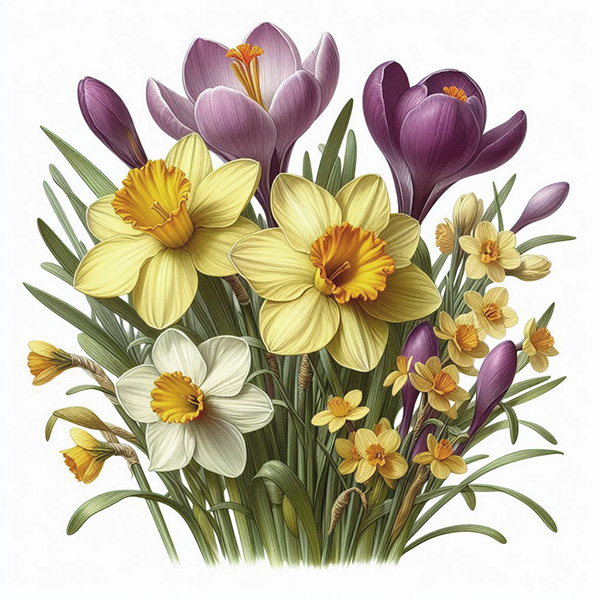
- Flowers: Flowering plants such as daffodils and crocuses are typical of Ostara and represent spring and new growth. These flowers are the first harbingers of spring and testify to the awakening of nature.
- The sun: As the goddess of spring, she is associated with the rising sun, which gives warmth and life.
- Green, yellow or pastel shades: The colours yellow, green and pastel shades represent the cheerful and lively nature of the Ostara festival. The fresh and young colours of blossoming nature.
Rituals in honour of Ostara
Small rituals were often celebrated at Ostara:
Nature walks: Consciously experiencing the first blossoms of the year and the return of spring through a walk.
Decorating with eggs and flowers: Celebrate the abundance and beauty of life by decorating your home.
Candle rituals: In many pagan communities, communal candle ceremonies were held during Ostara. Here, each participant lit a candle and expressed their personal or shared wishes. A wonderful way to celebrate the return of light and the renewal of nature during Ostara together.

Ostara meditation:
- Close your eyes and take a few deep breaths in and out. Feel your body fill with fresh spring energy with each inhalation and release all tension and winter with each exhalation.
- Imagine that you are sitting in a garden or forest. All around you, nature is blossoming, the trees are getting new leaves, crocuses and daffodils are blooming, and the birds are singing.
- Feel the renewing energy flowing into you, filling you with new strength and joie de vivre.
- Think of a wish or goal you would like to achieve in the coming months. Imagine planting this wish or goal like a seed in the earth, where it will be nourished by the powerful energy of spring.
- Take a moment to feel gratitude for the returning energy of spring and the opportunity to realise new projects and goals.
The role of nature and the seasons is central to the celebration of Ostara. The beginning of spring marks the start of a new cycle of growth, with people celebrating the awakening of nature and the rebirth of life.
During this festive period, people liked to prepare nine-herb soup. The soup was intended to detoxify the body and celebrate spring.
Recipe for nine-herb soup:
Ingredients (for 4 people):
- 1 small onion (diced)
- 1 clove of garlic (finely chopped)
- 2 tbsp butter or vegetable oil
- 1 litre vegetable stock
- 200 ml cream or plant-based alternative (e.g. oat cream)
- 1 large potato (peeled and diced)
The 9 herbs:
- Nettle (rich in iron, cleansing)
- Daisy (fortifying, slightly bitter)
- Dandelion (detoxifying, slightly spicy)
- Gundermann (herbal, healing)
- Yarrow (for digestion and immunity)
- Parsley (aromatic and fresh)
- Chives (for flavour)
- Wild garlic (slightly garlicky)
- Sorrel (lemony and tart)
Tip: If you can't find all the herbs, you can substitute herbs that are currently available, such as chervil, cress or basil.
Preparation:
Preparation of the herbs:
- Wash the herbs thoroughly and chop them coarsely.
- Set aside a few whole leaves or flowers for decoration.
Prepare the soup:
- Heat the butter or oil in a large saucepan.
- Fry the onions and garlic until translucent.
Cook the base:
- Add the diced potatoes and pour in the vegetable stock.
- Simmer the soup for about 15 minutes until the potatoes are soft.
Add herbs:
- Add the herbs to the soup and simmer for just 2–3 minutes so that they retain their colour and nutrients.
Purée:
- Purée the soup with a hand blender or in a blender until it has a creamy consistency.
- Stir in the cream and season the soup with salt, pepper and nutmeg.
Serving:
- Garnish the soup with the reserved herbs or flowers.
- Fresh bread, such as rustic farmhouse bread or baguette, goes perfectly with this dish.
Large fires: In some areas of Germany, a candle was placed in the field during the field blessing ceremony to pray for a good harvest. Fire wheels were also burned to mark the transition from darkness to light and to protect against evil.
Ostara in modern practice
Decorating and hiding eggs: Painting and hiding eggs is familiar to many, especially at Easter, but the custom is also part of the spring festival of Ostara. Eggs symbolise fertility and new life.
Lighting fires: Lighting bonfires brings the light and warmth of spring to people. The darkness of winter is dispelled by the burning fires.
Decorating altars: Many celebrate Ostara by setting up an altar with spring flowers, seeds, feathers or representations of fertility goddesses such as Freyja, Demeter or Isis. The altar offerings can also be collected during a walk.
Planting seeds: Planting seeds celebrates the awakening of nature and the growth of new plants. It is a time to start new projects and set personal goals.
Spring festivals and celebrations: Spring festivals are held all over the world, featuring music, dancing and festive meals.
Fertility rituals: Fertility rituals are an important part of Ostara celebrations. These rituals are intended to promote the fertility of the earth and of humans.
Blending of Ostara and Easter

Some customs and symbols have become mixed between Easter and Ostara over time. Both festivals celebrate spring, and the Christian faith has linked symbols of Ostara with its beliefs.
Eggs
- Christianity: In Christianity, eggs represent the resurrection of Jesus Christ and new life. Painting and hunting for eggs is a popular Easter custom.
- Pagan traditions: In pagan spring festivals such as Ostara, eggs represent fertility and the rebirth of nature.
Rabbit
- Christianity: The Easter bunny hides colourful eggs at Easter.
- Pagan legend: The origin of the rabbit as Ostara's companion may lie in a pagan legend: in this legend, the goddess transforms a bird into a rabbit that lays colourful eggs. Later, the rabbit was integrated into Christian Easter traditions as a symbol of fertility.
Spring equinox (equinox)
- Christianity: Lent lasts for 40 days after Ash Wednesday. After these 40 days, Christians celebrate Easter Sunday, which often falls at the same time as the spring equinox.
- Pagan traditions: Ostara is celebrated on or around the spring equinox, when day and night are of equal length.
Fire
- Christianity: In many Christian communities, Easter fires are lit to celebrate the light of resurrection.
- Pagan traditions: In contrast, bonfires were lit during pagan spring rituals to honour the awakening and purification of nature.
Flowers and plants
- Christianity: In Christian Easter celebrations, churches and homes are often decorated with flowers to celebrate rebirth and new life.
- Pagan traditions: In pagan Ostara celebrations, planting seeds and decorating with flowers honours fertility and the awakening of nature.
Summary
The spring festival of Ostara is all about the equinox, when day and night are once again in balance. Ostara celebrates the beginning of spring, the renewal of nature and the fertility of all life. In many cultures around the world, the beginning of spring is deeply rooted in history and mythology. There are various spring goddesses and many different ways to welcome spring.
Even today, the ancient traditional traces of Ostara can still be clearly seen in our actions. Ostara continues to show us how the universal appeal of spring influences our lives.
You may also be interested in these articles: Imbolc: The Celtic Festival of Light and Renewal ;


