





Twelve gods, one mountain, countless stories. The Olympians of Greek mythology have been part of our collective consciousness for over 2,700 years – and they still pop up everywhere: in films, in city names, in constellations, in language. Anyone who knows the Olympians understands a large part of European cultural history.

Here’s what you can expect in this article
- Who are the gods of Olympus?
- The origins of the Olympians: from Chaos to Olympus
- Mount Olympus: Seat of the Gods
- The 12 gods of Olympus: an overview
- The twelve gods in detail
- Olympians in the broader sense: family, heroes and related gods
- Images of the gods and religious practice in everyday life
- Pre-Olympian and other Greek deities
- The gods of Olympus in LARP, re-enactment and at medieval fairs
- FAQ on the gods of Olympus
 Reading time approx. 12 mins.
This article explains who the twelve Olympian gods are, what they represent, which myths are associated with them – and why the list of the Twelve was never entirely clear-cut.
Key points at a glance:
- The gods of Olympus form a family of gods led by Zeus, who rule over humanity and the world from Mount Olympus.
- The classical list comprises twelve Olympians – in Greek, the Dōdekátheoi (the Twelve Gods): Zeus, Hera, Poseidon, Demeter, Athena, Apollo, Artemis, Ares, Aphrodite, Hermes, Hephaestus, and either Hestia or Dionysus.
- Each god embodies specific aspects of life and explains natural phenomena and the everyday life of the Greeks.
- The exact composition of the Twelve varies depending on the region and era – despite his importance, Hades is not counted among the classical Olympians.
- The Olympian gods belong to an older generation of deities and took over the reigns of power following their victory over the Titans.
Who are the gods of Olympus?
The Greek gods of Olympus are among the best-known figures in world mythology. According to Greek belief, these deities resided on Mount Olympus – Greece’s highest peak at 2,917 metres. The Greeks practised polytheism and imagined their gods with human form, emotions and weaknesses: powerful and jealous, capable of love and vengeful, sublime and deeply human.
This belief in the gods has been captured in literature since the 8th to 7th centuries BC through the works of Homer (The Iliad, The Odyssey) and Hesiod (Theogony). Their texts remain the most important sources for the genealogy, myths and significance of the Olympians to this day.
The origins of the Olympians: From Chaos to Olympus

The Olympians did not exist from the very beginning – they fought their way to power. The story of their origins reads like a cosmic family drama.
In the beginning there was Chaos, from which Gaia (Earth) and Uranus (Sky) emerged. Their union gave rise to the Titans – including Cronus and Rhea, the parents of the future Olympians. Fearing a prophecy, Cronus devoured his children. But Rhea hid her youngest son Zeus on Crete. Zeus returned, freed his siblings Hera, Poseidon, Demeter, Hestia and Hades from his father’s belly – and overthrew him in the Titanomachy, a ten-year war.
After their victory, the three brothers divided the world:
- Zeus received the heavens
- Poseidon the sea
- Hades the underworld
- The Earth and Mount Olympus remained their joint possession
Thus arose the new generation of gods, who henceforth ruled over gods and mortals.
Mount Olympus: Seat of the Gods
Mount Olympus lies in northern Greece on the border between Thessaly and Macedonia. Its highest peak, Mytikas, reaches 2,917 metres. In ancient times, Mount Olympus was conceived as a divine realm with golden palaces, eternal spring and an impenetrable blanket of clouds. Here the gods feasted on ambrosia and drank nectar to preserve their immortality.
The name Olympus possibly means ‘the shining one’ and symbolises the cosmic axis between the divine and earthly spheres. The town of Dion at the foot of the mountain served as an important sanctuary in the 5th to 4th centuries BC, hosting festivals and sacrifices to Zeus Olympios.
A common misconception: the famous Olympic Games did not take place on the mountain, but in Olympia on the Peloponnese – also in honour of Zeus, with competitions, animal sacrifices and temporary truces between the Greek city-states.
The 12 Gods of Olympus: An Overview
| Greek name | Roman equivalent | Area of responsibility | Main symbol |
|---|---|---|---|
| Zeus | Jupiter | Sky, lightning, justice | Bolt of lightning, eagle |
| Hera | Juno | Marriage, family, birth | Peacock, crown |
| Poseidon | Neptune | Sea, waters, earthquake | Trident |
| Demeter | Ceres | Agriculture, fertility, grain | Ear of corn, torch |
| Athena | Minerva | Wisdom, craftsmanship, war (strategic) | Owl, olive tree |
| Apollo | Apollo | Light, art, healing, prophecy | Lyre, laurel wreath |
| Artemis | Diana | Hunting, Moon, Wild Nature | Bow, doe |
| Ares | Mars | War (bloody, chaotic) | Spear, helmet |
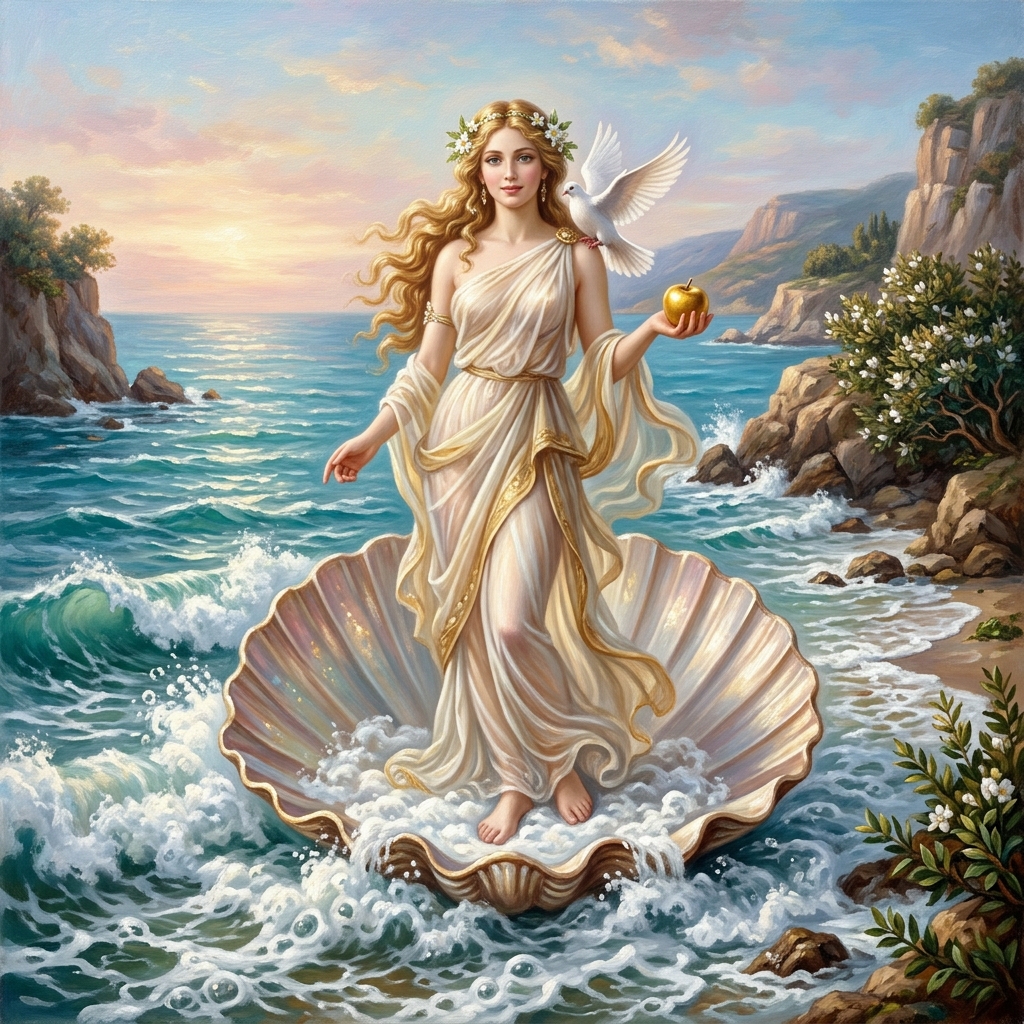
| Aphrodite | Venus | Love, beauty, attraction | Dove, apple |
| Hermes | Mercury | Messenger of the gods, traveller, merchant | Winged sandals, ceryx |
| Hephaestus | Vulcan | Fire, blacksmithing | Hammer, anvil |
| Hestia or Dionysus | Vesta / Bacchus | Hearth fire / Wine, Ecstasy | Flame / vine |
The twelve gods in detail
Zeus – Father of the Gods and Ruler of the Heavens
Zeus is the supreme god and ruler of the heavens, lightning and thunder. As the son of Cronus and Rhea and brother of Hera, Poseidon, Demeter, Hestia and Hades, he leads the family of gods. His symbols are the thunderbolt (forged by the Cyclopes), the eagle, the sceptre and the oak tree. Numerous myths recount his romantic relationships with goddesses and mortals – such as Europa or Alcmene, mother of Heracles. Roman name: Jupiter.
Hera – Goddess of Marriage and Guardian of the Family
Hera is the sister and wife of Zeus and queen of the gods. She protects marriage, childbirth and the legitimate family. Her symbols include the peacock, crown, pomegranate and sceptre. She is known for her jealousy towards Zeus’s lovers – for example, in her lifelong persecution of Heracles. Important sanctuaries were located in Argos and on Samos. Roman name: Juno.
Poseidon – God of the Sea and Earthquakes
As the brother of Zeus, Poseidon rules over the sea, waters and earthquakes. His trident can split earth and water. As the god of the sea, he possesses a palace in the depths and is accompanied by dolphins and horses. In a dispute with Athena over the patronage of Athens, he was defeated: his saltwater spring lost out to her olive tree. Roman name: Neptune.
Demeter – Goddess of Fertility and Agriculture
Demeter is the goddess of agriculture, fertility and grain. As the sister of Zeus, she embodies growth and the cycle of the seasons. Her symbols are ears of corn, a torch and a basket of fruit. The central myth concerns the abduction of her daughter Persephone by Hades – Demeter’s grief explains winter and thus the changing of the seasons. The Eleusinian Mysteries celebrated her power. Roman name: Ceres.
Hestia or Dionysus – The variable place among the Twelve
Hestia, goddess of the hearth fire and domesticity, is one of the original Twelve Olympians. She embodies inner peace and the sacred fire of community – a symbol of domestic life. Roman name: Vesta.
In later traditions, Dionysus often displaces her from the list of the Twelve. He is the god of wine, ecstasy and theatre – born of the mortal Semele and Zeus. His symbols are vine branches, grapes and animal skins. Roman name: Bacchus.
Athena – goddess of wisdom and patroness of Athens
Athena is the daughter of Zeus, born fully armed from his head – after he had swallowed the Titaness Metis. She embodies wisdom, strategic warfare and craftsmanship. Her symbols – the owl, olive tree, helmet and shield – shaped the Athenian Acropolis and the Parthenon temple. As the patron goddess of Athens, she won the contest against Poseidon by offering the gift of the olive tree. Roman name: Minerva.
Apollo – God of Light, the Arts and Prophecy
Apollo is the son of Zeus and the Titaness Leto, and the twin brother of Artemis. He presides over light, music, poetry and the healing arts. The famous Oracle of Delphi was dedicated to him – there the Pythia proclaimed divine prophecies. His symbols are the lyre, the bow and the laurel wreath. His Roman name remained Apollo.
Artemis – Goddess of the Hunt and the Moon
Artemis is the virgin goddess of the hunt, wild nature and the moon. She protects young girls and is often depicted with nymphs. Her symbols include a bow, quiver, doe and crescent moon. The myth of the hunter Actaeon, whom she transformed into a stag as punishment for spying on her whilst she was bathing, illustrates her uncompromising nature. Roman name: Diana.
Ares – God of bloody war
Ares is the son of Zeus and Hera and the personification of wild, chaotic war. Unlike Athena, who stands for strategic, orderly warfare, he embodies bloodlust and destruction on the battlefield. His symbols are the spear, helmet and shield. Though not particularly popular with the Greeks, he was nevertheless invoked before battles. The Roman Mars, on the other hand, embodied the orderly, state-sustaining aspects of war and was regarded as the patron god of Rome.
Aphrodite – Goddess of Love and Beauty
Aphrodite is the goddess of love, beauty and sexual attraction. One tradition (Hesiod) has her emerging from the sea foam near Cyprus; another (Homer) makes her the daughter of Zeus and the Titaness Dione. Her symbols – the dove, apple, myrtle and shell – feature throughout ancient art. The Judgement of Paris, in which she was chosen as the fairest and promised him Helen, triggered the Trojan War. Roman name: Venus.
Hermes – Messenger of the Gods and God of Travellers
Hermes is the son of Zeus and the nymph Maia. As the messenger of the gods, he mediates between the divine and human worlds. His symbols are winged sandals, a winged hat and the herald’s staff (kerykeion). He protects travellers and merchants – and, less honourably, thieves too. As Psychopomp, he guides the souls of the dead into the underworld. Roman name: Mercury.
Hephaestus – God of Fire and the Art of Blacksmithing
Hephaestus is the god of fire and blacksmithing. Despite his physical disability – he limps – he created ingenious works: the weapons of Achilles, the palaces of the gods and the golden handmaidens from his tools. His symbols are the hammer, anvil and smith’s cap. According to one version, he was thrown from Mount Olympus by Hera or Zeus. Roman name: Vulcan.
Olympians in the broader sense: family, heroes and related gods
In a broader sense, the term ‘Olympian’ encompasses the entire family of Zeus – including gods outside the mountain.
Hades and Persephone rule the underworld as a couple. Although not classical Olympians, they play a central role in the Greeks’ conceptions of the afterlife. Hades is absent from the list of the Twelve because he dwells permanently in the realm of the dead – not on Olympus.
Heroes such as Heracles are demigods – children of gods and mortals. Heracles was himself admitted to Olympus after his twelve labours. Other important figures: Asclepius (god of healing), Hebe (cupbearer of the gods) and Eileithyia (goddess of childbirth).
Ancient authors sometimes mention more than 19 Olympian deities. The number twelve had primarily cultic and symbolic significance – linked to twelve altars and the twelve-month calendar.
Images of the gods and religious practice in everyday life
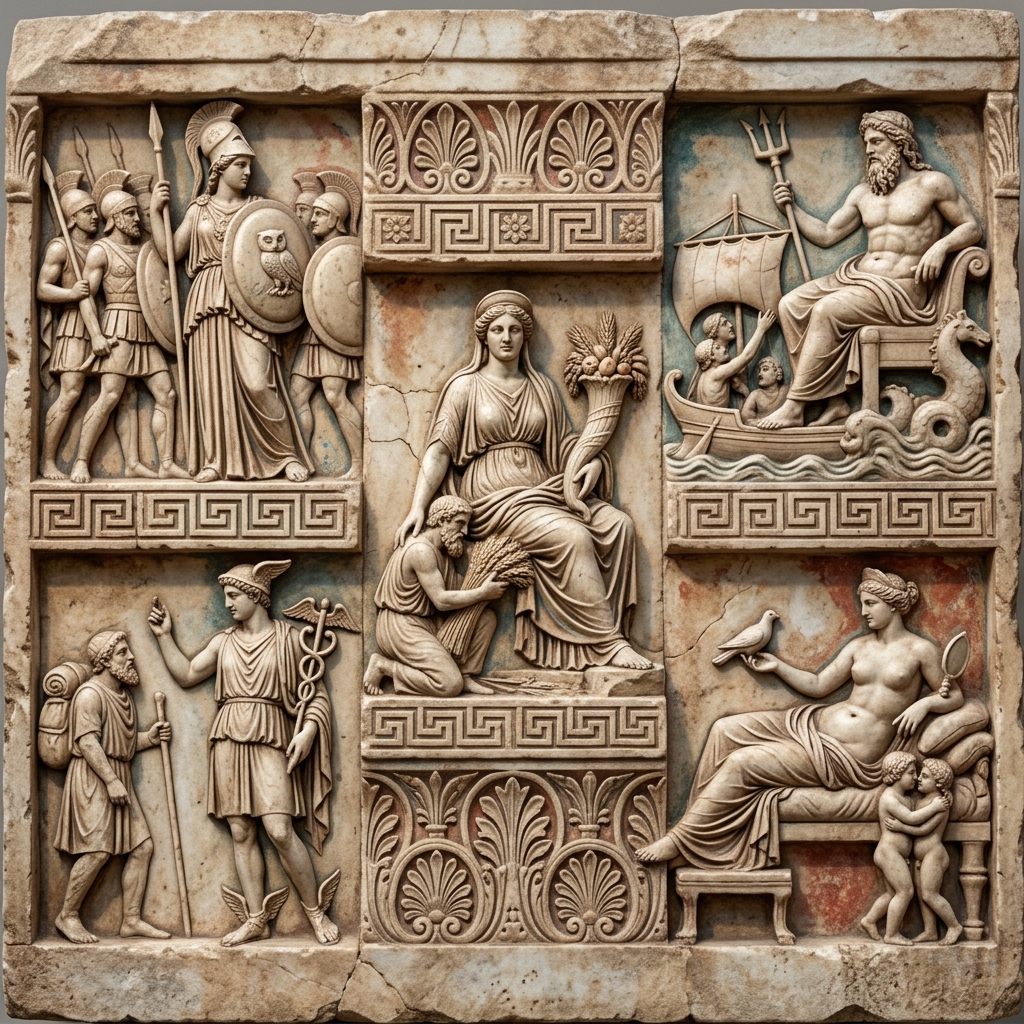
The Greeks imagined their gods as immortal, eternally young and physically idealised – yet possessing human passions such as jealousy, anger and love. Each god was responsible for specific areas of life:
- Farmers made sacrifices to Demeter for good harvests
- Sailors prayed to Poseidon for a safe voyage
- Warriors invoked Athena or Ares before battle
- Merchants and travellers honoured Hermes
- Lovers turned to Aphrodite
Major places of worship such as Olympia (Zeus), Delphi (Apollo) and Athens (Athena) attracted pilgrims for sacrifices, processions and festivals. At major festivals, up to a hundred oxen were sacrificed – a so-called hecatomb. In Homer’s Iliad, the gods intervene in wars and politics through oracles, dreams and direct intervention – over 200 divine interventions in this epic alone.
Pre-Olympian and other Greek deities
Alongside the Olympians, there exist older and other deities who embody forces of nature or abstract principles.
| Category | Examples |
|---|---|
| Titans | Cronus, Rhea, Atlas, Prometheus |
| Primordial Giants | Cyclopes, Hecatoncheires |
| Goddesses of Fate | Moirai: Clotho, Lachesis, Atropos |
| Goddesses of vengeance | Erinyes: Alekto, Megaira, Tisiphone |
| Goddesses of the arts | The Nine Muses |
| Nature spirits | Pan, various types of nymphs |
These beings were either defeated in the power struggles preceding the Olympian order or incorporated into the new system. Greek religion forms a dense network of principal and minor deities – at the centre are the Olympians.
The gods of Olympus in LARP, re-enactment and at medieval markets
Ancient Greece is one of the most fascinating settings for historical re-enactment – and the gods of Olympus are ever-present. Anyone portraying a priest of Apollo, a merchant wearing a Hermes amulet, or a warrior in the service of Athena needs a solid grounding in mythology.
The twelve Olympians provide a rich foundation for character development in an ancient setting:
- A healer invokes Asclepius – son of Apollo, god of medicine
- A merchant or traveller wears a symbol of Hermes on their belt
- A warrior chooses between Ares (raw power) and Athena (strategy and protection)
- A priestess serves Demeter, Artemis or Hestia
FAQ on the gods of Olympus
How many Olympian gods were there really – 12 or more?
In religious contexts, twelve Olympians are usually mentioned, but the exact composition varies by region and era. The author Pausanias lists 15 to 20 Olympian gods. The number twelve represents a symbolic order rather than a strictly historical list – linked to religious practices such as the twelve altars at Olympia.
Why is Hades not counted among the classical Olympian gods?
Hades is indeed the brother of Zeus and belongs to the same generation of gods. However, he is not counted among the Twelve because, as ruler of the underworld, he dwells permanently in the realm of the dead – not on Mount Olympus. His cult was sombre and reserved, in contrast to the Olympians, who were worshipped in a festive manner.
Did all Greeks believe in exactly the same Olympians?
The principal deities such as Zeus, Hera and Athena were known throughout the Greek world. Local traditions, however, placed particular emphasis on individual gods and used specific epithets. Athena dominated in Athens, Artemis in Ephesus, Apollo in Delphi – each with their own cult practices and festivals.
How did Greek and Roman gods differ?
The Romans adopted many Greek gods with Latin names: Zeus became Jupiter, Hera became Juno, Ares became Mars. In some cases, roles shifted – Mars became the central guardian god of the Roman state, whilst Ares was less widely worshipped in Greece. During the Imperial period, myths and depictions merged into a mixed Greco-Roman pantheon.
What sources provide us with information about the gods of Olympus today?
The most important early sources are Homer (the Iliad, the Odyssey) and Hesiod (Theogony) from the 8th to 7th centuries BC. Tragedies by Aeschylus, Sophocles and Euripides, as well as later authors such as Apollodorus and Pausanias, complete the picture. Archaeological finds – temples, cult images, vase paintings and inscriptions – provide vivid insights into the worship of the gods in antiquity.





- Available


