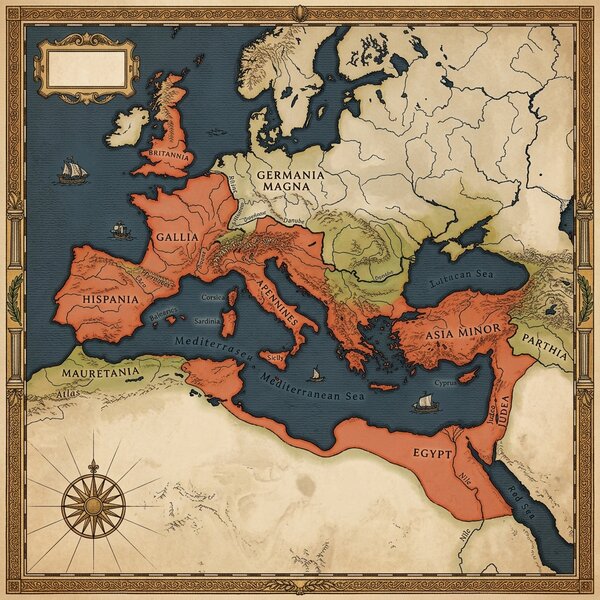

The persecution of witches conjures up images of dark times and obscure superstitions. Neither of these is entirely accurate. The great wave of witch trials did not take place in the Middle Ages, but in the early modern period – the 15th to 18th centuries, a time when Gutenberg invented the printing press, Columbus discovered America and the Enlightenment was on the horizon. And it was not mere superstition. It was a system: theologically grounded, legally enforced, socially supported.
What you can expect in this article
- Where did the belief in witches come from – and why did it become dangerous?
- Augustine and the theological foundation
- The Malleus Maleficarum – a handbook of persecution
- Why so many were affected – an overview of the causes
- Ergot: A possible scientific explanation
- Who was actually persecuted
- The witch trial – how injustice worked
- The chain reaction: denunciation begets denunciation
- A common misconception: burning or hanging?
- Two fates – Anna Göldi and Catherine Repond
- Not the same everywhere – regional differences
- The end of the witch craze – how a system comes to an end
- Frequently asked questions about the witch hunts
- Conclusion: What the witch hunts teach us
 Reading time approx. 12 mins.
Between 40,000 and 60,000 people were executed during this period – most of them women, but not exclusively. Behind each of these figures lies a specific story: an accusation, an interrogation, torture, a pyre or a gallows. This article explains how this system came into being, how it worked and why it took so long to come to an end.
📌 At a glance: The witch hunts took place mainly between the 15th and 18th centuries. Estimates suggest between 40,000 and 60,000 people were executed. Most of the victims were women, but men and children were also persecuted. The witch hunts were centred in German-speaking regions, Switzerland and France.
Where did the belief in witches come from – and why did it become dangerous?
Belief in magic, sorceresses and supernatural harm is ancient. In ancient cultures – Egypt, Babylonia, Greece, Rome – notions of harmful magic and magical practices existed. It was not magic as such that was condemned, but its abuse. In Rome, from the 3rd century AD onwards, those who practised harmful magic were punished by death – benevolent magic remained permitted.
What distinguished the European witch hunts of the early modern period from everything that had gone before was a decisive theological shift: black magic was linked to a pact with the devil. It was not the act alone that became a crime – but the relationship with the devil that was assumed to lie behind it. Anyone who practised magic had made a pact with the devil. This made witchcraft a crime against God – and thus a matter in which the Church saw a duty to act.
Augustine and the theological foundation
The Church Father Augustine (354–430) argued that whilst magic was ineffective, it nevertheless presupposed a tacit pact with the devil. This is a subtle but far-reaching distinction: it was not the result of the magic that constituted the crime, but the intention and the spiritual connection. This way of thinking fundamentally shaped the medieval and early modern understanding of witchcraft.
The Malleus Maleficarum – a handbook of persecution
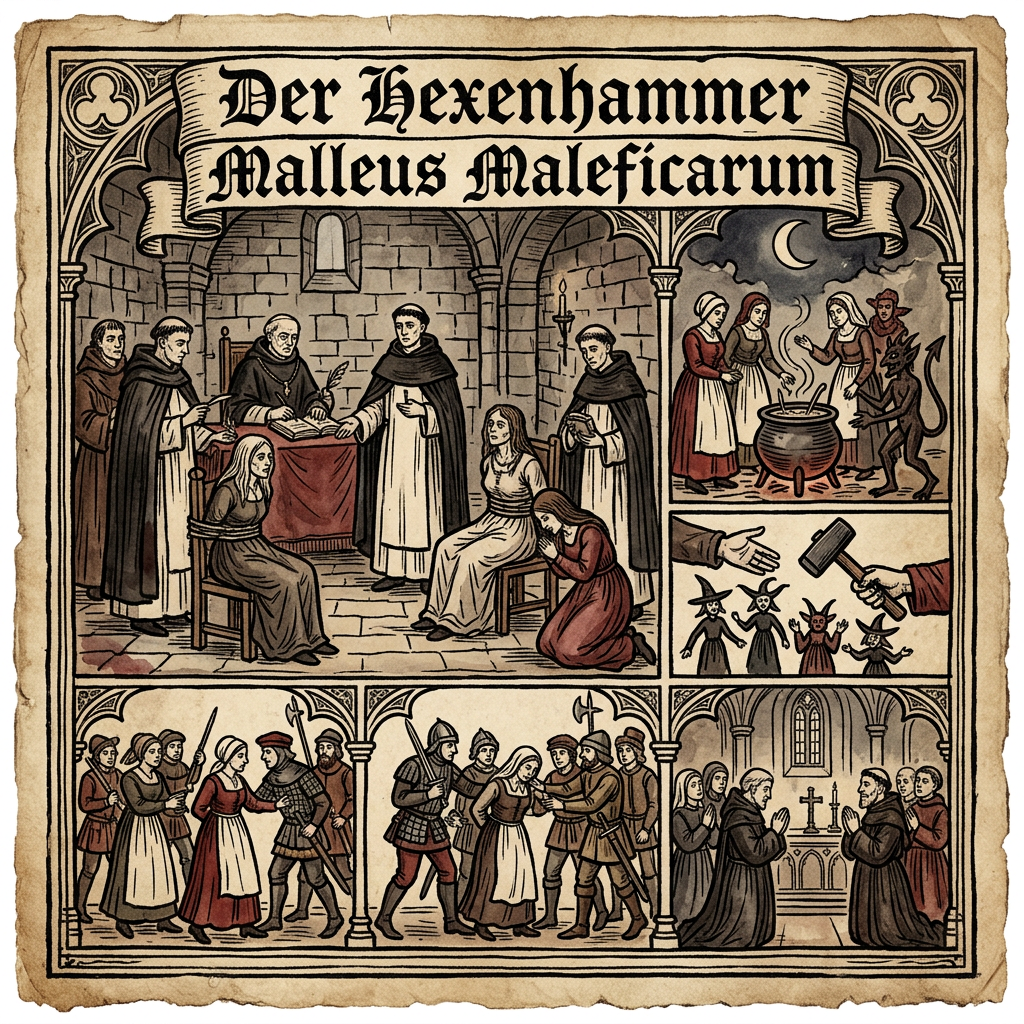
In 1486, the most influential work on witch-hunting was published: the Malleus Maleficarum, known in English as the Hammer of Witches, written by the Dominican friar Heinrich Kramer. The book went through some 30 editions by 1669 – a bestseller of the 15th century, printed on the newly invented printing press.
The Malleus Maleficarum provided instructions for identifying, persecuting and punishing witches. It emphasised that women were more susceptible to witchcraft than men – due to their supposedly weaker nature. This misogyny was not a marginal aspect, but the structural core of the work. It created a theological and legal foundation that legitimised and systematised the persecutions.
⚠️ Historical context: The Malleus Maleficarum was not the sole trigger for the witch hunts – some of these had already begun before its publication. But it standardised and significantly accelerated them. Without the printing press, it would not have had such a wide reach – the new technology acted here as a catalyst for injustice.
Why so many were affected – an overview of the causes
The witch hunts were not an irrational outburst of mass hysteria. They had causes – social, economic and political. Anyone who understood why someone was accused understood the society in which this took place.
| Cause | Specific effect |
|---|---|
| Natural disasters | Crop failures, livestock epidemics, storms – people sought someone to blame. Suspicion often fell on individuals on the margins of the community. |
| Diseases | The plague and unexplained illnesses were attributed to supernatural causes – women who practised healing were immediately suspected. |
| Personal feuds | Disputes with neighbours, jealousy, inheritance disputes – an accusation of witchcraft was the most potent means of personal revenge. |
| Economic interests | Convicted individuals lost their wealth. In regions where resources were scarce, an accusation was sometimes a means of redistribution. |
| Social control | Women who did not marry, had no children or lived unconventionally were regarded as suspicious. Conformity was enforced through fear. |
| Theological legitimisation | The Malleus Maleficarum provided the theoretical foundation. Those who followed the instructions believed they were carrying out God’s will. |

Ergot: A possible scientific explanation
For some of the most dramatic witch panics – particularly in certain regions with intensive rye cultivation – researchers today suspect a biochemical cause: ergot, a fungal infection of grain. Ergot contains hallucinogenic alkaloids that can lead to seizures, delusions and psychotic states. In an era lacking medical knowledge, such symptoms were interpreted as demonic possession. This does not explain all the persecutions – but it shows how real phenomena were fed into a system of interpretation based on belief in the devil and fear of witches.
Who was actually persecuted
The majority of victims were women – around 75 to 80 per cent according to current estimates. But the notion that it was exclusively women is incorrect. In Iceland, most of the accused were men. The same was true in some Eastern European regions. What the victims often had in common was that they stood on the margins of the community. Old women, widows, healers, social outcasts – people who lacked strong protective networks.
The witch trial – how injustice worked
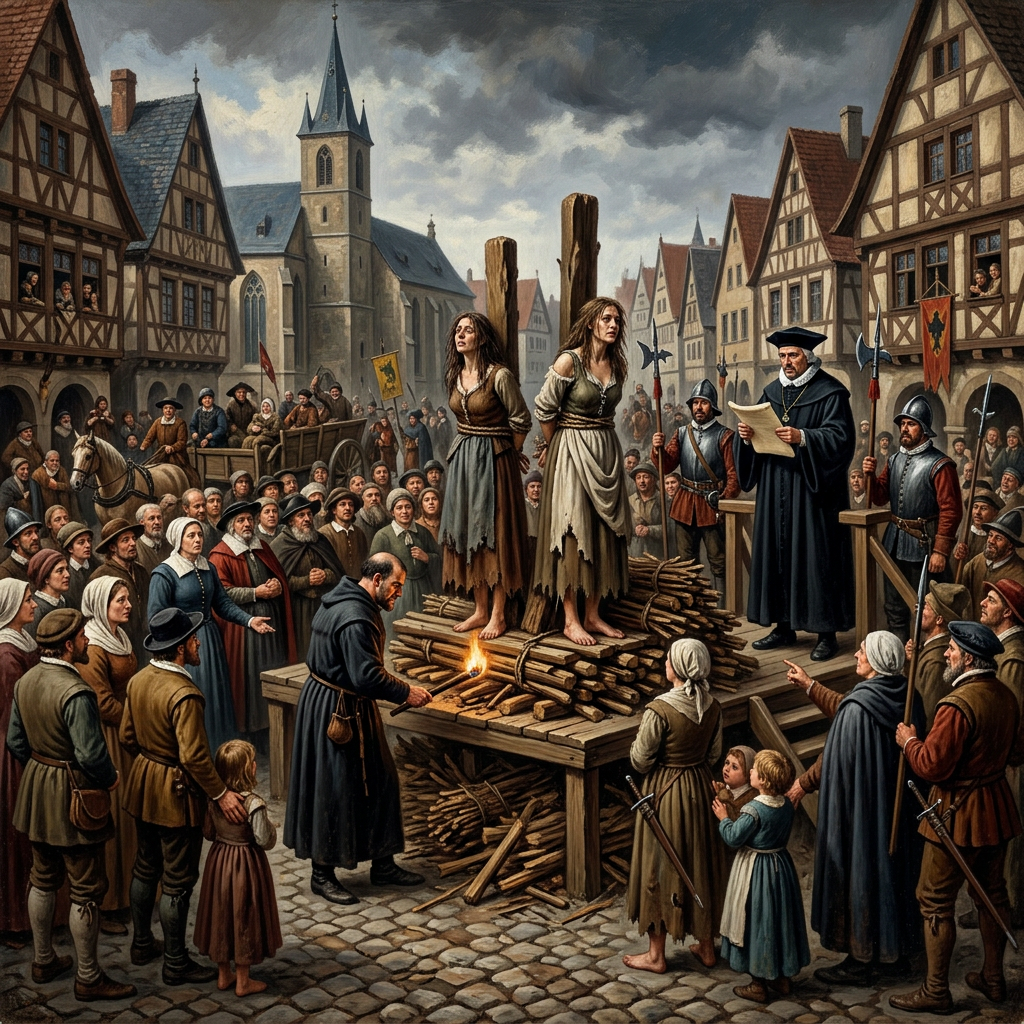
A witch trial was not a court proceeding in the modern sense. There was no fair trial, no independent defence, no presumption of innocence. There was a system designed to extract confessions – and which regarded torture as a legitimate means of establishing the truth.
| Phase | What happened |
|---|---|
| 1. Accusation | Denunciation by neighbours, anonymous tips or the authorities. Often triggered by personal feuds or coincidental proximity to a misfortune. |
| 2. Arrest | Arrest and detention under harsh conditions. Deprivation of sleep and food as the first means of pressure, even before formal torture. |
| 3. Interrogation | Questioning – initially without, then with torture. Aim: a confession and, above all, the names of other alleged witches. |
| 4. Confession | Almost always extorted. Many confessed to everything to end the suffering – even if it meant death. |
| 5. Trial | Public trial with virtually no possibility of defence. The confession was considered sufficient evidence. |
| 6. Execution | Death by burning, hanging or beheading – in Germany, usually strangulation before the pyre, not burned alive. |
The chain reaction: denunciation begets denunciation
The most dangerous element of the trial was the demand to name accomplices. Under torture, defendants named names – often at random, often to end the suffering, often out of genuine fear of death. Those named were arrested, tortured, and named further names. This is how the great witch panics arose, in which hundreds of people in a region were persecuted within a few months.
The small village of Buirheim near Cologne lost a significant proportion of its adult population to witch trials within a few years. This was no exception – it was a pattern.
A common misconception: burning or hanging?
In German-speaking regions, the most common method of execution was not burning at the stake, but strangulation or beheading – followed by the burning of the corpse. Burning at the stake was considered a particularly cruel punishment and was not the norm everywhere. In England, witches were predominantly hanged. The image of a burning pyre with a living person on it is historically accurate for some regions – but not the universal picture.

Two destinies – Anna Göldi and Catherine Repond
Anna Göldi was born in 1734 in Sennwald in the canton of St. Gallen, Switzerland. She grew up in poverty and worked as a maid, most recently from 1775 in the household of the doctor and politician Johann Jakob Tschudi in Glarus.
In 1782, she was accused of harming the Tschudi family’s younger daughter through witchcraft. The charge was based on the child’s mysterious illnesses, for which a cause was being sought. Anna Göldi was tortured until she made a confession. On 13 June 1782, she was executed by the sword in Glarus.
Formally, the charge was not witchcraft – this term was legally obsolete in Switzerland at the time. She was officially convicted of poisoning. Historians nevertheless regard her case as the last documented instance of a witch’s execution in Europe – for the logic of the proceedings, the torture and the forced confession followed the old pattern of witch trials to the letter.
In 2008 – more than 225 years after her death – the canton of Glarus officially rehabilitated Anna Göldi. Her case was recognised as a miscarriage of justice. Today, the Anna Göldi Museum in Glarus commemorates her and the history of the witch hunts.
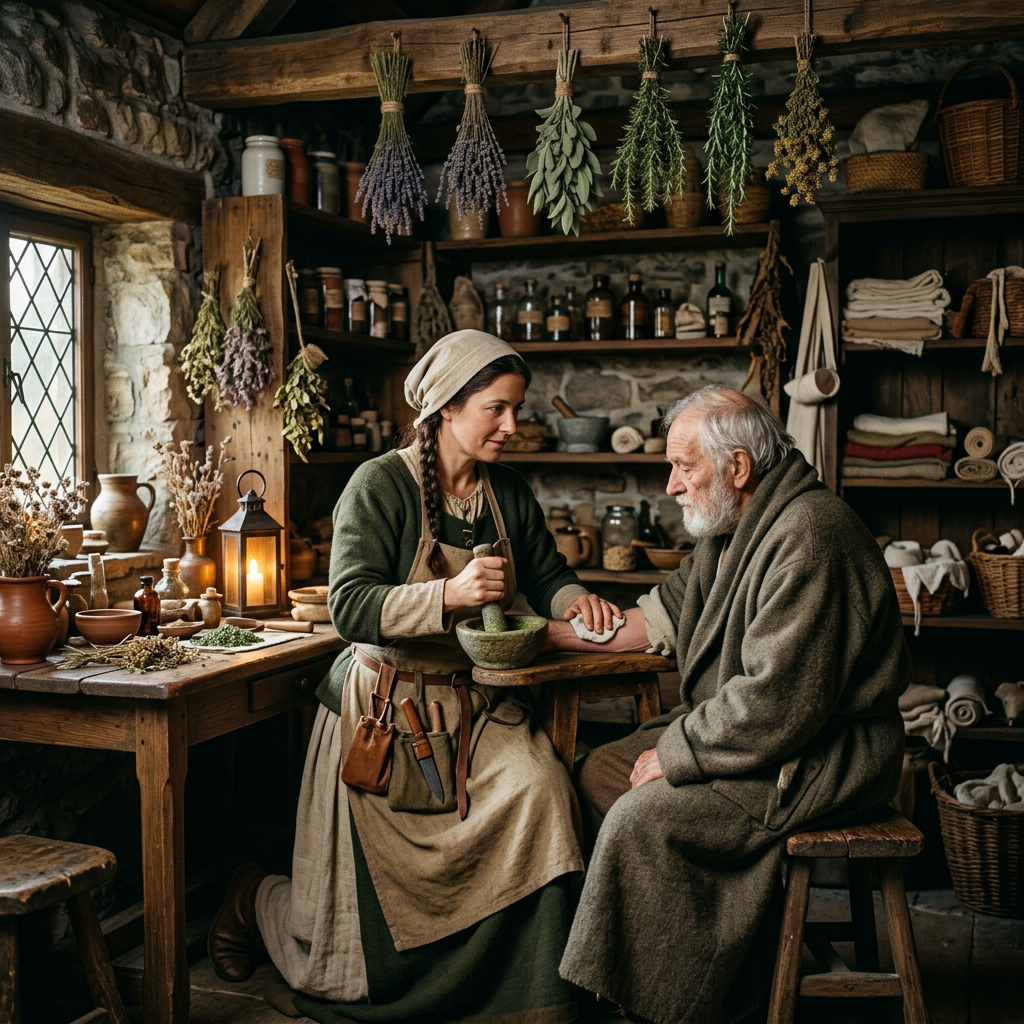 Catherine Repond was born in 1663 in Villarvolard in the Gruyère region, Canton of Fribourg. She led a simple life and was known for her knowledge of herbs and medicine. This knowledge was both her asset and her peril: in a world without modern medicine, healers were valued – and feared.
At the beginning of the 18th century, rumours of supernatural events were circulating in the region. In 1730, Catherine was accused of consorting with the devil, bewitching animals and causing weather disasters. She was taken to Fribourg, tortured and forced to confess under duress. On 15 September 1731, she was burned at the stake.
Her story is representative of thousands of women whose healing knowledge made them targets in a time of fear. The combination of female independence, medical knowledge and social marginalisation was a recurring pattern in the history of witch hunts.
💡 For LARP and reenactment: The witch as a character is far more complex than her reputation suggests: a woman with healing powers, a social outsider, a scapegoat for a society in crisis. Such a role offers far greater dramatic potential than the fantasy cliché. Anyone wishing to play a historically informed witch character is playing a woman in a society that is afraid – and projects that fear onto her.
Not the same everywhere – regional differences
The witch hunts did not unfold uniformly across Europe. In German-speaking regions, Switzerland and France, the trials were particularly brutal and frequent. The Holy Roman Empire – with its fragmented political structure and numerous small principalities – offered ideal conditions: every local lord could conduct his own trials without any overarching control.
In Spain, by contrast, the Inquisition was often sceptical of witchcraft accusations. It recognised that many accusations were based on personal enmity or superstition – and set higher standards of proof. The result: significantly fewer executions than in Central Europe. In Ireland, there were hardly any witch trials. In Iceland, the victims were predominantly men.
These regional differences show that the witch hunts were not an inevitable fate. They were the result of specific decisions by authorities – judges, theologians, rulers – and could have unfolded differently.
The end of the witch craze – how a system comes to an end
The witch hunts did not end due to a single moment or a single law. They ceased because several developments changed simultaneously.
- Legal reforms: the introduction of standards of proof, restrictions on torture, and a more critical attitude towards denunciations in many regions
- Intellectual criticism: as early as the 17th century, jurists such as Friedrich Spee von Langenfeld – who, as a confessor, had accompanied many condemned women – argued publicly against the witch trials
- Centralisation of the judiciary: Greater state control over local courts reduced the possibility of arbitrary trials
- Changing worldview: The dawn of the Enlightenment and its emphasis on reason, empiricism and provability made the interpretative framework of witchcraft belief increasingly untenable
Another decisive factor was criticism from within. In 1631, Friedrich Spee wrote the *Cautio Criminalis* – a work that demonstrated in detail the injustice of witch trials. He was a Jesuit, not a heretic. The fact that an insider of the system spoke out so clearly had an impact.
The last documented execution in Europe was that of Anna Göldis in Switzerland in 1782. In some parts of the world, people are still persecuted and killed for witchcraft today – this is not a story from the past, but a current reality in parts of Africa, Asia and Papua New Guinea.
⚠️ Not a closed chapter: witch hunts are not a thing of the past. In parts of Africa, Asia and Papua New Guinea, people are still being persecuted, abused and killed today for alleged witchcraft – particularly children and elderly women. The pattern is the same: fear, crisis, scapegoats.

Frequently asked questions about witch hunts
Did the witch hunts take place in the Middle Ages?
No – this is one of the most persistent misconceptions. The great wave of witch trials took place in the early modern period: the 15th to 18th centuries. In the Middle Ages proper, there were isolated trials for witchcraft, but no systematic persecution on this scale. The height of the witch trials coincided with the invention of the printing press, the discovery of America and the laying of the foundations of modern science.
How many people were executed?
Historical estimates put the number of those executed at around 40,000 to 60,000. More recent research tends to favour the lower figures. However, many accused died under torture or in prison – these are often not included in the figures. The majority of victims were women, around 75 to 80 per cent.
Why were so many of the victims women?
There were several interrelated reasons for this: the Malleus Maleficarum provided theological justification for focusing on women. Women were socially more vulnerable – they had less political power and fewer legal means of defence. The healing practices that women frequently engaged in made them suspect. And patriarchal society viewed independent, unmarried or childless women as a social anomaly that aroused suspicion.
What was the Malleus Maleficarum?
The Malleus Maleficarum, published in 1486, was a handbook for witch hunters. Written by the Dominican friar Heinrich Kramer, it provided theological justifications, practical guidance on identifying witches and instructions for conducting trials. It went through some 30 editions by 1669 – a bestseller that was mass-produced by the printing press and standardised the persecutions.
Why did the witch trials come to an end?
Not through a single reform, but through a combination of factors: legal reforms, intellectual criticism from within (such as Friedrich Spee’s *Cautio Criminalis* of 1631), greater state control over local courts and – in the long term – the changing worldview of the Enlightenment. The system of belief in witchcraft lost its social plausibility. Not quickly, and not everywhere at once – but inexorably.
Conclusion: What the witch hunts teach us
The witch hunts were not the result of stupidity or mere superstition. They were the result of a system – a system in which fear, power struggles, theological dogmas and legal structures interacted. It primarily affected people who had little to protect themselves: women, the elderly, outsiders, healers.
What this story tells us today: When societies face crises, they seek scapegoats. The interpretative framework changes – the pattern remains. Those who understand this see not only history, but the present.
For LARP and reenactment, this era offers one of the darkest and most dramatically rich settings that history has to offer. Not merely as a backdrop, but as a world in which every character – accuser, accused, judge, witness – carries a story linked to real human lives.






Letters from the trading house
New arrivals, market dates and offers, straight from Rinchnach. Unsubscribe any time with one click.
Subscribe to the newsletter